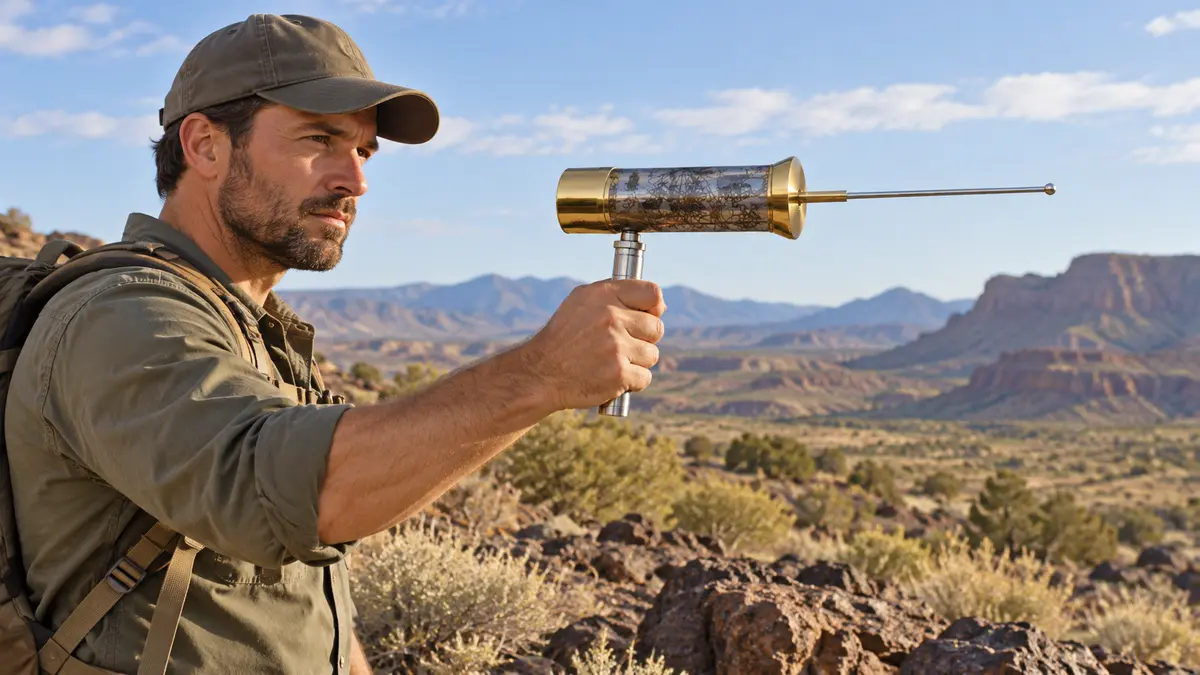
The Hakan 16 Detector should be evaluated differently from a conventional VLF, Pulse Induction, or imaging detector. The manufacturer presents Model 16 Piri Reis as a manual long-range area-scanning system that uses a mechanical gear mechanism and selectable target modes. Therefore, US buyers should not treat it as an electronic detector with a conventional search coil, digital Target ID, or automatic ground balance.
That distinction changes the buying decision.
The manufacturer advertises long-range and depth figures for Model 16. However, those figures are manufacturer-stated maximums. They do not prove that the device will locate a particular gold object, cavity, water source, or other target at the advertised distance or depth.
For that reason, a responsible purchase should begin with evidence and project fit.
First, identify what you expect the Hakan 16 Detector to do. Next, ask what evidence supports that use. Then request a controlled demonstration where practical. Finally, plan how you will confirm any locator response with another suitable method before excavation or other costly work.
This approach matters even more for US projects. A Texas property survey and a Nevada prospecting project create different access, target, and verification requirements.
If you are already considering the system, review the current Hakan 16 detector product information and ask Goldot-Tec to explain the exact package before you commit to an order.
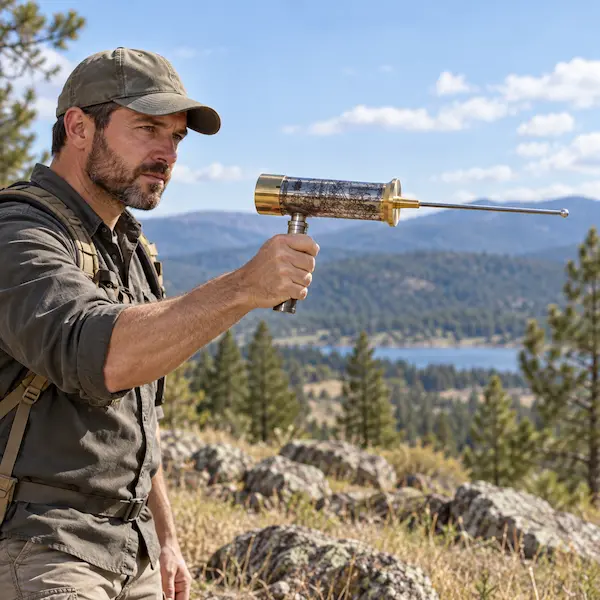
Hakan 16 Checks for US Customers
A Hakan 16 purchase should start with model verification.
Several online descriptions mix long-range systems with electronic metal-detector terminology. Therefore, check the current manufacturer description before comparing features.
Confirm the Exact Model
The system discussed here is the Hakan Model 16 Piri Reis.
The manufacturer describes it as the highest model in its area-scanning range.
Its construction uses chrome components and a mechanical gear system.
In addition, Model 16 uses selectable search modes rather than the sample-chamber method found on some other models in the Hakan range.
Therefore, confirm that your quote specifically identifies Model 16 Piri Reis.
Do not accept a generic “Hakan long-range detector” description.
Understand the Operating Method
The Hakan 16 Detector does not operate like a conventional search-coil detector.
Instead, the manufacturer describes a mechanical directional response through its Piri Reis gear system.
The operator selects a target category and surveys the area.
Therefore, the device should be understood as an area locator or preliminary directional-scanning tool.
It should not be presented as if it directly provides an electronic target ID.
Likewise, it does not produce a 3D underground image.
Correct the Power-System Description
Older articles may describe rechargeable batteries or a digital control interface.
However, those features do not match the current manufacturer description of Model 16.
The present Hakan documentation describes a manual mechanical system.
Therefore, buyers should not expect an electronic battery-powered detector unless the seller can document a separate component in the actual package.
This is exactly why model verification matters before purchase.
Manufacturer Claims vs Verified Evidence
The largest buying issue is not the number of search modes.
Instead, buyers should understand the difference between a product claim and independently demonstrated performance.
Advertised Range Is Not a Guaranteed Result
Hakan publishes an area-scanning figure of up to 1,200 meters with the antenna fully open.
The manufacturer also describes a shorter range when the antenna is not fully extended.
These are maximum manufacturer claims.
Therefore, do not convert them into statements such as:
“The Hakan 16 will locate gold from 1,200 meters.”
That conclusion is not established by the stated specification alone.
Target size could matter.
Terrain may matter.
Soil conditions may also matter.
Operator movement and interpretation can influence what the user believes the device is indicating.
Consequently, buyers should request reproducible evidence before relying on the range claim for an important project.
Depth Should Be Treated the Same Way
The manufacturer also advertises a maximum depth figure.
Again, that figure does not demonstrate that every target can be located at that depth.
A large buried structure cannot be compared with a small ring.
Likewise, a cavity creates a different detection problem from a metallic object.
Therefore, ask what target produced any depth demonstration.
Then ask how its location and depth were verified.
Without that context, one number tells the buyer very little.
Search Modes Do Not Confirm Target Identity
Model 16 offers seven selectable categories.
These include:
- Gold.
- Silver.
- Bronze.
- Mineral.
- Void.
- Water.
- Oxide.
The presence of a mode should not be treated as proof that the device chemically identifies that material.
Instead, treat the selected mode as part of the manufacturer’s operating method.
If the device indicates a direction while Gold mode is selected, the response still needs verification.
Do not excavate simply because one selected mode produced a locator movement.
Controlled Demonstration Before Purchase
A buyer considering an unconventional long-range system should ask for more than promotional footage.
A controlled demonstration can provide better information.
Use a Known Target Location
A useful demonstration starts with a known target.
The operator should not rely only on a location that was selected after the device produced a response.
Instead, the test should begin with a target whose position is already established.
This provides a reference.
Include an Area Without the Target
A negative comparison is also useful.
If every section of the test area produces a directional response, the demonstration gives the buyer little information.
Therefore, compare target and non-target areas.
The goal is repeatability.
Repeat the Test
One successful-looking pass is not enough.
Repeat the survey several times.
If possible, reset the operator’s starting position.
Then check whether the indicated direction remains consistent.
This makes the demonstration more informative.
Ask for Blind or Partially Blind Testing
A stronger demonstration reduces operator knowledge of target location.
For example, another person can select the target position while the operator does not know exactly where it is.
This reduces the possibility that expectation influences the movement.
A seller unwilling to discuss repeatable testing should not receive automatic confidence.
Confirming Targets Beyond Locator Signals
The Hakan 16 Detector should not become the only evidence behind a major excavation decision.
Instead, use it as one part of a verification workflow if you choose to use it.
Confirm Metallic Targets With Metal Detection
If Model 16 indicates a possible metallic target, follow the result with equipment suited to direct metal detection.
The correct second tool depends on the target.
A conventional detector may suit individual metallic targets.
Meanwhile, a professional PI system can make more sense for larger or deeper metal in difficult soil.
The purpose is independent confirmation.
Confirm Structures With Imaging or Survey Equipment
A claimed cavity or underground structure creates a different problem.
Therefore, another long-range response does not necessarily provide independent evidence.
A professional ground scanner, appropriate geophysical method, or other site-specific survey tool may provide stronger confirmation.
Choose the second technology according to what you actually need to verify.
Water Projects Need Their Own Verification
Water-location decisions can involve significant drilling expense.
Therefore, a directional water response should not become the only basis for drilling.
Professional hydrogeological information may be more appropriate.
Local geology, existing wells, and other site evidence can also matter.
In other words, match the verification method to the project.
Texas Detector Project Planning
Texas provides a useful example of why project definition matters.
However, the state name alone does not make the Hakan 16 Detector appropriate.
Start With an Authorized Site
A Texas project should begin with legal access.
Private property requires permission from the owner.
Public locations can apply different restrictions.
Therefore, confirm that the intended search or survey is allowed before bringing equipment to the site.
Example: Private Property Survey
Consider an authorized private property where the owner wants to investigate one section of land.
The buyer should first identify the question.
Is the project looking for a metallic object?
A possible cavity?
A water-related indication?
These are different objectives.
Therefore, select one objective before starting the locator survey.
Mark the Search Area
Divide the site into manageable sections.
Use fixed landmarks where practical.
Then record the operator’s starting location.
This creates a repeatable survey method.
If the device indicates a direction, mark it.
Afterwards, repeat the test.
Plan the Confirmation Method in Advance
Do not wait for an interesting signal to decide how it will be verified.
If the project concerns metal, have a suitable metal detector available.
If the objective involves underground structures, plan an appropriate survey method.
This prevents the project from becoming dependent on one locator response.
Nevada Search Project Questions
Nevada creates another useful example.
Prospecting is strongly associated with the state. However, land status and existing mining claims matter.
Therefore, project planning should begin before detector selection.
Check Claim and Land Status
Do not assume an open-looking area is automatically available.
A mining claim can affect who has rights to minerals at a site.
Therefore, check the location before prospecting.
This step matters regardless of which detector you buy.
Define Whether You Need Area Scanning
A long-range locator is intended to narrow a broad search area.
However, a prospector may already have a well-defined goldfield location.
In that case, a direct natural-gold detector can provide a clearer workflow.
Therefore, ask whether wide-area directional scanning solves a real problem.
If not, another detector category may be the better purchase.
Use a Second Tool for Gold Confirmation
If the Hakan 16 indicates a possible gold-related direction, confirm the area with equipment built for natural-gold detection.
This is especially important before digging or making additional project decisions.
A repeatable direct detector response gives the team another form of evidence.
Hakan 16 System Strengths
A fair buying assessment should identify why some buyers still consider the system.
Simple Mechanical Operation
The manufacturer presents Model 16 as a manual system.
Therefore, buyers do not need to manage menus, batteries, software updates, or complex electronic controls during the basic scan.
That simplicity may appeal to some users.
However, simple operation does not prove detection accuracy.
Those are separate questions.
Seven Search Categories
The seven selectable modes provide a structured operating workflow.
Users can choose the category associated with their intended search.
This is more organized than carrying several sample materials.
However, the selected category still needs external confirmation.
Wide-Area Survey Concept
Some buyers want to narrow a large project area before detailed scanning.
That is the strongest conceptual use case for a long-range locator.
However, the value depends on whether the directional response can be reproduced reliably for your project.
Therefore, testing should come before confidence.
Portable Physical Design
The Model 16 weighs approximately 1.5 kg according to the manufacturer.
Therefore, transport is relatively simple compared with large frame systems or multi-sensor scanning equipment.
Still, repeated manual operation can create fatigue during long surveys.
The operator should test handling before planning a large site.
Hakan 16 Operating Limitations
The limitations should carry as much weight as the feature list.
No Direct Electronic Target ID
The Hakan 16 does not provide the type of digital target identification found on conventional electronic detectors.
Therefore, the selected Gold mode should not be treated as proof of gold.
Likewise, Silver mode does not independently verify silver.
No 3D Underground Visualization
The system does not replace a professional 3D ground scanner.
If a project requires underground maps or measured subsurface visualization, select equipment designed for that task.
Manufacturer Range Is Not Independent Evidence
The advertised maximum range and depth figures come from manufacturer descriptions.
I did not find controlled independent validation for the Hakan 16 Model 16 in the sources reviewed.
Therefore, buyers should treat these numbers cautiously.
Operator Influence Matters
The system uses a manually held directional mechanism.
Consequently, operator movement and expectation can influence the way a response is interpreted.
Controlled and blinded demonstrations can help buyers evaluate this issue.
It Is Not a Replacement for Confirmation Equipment
Even if you choose the Hakan 16, serious projects may still require another detector or survey method.
Therefore, budget and transport planning should account for confirmation equipment when appropriate.
Hakan Package Questions Before Ordering
The exact package should appear in writing.
Do not rely on promotional images.
Confirm the Physical Model
Ask Goldot-Tec to confirm:
Model 16 Piri Reis.
Manufacturer.
Physical configuration.
Included antenna components.
Carrying or protective items.
Documentation.
Warranty terms.
Ask What Is Not Included
This question can prevent assumptions.
For example, buyers should not expect a rechargeable battery or digital control system if the documented model is manual.
Likewise, secondary confirmation equipment should not be assumed.
Ask for the exact package.
Confirm Training or Demonstration Support
Operator technique matters for a manual directional system.
Therefore, ask what instruction comes with the purchase.
A useful session should show:
Correct grip.
Antenna setup.
Mode selection.
Survey direction.
Repeat testing.
How to avoid overinterpreting one response.
How to plan confirmation.
Training should include limitations, not only successful-looking demonstrations.
Purchase Risk Assessment
The Hakan 16 Detector deserves a different risk assessment from a conventional detector.
Evidence Risk
The manufacturer publishes range and depth claims.
However, independent controlled evidence remains limited.
Therefore, the buyer should demand more verification before relying on those claims.
Project-Fit Risk
A long-range locator may not solve the actual search problem.
For example, a buyer who already knows the target area may gain more value from direct metal detection.
Likewise, a cavity project may require professional imaging.
Choose the system only if area localization serves a real role.
Confirmation-Cost Risk
A locator response may still require another technology.
Therefore, the initial product is not necessarily the complete project setup.
Consider the whole verification workflow.
Expectation Risk
Marketing terms such as Gold, Water, or Void can create strong expectations.
However, the selected mode should not be confused with conclusive identification.
Set expectations before purchase.
Conventional Detector Alternatives
Some US buyers may be better served by another system.
Natural-Gold Prospecting
For direct nugget searching, dedicated gold detectors use technologies built around coil-based detection.
These systems can provide direct audio or target responses while the coil passes over metal.
Therefore, buyers focused on gold prospecting should compare them before committing to long-range equipment.
Coins and Relics
A conventional VLF or simultaneous multi-frequency detector usually offers a clearer workflow for coins, jewelry, and relics.
These machines can provide target ID, discrimination, and search programs.
Therefore, Hakan 16 may add little value for ordinary park detecting.
Deep Metallic Targets
A professional Pulse Induction or frame-coil system may better fit large metallic targets.
Again, choose by project.
Underground Structures
Professional 3D scanners or other geophysical equipment can provide measured subsurface information.
These systems involve a different workflow but may better match structure-focused investigation.
You can compare detector specifications at Goldot-Tec before choosing between categories.
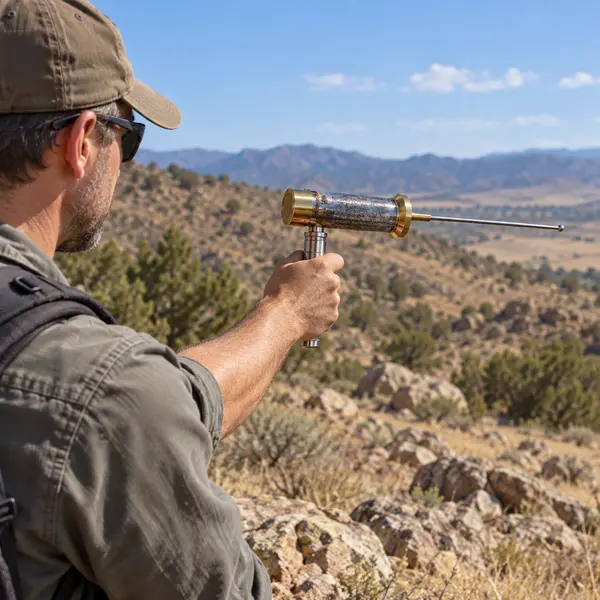
Reproducible Evidence Before Excavation
A responsible field workflow should produce evidence that another person can review.
Record the Initial Response
Write down:
Search mode.
Operator starting point.
Direction indicated.
Antenna position.
Surface conditions.
Nearby metallic objects.
Time of survey.
This makes the result easier to assess later.
Repeat From a New Start
Move away from the area.
Then restart the survey.
Do not simply continue following the first response.
Compare the new direction with the original result.
Use Another Operator When Practical
A second trained operator can provide another test.
However, that person should not simply copy the first operator’s route.
Independent starting conditions provide more information.
Confirm With Another Technology
The strongest workflow uses an appropriate second method.
A metallic target should ideally create evidence from direct metal-detection equipment.
A structural anomaly may require another survey method.
Do not excavate because two long-range locators point in the same general direction.
Independent measurement matters more.
Hakan 16 vs More Advanced Survey Systems
More complex equipment is not automatically better.
However, different systems collect different evidence.
Hakan 16
The Hakan 16 uses a manual directional area-scanning approach.
Therefore, its role is preliminary localization.
Electronic Metal Detector
A conventional electronic detector measures responses from metal within its detection field.
As a result, the operator receives a more direct target response.
3D Ground Scanner
A scanner collects measurements across a structured grid.
Software can then visualize subsurface differences.
However, those results still require interpretation.
Choose by Evidence Needed
If you only need a quick preliminary direction, you may consider a locator.
If you need direct metallic confirmation, use a metal detector.
If you need structured underground imaging, choose an appropriate scanner.
This is a stronger purchasing rule than choosing the system with the largest advertised number.
Hakan 16 US Buyer Checklist
Before requesting your assessment, prepare a short project description.
Project Goal
What are you trying to locate?
Gold?
Another metal?
A cavity?
Water?
A broad anomaly?
Choose one primary objective.
Site Information
Is the site authorized for your planned activity?
Is it private or public land?
Are there existing mining claims?
Are there obvious structures or metal sources nearby?
Document these factors.
Evidence Requirement
What result would make you proceed?
One directional signal should not be enough for a high-cost project.
Decide how many repeat tests you expect.
Also decide which confirmation equipment you will use.
Package Questions
Ask Goldot-Tec to confirm:
Exact Hakan model.
Physical package contents.
Manufacturer documentation.
Warranty.
Training.
Return or support process where applicable.
Current availability.
US delivery options.
This information provides a stronger basis for the purchase.
Frequently Asked Questions
What evidence should I request before buying the Hakan 16 Detector?
Ask for current manufacturer documentation and a controlled demonstration where practical. The manufacturer advertises specific maximum range and depth figures, but those claims should not be treated as guaranteed results. A useful demonstration should include repeat passes, known target and non-target areas, and preferably a test where the operator does not know every target position. You should also decide how any locator response will be confirmed with another suitable technology.
Should I excavate after receiving a Hakan 16 directional response?
No single locator response should automatically justify excavation. First, repeat the survey and record whether the direction remains consistent. Next, use an appropriate confirmation method based on the suspected target. Metallic targets may require direct metal detection, while cavities or underground structures may need another survey technology. Local access, landowner permission, claim status, and excavation rules must also be checked before disturbing the ground.
What support should US buyers request from Goldot-Tec?
Ask Goldot-Tec to verify that the product is Model 16 Piri Reis and provide the exact package contents, manufacturer documentation, warranty terms, training options, current availability, and delivery choices for your state. Explain whether your planned project is an authorized Texas property assessment, a permitted Nevada search, or another US use case. Also ask how Goldot-Tec recommends confirming locator indications before you make excavation or drilling decisions.
Request Your Hakan 16 US Purchase Assessment
The Hakan 16 Detector should not be purchased on the strength of one advertised range or depth number.
The manufacturer describes Model 16 Piri Reis as a manual mechanical area-scanning system.
It provides seven selectable target categories.
Its Piri Reis gear mechanism creates the directional response used during the survey.
However, these product descriptions do not independently prove that the system can locate a particular gold target, water source, cavity, or other underground feature at the advertised maximum range or depth.
Therefore, evidence should guide the purchase.
First, define the project.
Then, confirm the exact model.
Next, request a controlled demonstration when possible.
Afterwards, plan how every important indication will be verified.
Texas buyers should begin with an authorized site.
Nevada buyers should also check land and mining-claim status.
In either case, do not select a locator simply because the project covers a large area.
Choose it only when preliminary directional scanning solves a real problem.
If your project requires direct metal detection or measured underground imaging, another system may provide a clearer workflow.
You can also browse Goldot-Tec’s long-range systems when comparing the Hakan 16 with other area-scanning options.
Buying in the United States? Ask Goldot-Tec about availability and delivery options for your state. Send the team your project goal, site conditions, target type, evidence requirements, and planned confirmation method. Then request a Hakan 16 purchase assessment before you commit to the final package.