

This ruby long range detector review takes an evidence-led approach to the Treasure Navigator Ruby. Rather than assuming that advertised long-range capability, target selection, or directional response automatically translates into guaranteed field performance, the review focuses on product identity, field setup, repeatability, operator influence, package verification, and the steps a buyer should take before relying on any indicated target area.
Treasure Navigator currently lists TREASURE NAVIGATOR RUBY in its official product catalog, confirming that Ruby is part of the company’s detector range. Goldot-Tec also currently lists a Ruby long-range detector within its Long Range Systems category and classifies it as a professional long-range product.
The most useful conclusion from a ruby long range detector review is therefore not whether one demonstration looks impressive. It is whether the same response can be reproduced under controlled conditions when the operator does not already know where the target is.
Ruby Long Range Detector: Product Identity and Intended Use
The first task in any ruby long range detector review is confirming exactly which product is being discussed.
The manufacturer’s current product catalog identifies the model as TREASURE NAVIGATOR RUBY. Treasure Navigator also states that its company has operated in detection-related fields since 1999 and describes its wider work as involving long-range and underground exploration equipment.
Goldot-Tec separately lists Ruby within its long-range detector inventory.
This positioning suggests that Ruby should be evaluated primarily as a wide-area reconnaissance locator, not as a direct replacement for a conventional search-coil detector designed to pinpoint individual coins or jewelry at close range.
Before buying, confirm:
- Exact Treasure Navigator Ruby model
- Current hardware revision
- Serial number
- Original manual
- Search functions
- Included antennas or receiver components
- Battery and charging equipment
- Carrying case
- Warranty documentation
- Training availability
Avoid assuming that every Ruby listing represents the same generation or package.
Documented Search Functions to Verify
A careful ruby long range detector review should distinguish between functions shown in reseller material and capabilities that have been independently validated.
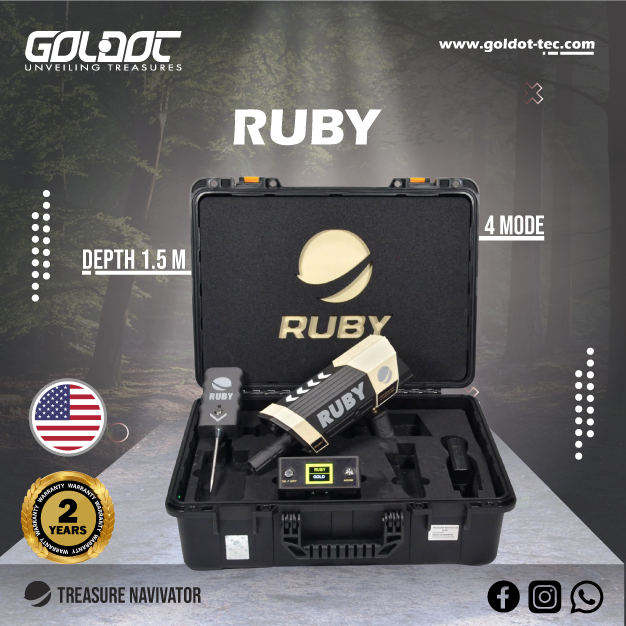
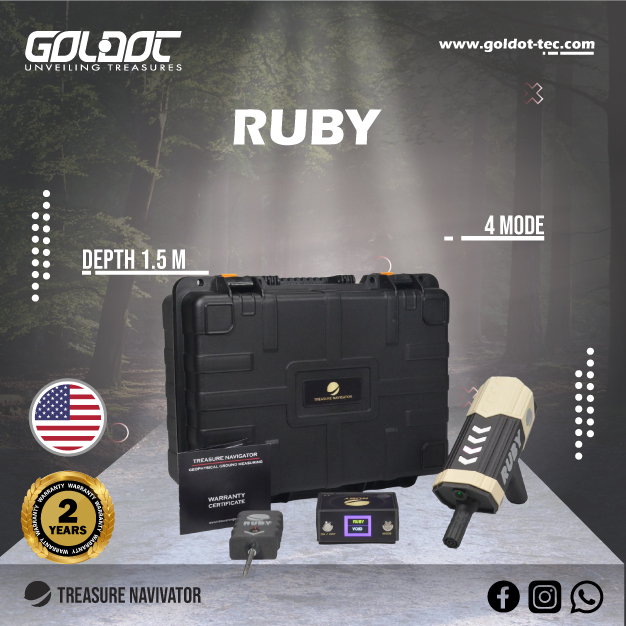
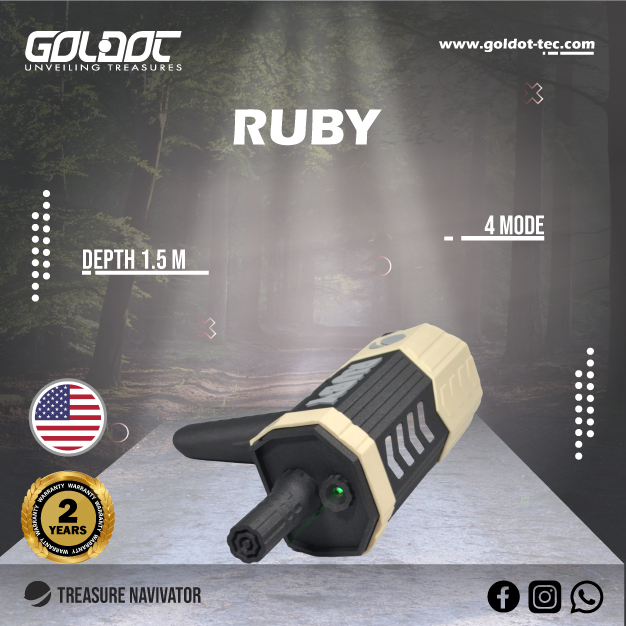
Current third-party product imagery for Treasure Navigator Ruby shows a handheld long-range scanning unit and identifies multiple search programs, including ALL, TRACKING, and LIGHT MODE, along with several antenna elements. Those details are useful as reseller documentation, but they should still be confirmed against the exact manual supplied with the detector before purchase.
The practical buyer questions are:
| Function to Verify | Buyer Question |
|---|---|
| Wide-area searching | How is the initial search direction established? |
| Target-selection modes | What does each mode actually change internally? |
| Directional tracking | How should a suspected direction be repeated? |
| Signal indication | Is feedback visual, directional, audible, or combined? |
| Ground adjustment | Is any calibration required before searching? |
| Target confirmation | What secondary method is recommended? |
A feature name does not by itself prove detection accuracy.
Setting Up the Detector in the Field
The strongest ruby long range detector review should include a repeatable field procedure.
Start in an area where obvious interference can be documented.
Record:
- Search-area boundaries
- Starting position
- Operator direction
- Nearby vehicles
- Fences
- Large surface metal
- Power installations
- Ground conditions
- Weather
- Visible geological changes
The goal is to create conditions that can be reproduced.
If the operator receives a directional indication, mark the starting position rather than immediately walking toward the suspected target.
Repeat the procedure from the same point.
Only after obtaining a repeated indication should the user change the test geometry.
Build a Blind Test Instead of Relying on a Demonstration
This is the most important part of a responsible ruby long range detector review.
A normal demonstration can be misleading if the operator already knows where the target is located.
A stronger test uses blind target placement.
Prepare Several Test Positions
Another person should prepare multiple possible locations.
Some locations contain a target. Others remain empty.
The operator should not know which positions contain anything.
Define the Target Clearly
Record:
- Material
- Dimensions
- Orientation
- Burial depth
- Soil type
Without these details, one successful trial cannot be compared with another.
Repeat the Test
Conduct multiple trials and record:
- Correct indications
- Missed targets
- Empty-area indications
- Directional errors
- Inconsistent responses
The purpose is not to produce one successful video. It is to determine whether the detector performs better than chance across repeated trials.
Why No-Target Control Passes Matter
Many long-range demonstrations test only locations where something has been buried.
That does not measure false positives.
A credible ruby long range detector review should include empty control areas.
For example, if a system correctly indicates a target several times but also indicates targets in most empty locations, the practical value is much lower than the successful demonstrations suggest.
Control tests help answer:
Does the Ruby respond specifically to the hidden target, or does it produce directional indications even when no target is present?
That question is more important than an isolated maximum-range claim.
Terrain, Weather, and Nearby-Metal Effects
Long-range locating should be tested under documented environmental conditions.
Potential influences include:
- Large metallic structures
- Vehicles
- Fences
- Electrical equipment
- Underground utilities
- Mineralized soil
- Uneven terrain
- Moisture
- Wind
- Operator posture
Do not assume that the detector automatically compensates for all of these factors unless the manufacturer documentation explicitly says so.
The purpose of recording environmental conditions is to identify whether a signal changes when the surroundings change.
If the Ruby repeatedly points in one direction only when a nearby vehicle is present, that observation matters.
Operator Influence and Repeatability
A key issue in this ruby long range detector review is operator consistency.
The user should maintain:
- Similar grip
- Same starting position
- Consistent body orientation
- Same detector orientation
- Same search mode
- Similar movement speed
When testing handheld directional systems, small changes in operator movement can influence what appears to be a directional response.
That is why blind testing is valuable: the operator cannot unconsciously move toward a known target location.
If several different operators can reproduce the same result without knowing the target location, the evidence becomes stronger.
Target Selection and Signal Interpretation
Any target-selection function should be interpreted conservatively.
A detector setting labeled for a particular target does not automatically prove that every resulting indication comes from that material.
For example, if a search mode is intended to focus on a target category, the proper test is to compare:
- Correct target
- Different metal target
- Empty location
- Multiple repetitions
This helps evaluate discrimination rather than simply assuming it.
A ruby long range detector review should therefore avoid phrases such as “precisely identifies gold” unless a controlled documented test supports that statement.
Confirming an Indicated Zone With Another Detector
Long-range reconnaissance and close target confirmation are different stages.
Once Ruby narrows the search to a smaller location, use another appropriate method.
Depending on the target, confirmation could involve:
- Conventional metal detector
- Pulse induction detector
- 3D ground scanner
- Magnetometer
- Ground Penetrating Radar
Goldot-Tec’s broader long range metal detector collection contains several systems designed for broad-area searching, while close-range and imaging technologies are available elsewhere in the store.
The goal is independent confirmation before excavation.
Package Contents and Accessories
Because the detailed Goldot Ruby product page could not be reliably retrieved during this review, package contents should not be guessed.
Product imagery available online shows a hard transport case containing the Ruby detector and several accessories, but photographs are not a substitute for a written package specification.
Before buying, request confirmation of:
- Main Ruby detector
- Receiver or control module
- Antenna components
- Power equipment
- Charger
- Carrying case
- Manual
- Warranty
- Training materials
The seller should identify each item in writing.
A missing component can affect whether the system is immediately field-ready.
Practical Advantages of the Ruby Concept
The strongest potential advantage identified in this ruby long range detector review is search-area reduction.
A user facing a very large field may benefit from a system intended to prioritize smaller zones before deploying slower close-range equipment.
Other practical advantages may include:
- Portable handheld design
- Hard-case transport
- Fast preliminary reconnaissance
- Multiple search approaches
- Potential integration with secondary detectors
These are workflow advantages rather than proof of target-detection performance.
Important Limitations Buyers Should Understand
A balanced ruby long range detector review also needs limitations.
First, reliable public technical documentation for the exact Ruby model is currently more limited than for many conventional detector platforms.
Second, long-range directional results require repeatability testing.
Third, target-identification claims should be tested blind rather than accepted from menu labels.
Fourth, environmental and operator effects need careful control.
Finally, Ruby should not automatically replace a conventional detector when precise close-range recovery is the goal.
These considerations make buyer training especially important.
Seller, Warranty, and Authenticity Checks
Goldot currently lists Ruby within its professional long-range detector inventory, while Treasure Navigator’s official catalog confirms Ruby as one of its products.
Before ordering, request:
- Seller company details
- Exact product name
- Serial number
- Photograph of the actual unit
- Written package contents
- Warranty terms
- Repair contact
- Training details
- Return conditions
- Invoice
If the seller provides performance claims, request the associated test procedure.
Avoid relying only on videos where the operator already knows the target position.
Alternatives to Consider Before Buying
The right alternative depends on what problem you are trying to solve.
If the goal is wide-area reconnaissance, compare Ruby with other systems in Goldot-Tec’s long range detector collection.
If the real goal is coins, jewelry, or shallow relics, a conventional VLF or simultaneous multi-frequency detector is usually a more direct tool.
If the goal is underground cavities or structural imaging, a 3D ground scanner or GPR system may provide more directly interpretable data.
A strong ruby long range detector review should therefore help determine whether long-range reconnaissance is actually necessary before recommending the product.
Final Buyer Checklist
Before accepting a Ruby detector offer:
- Confirm Treasure Navigator Ruby identity.
- Check serial number.
- Request the current technical manual.
- Confirm all package components.
- Verify battery and charger.
- Request written warranty terms.
- Ask for training.
- Test using unknown target locations.
- Include empty control locations.
- Record hits and misses.
- Repeat tests with another operator.
- Confirm suspected areas using another detection method.
This checklist provides a much stronger buying framework than relying on one promotional demonstration.
Frequently Asked Questions
Is Ruby an official Treasure Navigator product?
Yes. Treasure Navigator currently lists TREASURE NAVIGATOR RUBY in its official product catalog.
Is Ruby a conventional metal detector?
It is listed by Goldot-Tec within its long-range detector category, so it should be evaluated primarily as a long-range locator rather than a normal search-coil detector.
What range or depth does Ruby guarantee?
This ruby long range detector review does not assign a guaranteed range or depth because sufficiently clear current manufacturer documentation supporting a universal result was not available during verification.
How should Ruby be field tested?
Use blind target placement, several possible target locations, empty control areas, repeated trials, and written recording of hits and misses.
Can Ruby identify a target material with certainty?
Any target-selection or discrimination claim should be verified with blind tests using the intended target, different materials, and empty control positions before being treated as reliable.
Should a Ruby indication be confirmed before excavation?
Yes. Repeat the indication first, then confirm the smaller target zone with another suitable detection method before making a major excavation decision.
Conclusion
This ruby long range detector review finds that the strongest way to evaluate Treasure Navigator Ruby is as a wide-area reconnaissance tool whose performance should be tested rather than assumed.
Treasure Navigator confirms Ruby as part of its official product lineup, while Goldot-Tec lists the detector within its professional long-range category.
The buyer should focus on exact model verification, package completeness, repeatable blind testing, no-target control trials, operator consistency, environmental conditions, warranty support, and secondary target confirmation.
The most important conclusion from the ruby long range detector review is simple: an indicated direction becomes meaningful only when it can be reproduced under controlled conditions and independently confirmed. That approach gives serious buyers far more useful information than relying on range claims or one successful demonstration.