Garrett AT Max and Garrett Goldmaster 24K are both coil-based VLF metal detectors, yet they answer different buying questions. The AT Max is an all-terrain detector for coins, jewelry and relics across mixed sites, with a fully submersible control unit. The Goldmaster 24K is a dedicated prospecting machine built around sensitivity to small natural gold and ground handling in gold-bearing areas. Choosing by a generic “best gold detector” label hides this practical difference.
If your main targets are small nuggets in mineralized gravel, start with the Goldmaster 24K. If you want a versatile machine for varied targets and wet land or shallow-water searches, examine the AT Max. Neither can identify every buried object without recovery, and neither has one universal depth figure that applies to all gold sizes and soils. This guide uses Garrett’s published specifications and explains how to test each model for your site.
| Decision factor | Garrett AT Max | Garrett Goldmaster 24K |
|---|---|---|
| Primary job | All-terrain coin, jewelry and relic search | Small natural gold prospecting |
| Search approach | Single-frequency VLF with target identification and discrimination | 48 kHz VLF with high sensitivity to small gold |
| Ground handling | Adjust settings for the site and target mix | XGB automatic ground tracking plus manual controls |
| Water use | Detector body rated submersible to 10 ft / 3 m | Search coil waterproof; do not assume control box is submersible |
| Buyer priority | Versatility and water access | Fine gold response and prospecting controls |
The table compares intended use and manufacturer-described features. It is not a controlled performance ranking. Coil choice, target shape, ground mineralization and operator settings affect every field result.
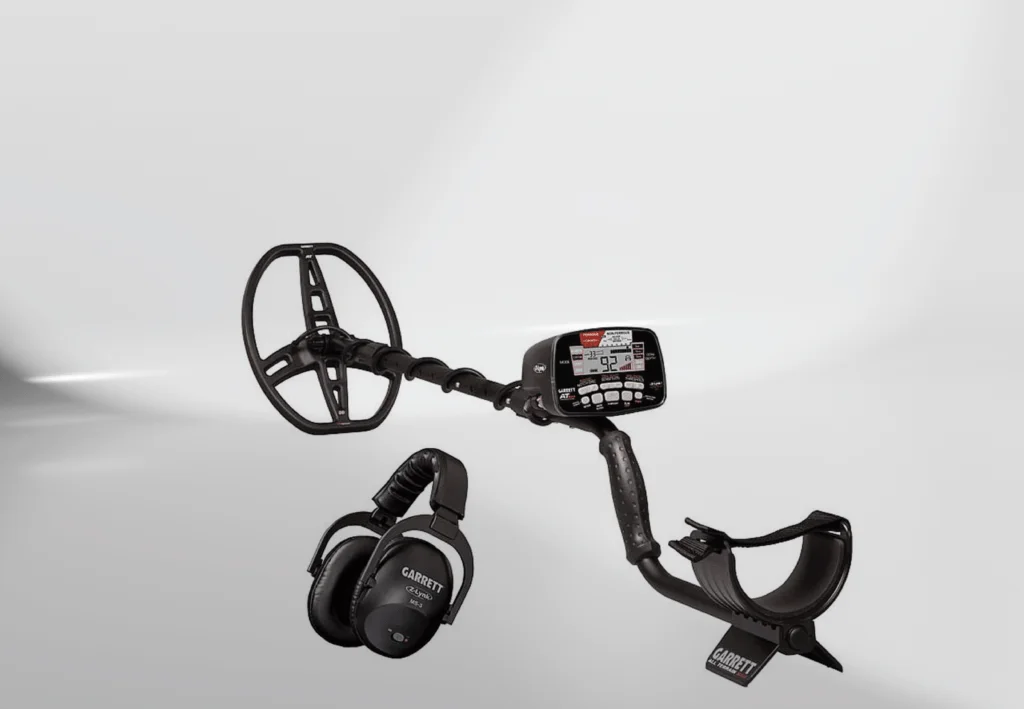
Garrett markets the AT Max for broad metal-detecting use. Target identification, discrimination and Iron Audio help a user sort repeatable metal signals in places with mixed trash and desirable targets. Its true All Metal mode is useful when you want to listen for weaker responses rather than reject a wide range of targets. These controls support decisions about digging; a displayed ID is still an estimate and can be affected by target depth, corrosion and nearby metal.
The control housing is rated submersible to 10 feet, but the supplied wireless headphones are not an underwater accessory. Garrett’s AT Max manual warns that radio signals do not pass through water in the way the wireless headset requires and directs underwater users toward an appropriate wired waterproof headset. A buyer who needs to immerse the control unit should price the complete water-ready setup, not assume the standard headphone package is sufficient.
AT Max can respond to gold because gold is conductive, but it was designed as a general-purpose platform. Small flakes and tiny nuggets may be harder to hear than with a specialized high-frequency prospecting detector. For coin and jewelry hunting where you also occasionally encounter gold, that tradeoff can be sensible. Inspect the Garrett AT Max package and availability before ordering.
The Goldmaster 24K runs at 48 kHz, according to Garrett. Its high-frequency VLF design is intended to make the weak response from small nuggets easier to notice. Garrett also lists XGB automatic ground balance, Ground-Sync and TracLock for changing mineralized ground, plus VCO and two-tone audio choices. These features support a prospecting workflow where the operator pays attention to faint, repeatable signals and changing ground noise.
A high frequency does not guarantee a find. It can also make the detector responsive to hot rocks and small trash. Use the highest sensitivity that remains stable in the actual ground; do not treat the maximum setting as a target for every site. Ground balance should be checked when soil changes, and an ambiguous response should be approached from more than one direction. The Goldmaster’s coil is waterproof, but that does not establish a waterproof rating for the whole control box.
If your main task is finding small natural gold in dry ground or shallow river margins, review the Goldmaster 24K product configuration. Confirm the coil size, headphones, power supply and warranty in the actual offer. A coil designed for close work in tight gravel is a different buying choice from a broad search coil for larger open areas.
“Gold” can mean a tiny nugget, a larger buried piece, a ring or a coin. These targets differ in size, shape and conductivity. A prospecting detector optimized for small natural gold is not necessarily the best first choice for a park full of mixed jewelry and trash. A versatile detector can find gold rings, yet its mixed-site controls do not make it a specialist on the smallest nuggets. Define the target before using a depth or sensitivity claim to choose between the two.
Mineralized ground creates a further tradeoff. Raising sensitivity can amplify both target and ground response; ground balance and careful audio interpretation matter. An air test is useful for learning controls but cannot reproduce buried targets in local soil. Read the VLF and PI comparison if mineralization is central to your choice, and compare direct coil technologies rather than unrelated long-range or 3D claims.
Water ratings apply to specific parts of a kit. Garrett specifies the AT Max detector as submersible to 10 feet, while its included wireless headphones should stay out of the water. In a submerged search, a suitable wired headset and connector setup are needed. The Goldmaster 24K’s search coil can operate in water, but the available manufacturer description does not make the whole instrument a dive detector. Keep its control housing and connections within the stated manual limits.
Fresh water and salt water also behave differently for a single-frequency VLF detector. Wet conductive sand can increase noise. If beach hunting is your primary job, test the exact machine in that environment and compare other options built for the beach. Do not infer saltwater suitability solely from a waterproof rating. For a first machine that will be used on varied sites, our beginner detector guide explains how to weigh setup, target mix and field conditions.
Repeat the test after a soil change. A machine that gives a dramatic signal in air but unstable responses in the actual field may be the poorer match. Likewise, a quiet detector is not automatically better if it misses the target class you intend to recover.
Choose the AT Max when your use is mixed coin, jewelry and relic hunting, you need a fully submersible detector body, and its standard controls suit your sites. Budget for a compatible wired headset if the control unit will go under water. Choose the Goldmaster 24K when small natural gold is the main target and you are willing to learn ground tracking, subtle audio and prospecting recovery. Neither model is a substitute for a genuinely different technology when the job requires it.
Compare the current store listings for contents and warranty, then use a representative field demonstration. Avoid a universal “winner” label or a depth number without target, soil and coil details. Buy the configuration that produces repeatable evidence for your actual targets.
It can detect conductive gold targets, including jewelry, but it is an all-terrain general-purpose model rather than a small-nugget specialist.
Garrett designed it for sensitivity to small natural gold. Its ground controls help the operator work mineralized areas, provided the machine is set and interpreted correctly.
Garrett rates the AT Max control unit to 10 feet. Its supplied wireless headphones are not submersible. Goldmaster’s coil is waterproof; do not assume its control box can be immersed.
There is no single answer for every target. Size, coil, soil, settings and test method determine the result. Run a controlled comparison on the target you care about.