

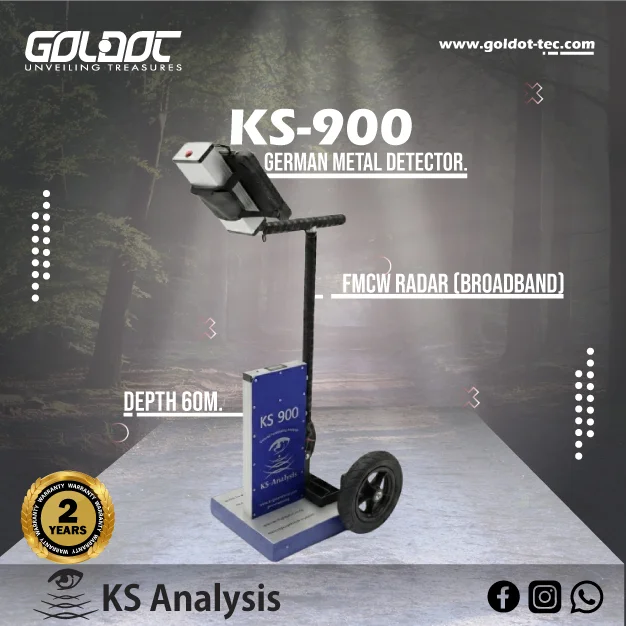
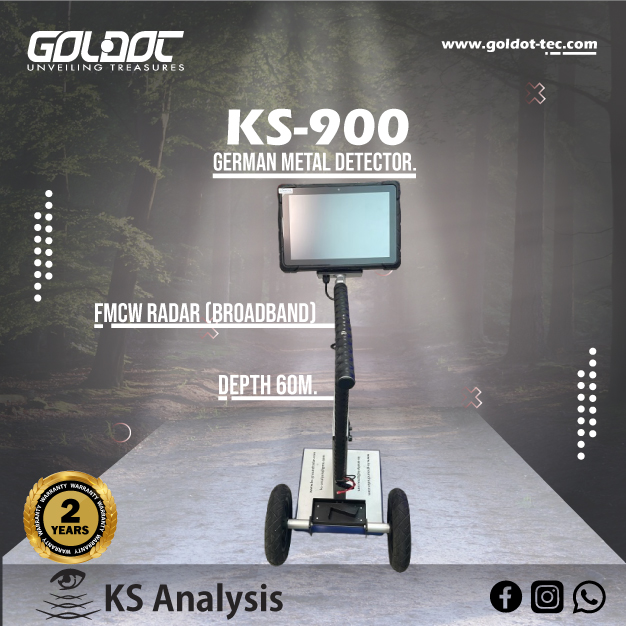
The KS-900 GPR is a professional ground penetrating radar system designed for advanced underground investigations Built for treasure hunters, archaeologists, geologists, and survey professionals, it combines deep scanning capabilities with advanced imaging software In this review, we explore its technology, detection depth, software features, real-world performance, advantages, disadvantages, pricing, and overall value to help professionals determine whether the KS-900 is the right investment.
Technology Behind the KS-900 GPR
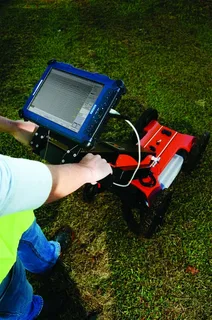
The KS-900 utilizes Ground Penetrating Radar (GPR) technology to analyze underground structures and anomalies The system sends electromagnetic waves into the ground and records the reflected signals from different subsurface materials.
This technology allows users to identify changes in soil composition and detect underground features that may include:
- Buried metallic objects
- Underground chambers
- Tunnels and passages
- Natural caves
- Utility lines and pipes
- Archaeological remains
- Geological formations
Unlike conventional metal detectors, the KS-900 provides visual information about the underground environment rather than simply indicating the presence of metal.
Visit the official KS-900 page to explore complete specifications, advanced GPR technology, software features, and professional underground scanning capabilities.
Detection Depth of KS-900 GPR
One of the most discussed features of the KS900 GPR is its depth capability.
Ground penetrating radar performance depends heavily on environmental conditions While manufacturers often advertise maximum depth ratings, actual results vary based on several important factors:
Soil Conditions
Dry sandy soil generally produces better radar penetration than wet clay-rich soil High moisture levels and mineralization can reduce signal strength and scanning depth.
Target Size
Larger underground structures such as tunnels, chambers, and caves are typically easier to detect at greater depths than small individual objects.
Ground Composition
Rock layers, mineral deposits, and salt content can influence radar wave propagation and affect the clarity of scan results.
Under favorable conditions, the KS-900 is capable of detecting large underground anomalies at significant depths, making it suitable for professional exploration projects.
Learn more about GR-4 Dual, a powerful 3D ground scanner that combines advanced underground imaging with deep target detection to help locate hidden structures and valuable targets.
Software and Imaging Capabilities
Professional users often consider software quality just as important as hardware performance.
The KS-900 includes advanced analysis software that helps transform radar signals into understandable visual representations.
2D Imaging
Two-dimensional scans allow operators to examine underground cross-sections and identify potential targets.
3D Visualization
Three-dimensional imaging provides a more detailed view of underground structures, helping users better understand target shape, size, and location.
Layer Analysis
The software can display different soil layers and geological formations, making it useful for both archaeological and geological investigations.
Data Storage and Review
Users can save scanning projects for future analysis, comparison, and reporting.
These features are particularly valuable for professionals working on large survey projects where accurate documentation is required.
Who Needs the KS-900 GPR?
The KS-900 is not intended for casual users. Its capabilities are best suited to professionals who need detailed underground imaging.
Treasure Hunters
Professional treasure hunters can use the KS-900 to locate underground chambers, hidden structures, and potential excavation targets before digging.
Archaeologists
Archaeological teams can investigate historical sites while minimizing unnecessary excavation and preserving valuable cultural resources.
Geologists
Geologists may use the system to analyze subsurface formations, identify cavities, and conduct geological studies.
Infrastructure Survey Teams
Engineering companies can use the KS-900 for locating buried utilities, pipelines, and underground structures before construction projects begin.
Explore the Minelab GPZ 8000 Official Page to discover cutting-edge GeoZVT™ technology, exceptional gold sensitivity, and industry-leading depth performance for professional prospectors.
Advantages of the KS-900 GPR
Deep Ground Investigation
The system is designed for professional-level subsurface exploration and can identify deep underground anomalies under suitable conditions.
Advanced Imaging
The combination of 2D and 3D visualization improves interpretation accuracy and helps users make informed decisions.
Multi-Purpose Applications
The KS-900 can be used across multiple industries including archaeology, treasure hunting, geology, and civil engineering.
Professional Data Analysis
Advanced software tools provide detailed underground information rather than simple detection alerts.
Field Portability
The system is designed for field operations and can be transported between survey locations efficiently.
Disadvantages of the KS-900 GPR
High Initial Cost
As a professional-grade radar system, the KS-900 represents a significant investment compared to standard metal detectors.
Learning Curve
Interpreting radar data requires training and practical experience Beginners may need time to understand scan results correctly.
Environmental Limitations
Like all GPR systems, performance can be affected by soil moisture, mineralization, and local ground conditions.
Not Ideal for Small Targets
Ground radar systems generally perform best when locating larger underground structures rather than very small isolated objects.
KS-900 vs Other GPR Systems
When compared to many mid-range ground radar systems, the KS-900 offers several advantages.
| Feature | KS-900 GPR | Typical Mid-Range GPR |
|---|---|---|
| 2D Imaging | Yes | Yes |
| 3D Visualization | Yes | Limited |
| Deep Scanning | Excellent | Moderate |
| Professional Analysis Tools | Advanced | Basic |
| Archaeological Applications | Excellent | Good |
| Infrastructure Surveying | Excellent | Good |
| User Learning Requirement | High | Medium |
The KS-900 is clearly positioned toward professional users who need advanced imaging and detailed underground analysis rather than simple detection functionality.
Discover the best gold detectors of 2026, comparing depth, technology, performance, and value to find the ideal detector.
Real Results in the Field
Field performance is one of the most important considerations when evaluating any ground radar system.
Experienced users report success in locating:
- Underground chambers
- Buried tunnels
- Large cavities
- Hidden structures
- Geological anomalies
- Utility networks
However, successful detection depends on proper survey methodology, accurate data interpretation, and realistic expectations regarding site conditions.
Professional operators generally achieve better results because they understand how to analyze radar signatures and distinguish genuine targets from natural ground variations.
Price and Value
The KS-900 belongs to the premium category of professional ground radar systems.
Although the initial purchase cost can be substantial, many professionals consider it a worthwhile investment because it offers:
- Detailed underground imaging
- Reduced excavation risk
- Improved survey accuracy
- Time savings during exploration
- Better project planning
For organizations that conduct regular underground investigations, the long-term value can outweigh the initial investment.
Browse and Shop Metal Detectors to compare professional gold detectors, treasure hunting systems, ground scanners, and advanced detection equipment from leading manufacturers worldwide.
Final Verdict
The KS-900 GPR is a professional ground penetrating radar system built for serious underground exploration and surveying Its combination of advanced imaging software, deep scanning capabilities, and versatile applications makes it an attractive option for treasure hunters, archaeologists, geologists, and engineering professionals.
While it requires experience and carries a higher price tag than conventional detection equipment, the KS-900 provides the detailed subsurface information needed for informed decision-making For professionals seeking advanced ground radar technology in 2026, the KS900 GPR remains one of the most capable solutions available.
Frequently Asked Questions (FAQ)
1. What is the maximum detection depth of the KS-900 GPR?
The detection depth of the KS-900 depends on soil conditions, target size, and ground composition. Under favorable conditions, it can detect large underground anomalies at significant depths suitable for professional investigations.
2. Can the KS-900 detect gold and buried treasures?
The KS-900 can identify underground anomalies, chambers, voids, and structures that may contain treasures. However, as a GPR system, it detects subsurface features rather than specifically identifying gold.
3. Is the KS-900 suitable for beginners?
The KS-900 is primarily designed for professional users. Beginners can use it, but interpreting radar data requires training and experience to achieve accurate results.
4. What industries commonly use the KS-900 GPR?
The KS-900 is widely used in treasure hunting, archaeology, geology, infrastructure surveying, utility detection, and underground exploration projects.
5. How does the KS-900 compare to traditional metal detectors?
Unlike conventional metal detectors that mainly indicate the presence of metal, the KS-900 provides detailed 2D and 3D underground imaging, helping users visualize subsurface structures and anomalies before excavation.