

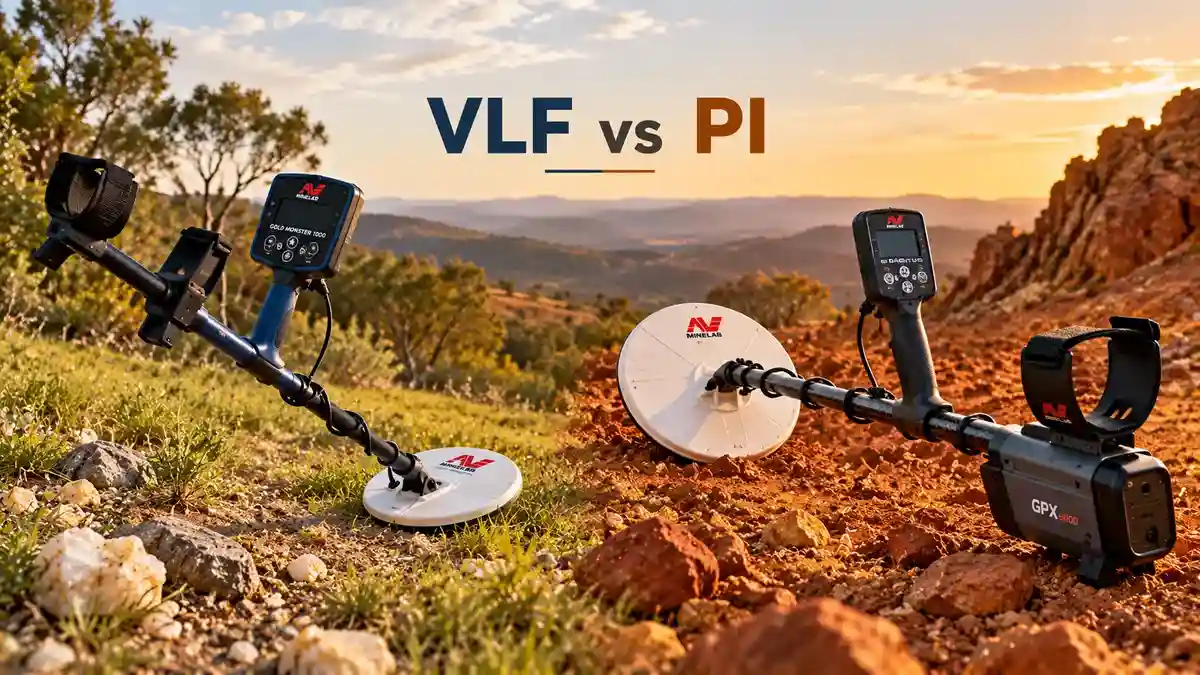
Choosing between VLF and Pulse Induction technology is an important purchasing decision for anyone planning natural-gold prospecting in the United States. A detector that performs well around shallow bedrock and small nuggets may behave differently in highly mineralized ground, while equipment designed for demanding goldfields may provide less useful target identification for conventional coin hunting.
A practical VLF vs PI metal detector comparison should begin with expected nugget size, soil mineralization, terrain, operator experience, and the search-coil configuration. These factors determine whether a high-frequency VLF detector or a specialist PI platform is more appropriate.
This guide explains how both technologies work, compares their strengths and limitations, and uses Minelab Gold Monster 1000, Nokta Gold Finder 2000, and Minelab GPX 6000 as real product examples. The goal is to help US buyers select suitable prospecting equipment and request a complete package from Goldot-Tec.
How VLF Metal Detectors Work
VLF stands for Very Low Frequency.
This technology uses continuous electromagnetic transmission and analyzes responses caused by metallic objects.
A conventional VLF search coil includes transmitting and receiving elements, although their physical arrangement varies by coil design.
The transmitter generates an electromagnetic field, while the receiver detects changes associated with nearby conductive or magnetic materials.
The detector processes these changes and presents information through audio, numerical identification, or another supported display.
Key Characteristics of VLF Technology
VLF detectors can provide several practical advantages:
- Continuous electromagnetic transmission.
- Sensitivity to small metallic targets.
- Target discrimination on suitably equipped models.
- Numerical or graphical target information.
- Ground-balance adjustments.
- Search coils for different target sizes and terrain.
- Relatively straightforward operation on selected prospecting models.
However, VLF performance depends heavily on the detector’s operating frequency and signal-processing design.
A high-frequency gold detector is not identical to a conventional low-frequency coin detector, even though both use VLF technology.
Why VLF Appeals to Gold Prospectors
High-frequency VLF platforms are particularly relevant when small natural gold is the main objective.
Tiny nuggets can produce weak responses that require suitable sensitivity, coil control, and stable ground handling.
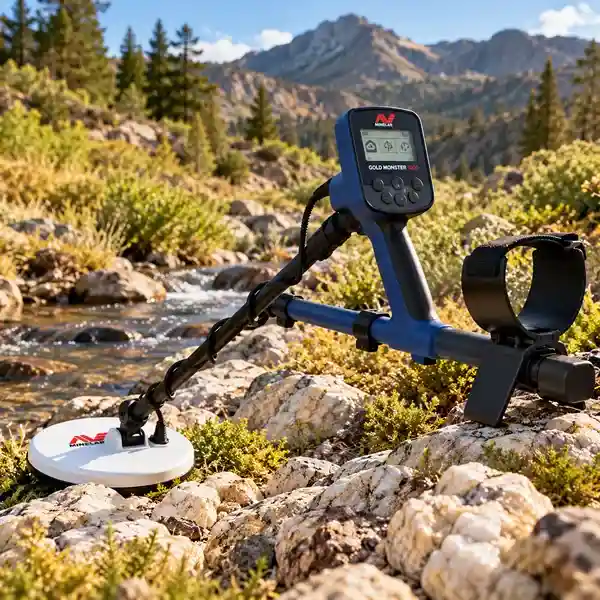
For example, Minelab Gold Monster 1000 uses a 45 kHz VLF platform with automatic ground balancing and noise cancellation.
Its Gold Chance indicator supports target evaluation, although it cannot guarantee that a recovered object will contain gold.
Buyers focused on fine natural gold can review the Gold Monster 1000 VLF example to understand its operating controls, compatible coils, and standard package.
The detector’s waterproof search coil also has different protection limits from its rain-resistant control housing.
Therefore, buyers should confirm environmental requirements before ordering.
Where VLF Can Become Challenging
Highly mineralized soil can produce strong ground responses.
Hot rocks, conductive ground, and electromagnetic interference can make small targets harder to distinguish.
In these situations, operators may need to adjust sensitivity, ground balance, or coil configuration.
A VLF detector should not automatically be rejected because mineralization exists.
However, when the ground response overwhelms the intended target signals, a specialist PI platform may provide a more practical option.
How PI Metal Detectors Work
PI stands for Pulse Induction.
Instead of using continuous-wave transmission in the same way as a conventional VLF detector, PI equipment sends current pulses through its search coil.
After each pulse, the system evaluates the resulting electromagnetic response.
Conductive metallic targets affect that response, allowing the detector to identify potential objects beneath the search area.
Key Characteristics of PI Technology
PI systems can provide advantages that include:
- Pulse-based electromagnetic target detection.
- Ground handling suited to certain difficult mineralized conditions.
- Specialist natural-gold prospecting applications.
- Compatible coils for different target priorities.
- Potential advantages on some larger metallic targets.
- Operation in selected conductive-ground environments.
However, these capabilities differ between models.
Not every PI detector provides the same sensitivity, ground adjustment, coil choices, or audio controls.
Likewise, PI technology does not eliminate all unwanted ground signals or electromagnetic interference.
Why PI Appeals to Professional Prospectors
Specialist PI systems can be useful where strong mineralization makes conventional VLF operation difficult.
For example, Minelab GPX 6000 uses GeoSense-PI technology to process ground and target signals during operation.
Its automatic ground-handling functions and compatible coil options support different natural-gold prospecting requirements.
However, the detector’s conventional target discrimination is limited compared with many coin-focused VLF systems.
Therefore, the buyer must be prepared to interpret audio responses and recover uncertain targets.
PI becomes a purchasing advantage when the ground, target, and search method justify it, not simply because the technology is associated with professional equipment.
Gold Detection Performance
Natural-gold prospecting is where the VLF vs PI metal detector decision becomes particularly important.
Both technologies can detect natural gold, but their practical advantages depend on the target and surrounding conditions.
VLF Gold Performance
High-frequency VLF detectors deserve consideration for:
- Fine natural-gold nuggets.
- Small metallic targets around shallow bedrock.
- Narrow cracks and restricted prospecting areas.
- Suitable mild or moderately mineralized ground.
- Locations where compact coils improve maneuverability.
For example, Nokta Gold Finder 2000 uses a 61 kHz VLF system designed for small natural-gold prospecting.
Its automatic ground balancing and straightforward controls make it relevant to buyers who prefer less manual setup.
The detector also supports compatible coils for different search conditions.
However, difficult mineralization and conductive ground may affect the stability of high-frequency VLF operation.
Buyers should compare Gold Finder 2000 prospecting controls when choosing a simple VLF detector according to terrain and operator experience.
PI Gold Performance
PI systems become especially relevant when the prospecting environment includes challenging ground conditions.
Suitable applications can include:
- Strongly mineralized goldfields.
- Ground containing problematic hot rocks.
- Natural-gold targets of varying sizes.
- Extended prospecting across difficult terrain.
- Situations where conventional VLF operation becomes unstable.
For example, the GPX 6000 pulse induction platform combines GeoSense-PI technology with automatic features intended for natural-gold prospecting.
It can be considered when a buyer needs specialist ground handling rather than conventional coin-style discrimination.
However, its performance should still be evaluated according to the actual target size, ground, and search coil.
Choosing According to Nugget Size
For tiny natural gold in suitable shallow ground, a high-frequency VLF platform may provide an effective search solution.
For mixed nugget sizes in difficult mineralization, a specialist PI detector may be preferable.
However, neither statement creates a universal winner.
Some PI detectors can respond effectively to small nuggets, while the performance of a VLF system can vary considerably with ground conditions.
The best purchase is the detector that provides usable target responses in the environment where you expect to prospect.
Pros and Cons of VLF Detectors
VLF equipment offers several buying advantages, especially when the user’s search goals include small natural gold or conventional metallic targets.
Main Advantages
- Small-target sensitivity: Gold-focused high-frequency models can respond effectively to fine nuggets in suitable ground.
- Target discrimination: Many VLF detectors provide information that helps users evaluate iron and other unwanted metal.
- Manageable operation: Selected gold models include automatic ground balancing and simple search controls.
- Compact coil options: Suitable for bedrock cracks, rocks, vegetation, and confined search areas.
- Versatility: Some VLF detectors also support conventional coins, jewelry, and relics.
Practical Disadvantages
- Strong mineralization can reduce operating stability.
- Conductive ground may require more careful adjustment.
- Hot rocks can produce unwanted signals.
- Aggressive discrimination may reject weak gold responses.
- High-frequency specialist machines may be less versatile for unrelated searches.
When VLF Makes Commercial Sense
VLF can be the more practical purchase when most searches involve small nuggets and the ground allows reasonably stable operation.
It also deserves consideration when the buyer values easy controls, manageable equipment, or useful iron indication.
However, the exact model matters.
A dedicated gold-focused VLF detector should not be treated as interchangeable with every recreational coin machine.
Pros and Cons of PI Detectors
PI equipment provides another prospecting approach, particularly for buyers working challenging mineralized ground.
Main Advantages
- Specialist ground-handling capabilities.
- Suitable performance in many mineralized goldfield conditions.
- Technology designed for natural-gold prospecting.
- Different compatible coils on selected professional models.
- Potential benefits for particular larger metallic targets.
- Useful operation in some salt-affected environments.
Practical Disadvantages
- Less detailed conventional discrimination on many models.
- Greater dependence on careful audio interpretation.
- Additional training may be needed for advanced setups.
- Certain coil configurations can increase carrying requirements.
- Equipment packages may require additional accessories for particular sites.
When PI Makes Commercial Sense
PI becomes relevant when difficult ground conditions are a recurring part of the prospecting project.
It may also suit experienced operators who value specialist goldfield features more than conventional Target ID.
However, a buyer who mainly searches mild ground for tiny shallow nuggets should still evaluate appropriate VLF options.
The purchasing decision should follow the field requirements rather than a general assumption that professional equipment must use PI.
Depth Comparison
Detection depth is a major consideration, but the VLF vs PI metal detector comparison should never depend on one unsupported maximum-depth figure.
A larger nugget, a thin gold fragment, and a substantial metallic object can produce different detector responses.
VLF Depth Performance
VLF detectors can provide useful target responses on:
- Coins and jewelry.
- Small metallic relics.
- Fine natural gold.
- Small nuggets in suitable ground.
However, increasing mineralization may make weak signals more difficult to interpret.
Coil size, operating frequency, and sensitivity settings also affect practical results.
Therefore, a high-frequency VLF detector may be a suitable choice for shallow small-gold prospecting without necessarily being the correct system for every larger target.
PI Depth Performance
PI detectors may maintain more usable target responses in some highly mineralized environments.
This can create a practical advantage when ground interference forces another detector to operate at reduced sensitivity.
However, greater target depth is not guaranteed.
A PI detector does not automatically outperform every VLF machine on every metallic object.
Target characteristics and coil configuration remain central to the result.
Factors Affecting Both Technologies
When comparing depth claims, consider:
- Nugget size and weight.
- Target thickness and orientation.
- Metal composition.
- Coil size and design.
- Soil mineralization.
- Ground moisture and conductivity.
- Electromagnetic interference.
- Detector sensitivity and ground settings.
- Sweep speed and operator experience.
An air test conducted with a large metallic target cannot reliably predict performance on a small nugget buried in mineralized soil.
Therefore, compare actual operating requirements rather than accepting a single depth number.
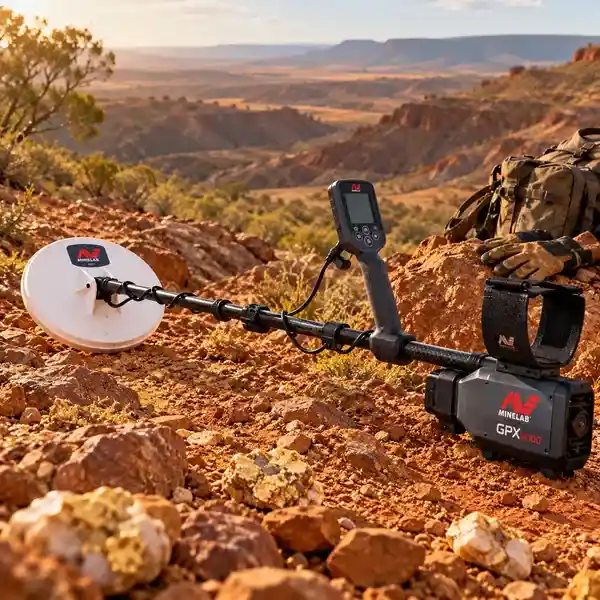
Depth Comparison Overview
A practical comparison should identify the target, ground conditions, discrimination requirements, and limitations of each technology.
| Search Requirement | VLF Buying Consideration | PI Buying Consideration | Example Models |
|---|---|---|---|
| Tiny natural gold | High-frequency gold models can offer useful small-target sensitivity | Some specialist PI models can also detect small nuggets | Gold Monster 1000, Gold Finder 2000, GPX 6000 |
| Mildly mineralized ground | VLF can provide stable operation with appropriate ground balance | PI may be unnecessary if the VLF already meets the goal | Gold Monster 1000 or Gold Finder 2000 |
| Highly mineralized goldfields | Strong ground responses can limit practical sensitivity | Specialist PI may provide more usable stability | GPX 6000 |
| Iron-contaminated locations | Many VLF systems provide useful discrimination | Conventional discrimination may be more limited | Gold-focused VLF versus GPX 6000 |
| Larger natural-gold targets | Results depend on coil, frequency, and ground | Some PI configurations may be advantageous | GPX 6000 with suitable coil |
| Narrow bedrock cracks | Compact VLF coils can improve handling | A PI coil may be less convenient if its size limits access | Gold Finder 2000, Gold Monster 1000 |
| Extended remote prospecting | Check weight, batteries, and standard equipment | Check coil choice, power equipment, and audio training | All three models |
| Salt-affected ground | Stability depends on model and settings | PI may be advantageous in suitable conditions | Compare verified model configurations |
This table provides conditions for choosing equipment rather than declaring that one technology always detects deeper.
After determining the likely technology, you can compare detectors by nugget size and soil to narrow the shortlist to suitable models.
Discrimination Comparison
Discrimination refers to a detector’s ability to evaluate or reject particular types of target responses.
It is especially useful when the search area contains unwanted iron or other metallic objects.
VLF Discrimination
Many modern VLF detectors provide numerical Target ID, iron indication, or adjustable rejection settings.
These features can help users prioritize signals when searching areas containing metallic waste.
For example, Gold Monster 1000 offers a Gold Chance indicator, while Gold Finder 2000 includes iron-discrimination functionality.
However, neither system guarantees that a target indication represents natural gold.
Gold can produce signals that overlap with other metals.
Therefore, aggressive discrimination may cause users to overlook desirable weak targets.
PI Discrimination
Many specialist PI gold detectors provide less conventional discrimination than modern VLF coin detectors.
This means the operator may need to investigate more uncertain responses.
For gold prospectors, that trade-off can be acceptable when the technology provides advantages in the intended ground.
However, the exact capabilities vary by model.
Buyers should verify whether a detector provides conventional Target ID, basic target classification, or primarily audio responses.
Choosing According to Target Information
If the site contains substantial metallic trash, useful VLF discrimination may become an important purchasing advantage.
If the main challenge is severe mineralization, the benefits of a specialist PI system may outweigh its limited identification features.
However, no discrimination method can reliably confirm that every accepted target contains gold.
Package Configuration and Buyer Value
A useful VLF vs PI metal detector purchasing decision should consider the complete equipment package rather than the detector’s control unit alone.
The correct configuration depends on the ground, coil requirements, batteries, audio, and operator experience.
VLF Package Requirements
For a gold-focused VLF detector, confirm:
- Exact detector model and operating frequency.
- Included search coil and size.
- Compatible additional coils.
- Ground-balance features.
- Available search modes.
- Iron indication or discrimination controls.
- Audio equipment.
- Battery and charging accessories.
- Weather-protection limits.
- Manufacturer warranty and support.
A simple detector may provide better practical value when the user does not need extensive manual controls.
PI Package Requirements
For a specialist PI system, confirm:
- Exact detector and technology.
- Supplied Mono or Double-D coils, where applicable.
- Suitable coil configuration for target size and terrain.
- Ground modes and available operating controls.
- Headphones and audio connections.
- Battery and charging arrangements.
- Complete carrying equipment.
- Search-coil and control-unit weather protection.
- Warranty documentation.
- Available setup guidance.
A professional system may require additional familiarization before extended field use.
Therefore, training and configuration should be part of the buying discussion.
Comparing Complete Packages
Do not assume that two product listings include identical accessories.
A detector may be offered with different coils, headphones, or charging equipment.
Ask Goldot-Tec to confirm the exact components and current availability before placing an order.
The correct package should be usable for the intended goldfield rather than simply contain the greatest number of accessories.
Best Use Cases
The original VLF vs PI metal detector distinction becomes most useful when buyers connect each technology to actual prospecting conditions.
Choose VLF If You
Consider a gold-focused VLF detector when:
- Small nuggets are the priority: You expect fine natural gold and need suitable small-target sensitivity.
- Ground conditions permit stable operation: Mild or manageable mineralization allows productive searching.
- Discrimination matters: Metallic trash is common, and you want useful target information.
- Compact coils are important: You regularly search bedrock cracks, rocky areas, or restricted terrain.
- Straightforward operation is preferred: You want automatic controls and a manageable learning curve.
Gold Monster 1000 and Gold Finder 2000 provide different approaches within this category.
However, the best choice depends on the actual site and operator.
Choose PI If You
Consider specialist PI equipment when:
- Difficult mineralization is common: Conventional VLF detectors struggle with unstable ground responses.
- Natural gold is the central objective: You prospect regularly rather than occasionally searching jewelry or coins.
- Different nugget sizes are expected: You need a coil and technology combination suitable for the intended target range.
- Professional operation is acceptable: You are prepared to interpret subtle audio and learn the ground-handling controls.
- The site justifies specialization: Your normal prospecting conditions benefit from the capabilities of a PI platform.
GPX 6000 represents a relevant professional example.
However, choose it because its technology matches the ground rather than assuming that PI guarantees more finds.
Nevada and Arizona Prospecting Examples
A permitted Nevada goldfield project may involve significant mineralization, open terrain, and long sessions.
In that scenario, PI equipment may be worth comparing.
However, not every Nevada site requires the same detector.
Meanwhile, an authorized Arizona prospecting location with narrow bedrock cracks and relatively manageable mineralization may favor a compact high-frequency VLF coil.
Another Arizona site may present very different ground conditions.
Therefore, target size and soil should guide the technology rather than the state name.
Always verify land ownership, mining claims, and prospecting permissions before searching.
Real Field Tests and Prepurchase Verification
A reliable purchase should not be based on unverified statements that one technology always detects deeper or recovers more gold.
Instead, ask how a detector responds under documented conditions.
Test the Same Target Type
When comparing VLF and PI systems, use representative natural-gold targets where a controlled demonstration is possible.
Record their size, shape, and orientation.
A test using a large metallic object does not establish performance on tiny gold.
Evaluate Ground Stability
Compare how each detector handles the actual soil.
Important observations include:
- Baseline ground noise.
- Repeatable target audio.
- Ground-balance behavior.
- Sensitivity stability.
- Responses near hot rocks.
- Electromagnetic interference.
- Practical coil handling.
A system that produces less usable noise may help the operator recognize weak signals more consistently.
However, the test must reflect the planned prospecting location.
Compare Coil Configurations
Coil choice can influence the comparison.
A compact VLF coil may be convenient around narrow rocks, while a different PI coil may suit broader prospecting areas.
Therefore, comparing unlike coils without documenting their role can produce misleading conclusions.
Record the Demonstration
When testing is available, document:
- Detector model.
- Coil used.
- Search mode.
- Sensitivity and ground settings.
- Target dimensions.
- Ground conditions.
- Operator experience.
- Repeatability of the response.
These observations provide more useful purchase information than an unsupported claim about which technology won.
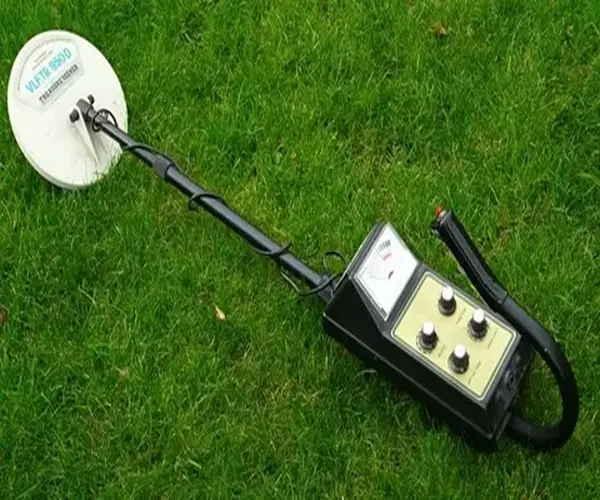
Operator Experiences and Practical Preferences
Different operators value different features.
However, general statements about what all VLF or PI users experience should not replace verified testing.
Instead, buyers should assess the workflow they are prepared to use.
VLF Operator Priorities
A VLF buyer may value:
- Straightforward ground adjustment.
- Compact and manageable equipment.
- Iron indication.
- Suitable small-gold sensitivity.
- A simple initial setup.
- Practical coil options.
These priorities are relevant when the intended search environment does not require the benefits of a specialist PI platform.
PI Operator Priorities
A PI buyer may prioritize:
- Ground stability in difficult mineralization.
- Specialist nugget-detection capability.
- Appropriate Mono or Double-D coil configurations.
- Clear audio interpretation.
- Reliable power arrangements.
- Professional setup and support.
However, the buyer should understand that limited discrimination may require more target recovery.
Should You Own Both Technologies?
Some prospectors may benefit from using both technologies when their search locations vary considerably.
A compact VLF system can address one type of small-gold search.
A specialist PI detector may better suit another site with difficult mineralization.
However, owning two detectors is not automatically necessary.
Begin with the system that serves most of your current prospecting work.
Additional equipment should solve a clear, recurring limitation.
Final Recommendation for US Gold Buyers
The VLF vs PI metal detector decision depends on the natural-gold targets, ground conditions, and operating requirements that matter most.
High-frequency VLF equipment such as Gold Monster 1000 and Gold Finder 2000 can be appropriate for small nuggets, confined terrain, and prospecting locations where ground conditions allow stable operation.
Specialist PI equipment such as GPX 6000 deserves consideration when difficult mineralization, varied nugget sizes, and dedicated goldfield work justify a different detection approach.
However, neither technology guarantees a particular depth, target identity, or gold discovery.
The correct system should match the expected nugget size, soil response, coil requirements, experience, and complete field package.
Before ordering, choose a gold and ore detector package suited to your prospecting priorities and confirm the relevant equipment with Goldot-Tec.
Frequently Asked Questions
Which is better for natural gold, VLF or PI?
High-frequency VLF detectors can be suitable for small natural-gold nuggets in manageable ground. Specialist PI detectors may provide advantages in strongly mineralized environments. The correct choice depends on nugget size, ground conditions, coil configuration, and operator experience.
Are PI detectors always deeper than VLF detectors?
No. Detection depth depends on target size, metal composition, orientation, ground mineralization, coil design, settings, and operator technique. PI may offer advantages in certain difficult conditions, but no technology guarantees greater depth on every target.
What should I confirm before buying a VLF or PI detector?
Confirm the exact model, technology, search coil, ground-handling controls, audio equipment, battery system, weather protection, warranty, and available support. Explain your expected gold size and prospecting conditions so Goldot-Tec can recommend a suitable package.
Request Your US Gold Prospecting Setup from Goldot-Tec
The most useful VLF vs PI metal detector comparison is the one that leads to an equipment choice you can justify in the field.
Choose VLF when small natural gold, compact-coil searching, and suitable ground conditions make its features practical.
Choose specialist PI when challenging mineralization and professional natural-gold prospecting support that decision.
Do not purchase either technology solely because of a maximum-depth claim or a promise of superior performance.
Buying in the United States? Contact Goldot-Tec for Availability and a personalized VLF or PI detector recommendation. Share your expected nugget size, mineralization, terrain, operator experience, preferred coil, and delivery state. Ask the team to compare Gold Monster 1000, Gold Finder 2000, and GPX 6000 configurations, confirm package contents and technical support, and help you select a detector suited to your actual gold-prospecting work.