

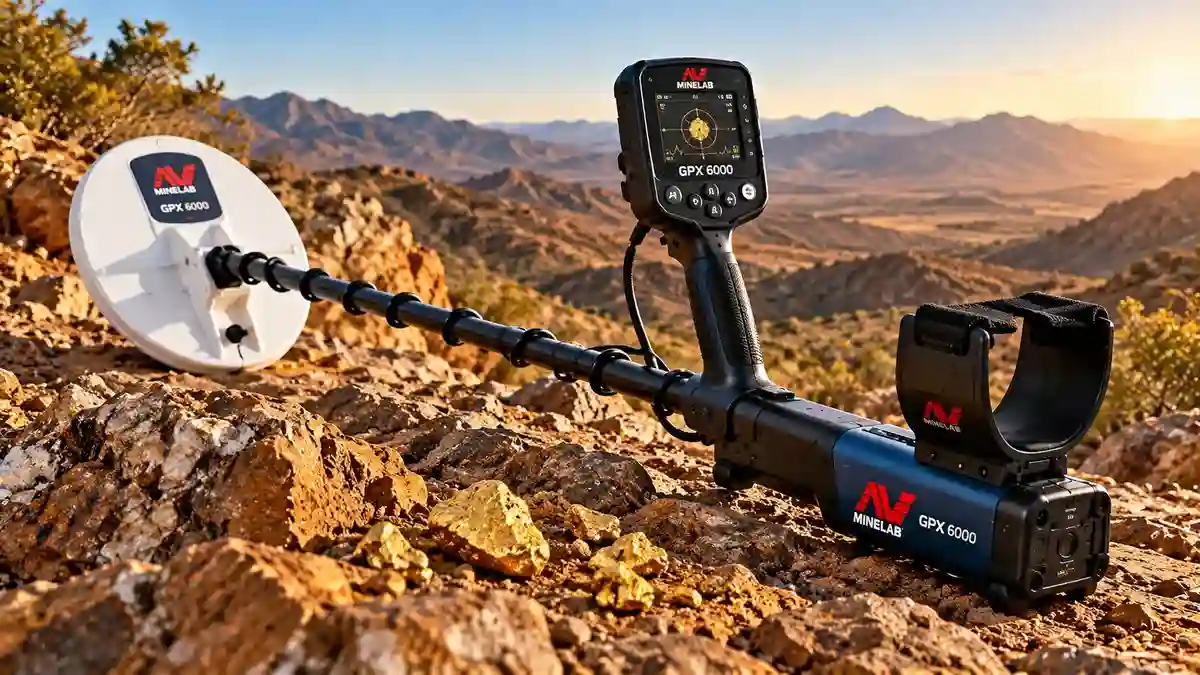
Choosing the best gold nugget detector for US prospecting starts with the size of the natural gold you expect to find, the soil you will search, and your experience level. Tiny nuggets in shallow bedrock cracks require different equipment from larger gold targets in difficult mineralized ground. The right detector should match these conditions while providing manageable controls, suitable coils, and reliable support.
A high-frequency VLF detector can provide excellent sensitivity to very small natural gold in suitable conditions. Meanwhile, Pulse Induction technology may offer advantages when strong mineralization creates excessive ground noise. Modern gold-focused multi-frequency systems introduce another option for buyers who want small-target sensitivity and automatic ground handling.
This guide compares seven gold nugget detectors, explains their purchasing advantages and limitations, and provides a practical selection process. Whether you plan to prospect in Arizona, Nevada, Colorado, or another authorized US location, the goal is to choose suitable equipment and request a complete prospecting package from Goldot-Tec.
What Makes a Good Gold Nugget Detector?
A gold nugget detector is designed to locate naturally occurring metallic gold rather than focusing primarily on coins, manufactured jewelry, or conventional relics.
Natural gold can be difficult to detect because its physical properties and surrounding ground conditions vary considerably.
Common challenges include:
- Very small nuggets that produce weak metallic responses.
- Gold mixed with quartz or other minerals.
- Nuggets located inside narrow bedrock cracks.
- Iron-rich soil and magnetic mineralization.
- Hot rocks that produce unwanted detector responses.
- Irregular gold shapes and orientations.
- Metallic waste around historical mining locations.
The best gold nugget detector should provide usable sensitivity while maintaining enough stability for the operator to recognize repeatable signals.
However, sensitivity alone does not determine performance.
A detector operating with excessive sensitivity may generate unwanted noise, making faint gold signals more difficult to identify.
Therefore, buyers should consider ground handling, coil size, operating technology, audio feedback, ergonomics, and operator experience together.
Match Detector Capability to Your Prospecting Goals
Before comparing models, define what you expect to search for most frequently.
For example, a buyer targeting tiny nuggets around exposed bedrock may benefit from compact search coils and sensitive VLF technology.
Another prospector covering mineralized open ground may require a professional PI system with different ground-handling capabilities.
The ideal purchase should also account for how often you prospect and the amount of technical adjustment you are comfortable managing.
Best Gold Nugget Detectors Compared
The following gold nugget detector comparison preserves seven specialist models with different prospecting applications.
The table highlights the operating technology, expected gold targets, suitable ground conditions, and operator experience.
It is a buying reference rather than a ranking based on guaranteed detection depth.
| Detector | Technology | Primary Gold Target | Suitable Ground Conditions | Experience Level |
|---|---|---|---|---|
| Minelab GOLD MONSTER 2000 | Multi-Au hybrid simultaneous multi-frequency technology | Fine and small natural gold | Variable ground where its gold-focused processing and compact coil are suitable | Beginner to advanced |
| Minelab GOLD MONSTER 1000 | 45 kHz VLF | Fine and small nuggets | Mild to moderately mineralized ground | Beginner to intermediate |
| Nokta Gold Finder 2000 | 61 kHz VLF | Small natural gold in restricted areas | Dry prospecting sites and suitable mineralized ground | Beginner to intermediate |
| Garrett Goldmaster 24K | 48 kHz induction-balance VLF | Fine and small gold | Mild to changing mineralization requiring adjustable ground handling | Beginner to advanced |
| Minelab SDC 2300 | MPF Pulse Induction | Small nuggets in challenging environments | Mineralized, wet, and salt-affected prospecting locations | Intermediate |
| Garrett Axiom | Ultra-Pulse Induction | Small to larger natural-gold targets | Mineralized ground, hot rocks, and demanding goldfields | Intermediate to advanced |
| Minelab GPX 6000 | GeoSense-PI | Natural gold across different nugget sizes | Challenging mineralization and varied goldfield conditions | Intermediate to professional |
The correct choice depends on the actual location.
A VLF detector may offer excellent practical sensitivity in suitable shallow-gold locations. However, difficult mineralization can change the buying decision toward PI technology.
Likewise, a professional PI machine should not automatically replace a lighter gold-focused detector when the expected targets are very small and the ground allows stable operation.
Minelab GOLD MONSTER 2000
The Minelab GOLD MONSTER 2000 is designed for prospectors who prioritize fine natural gold while working in locations with changing ground conditions.
Its Multi-Au technology combines simultaneous multi-frequency detection with a specialized ground-processing approach. Minelab describes the platform as a hybrid SMF-PI system, although this does not make it identical to a conventional standalone PI prospecting detector.
The GOLD MONSTER 2000 provides Normal, Benign, and Difficult ground modes, automatic and manual sensitivity options, numeric Target ID, a depth indicator, and Echo Wave audio.
Its compact 5-inch Double-D search coil makes it practical for working around exposed rock, narrow cracks, and areas where larger coils are difficult to position.
Buyers interested in this platform should review the Gold Monster 2000 prospecting package and confirm the supplied coil, power equipment, and current configuration.
Main Advantages
- Gold-focused Multi-Au technology for fine-target prospecting.
- Automatic ground-handling features that simplify operation.
- Compact coil for narrow spaces and careful search coverage.
- Numerical target information and audio feedback.
- Lightweight construction for extended prospecting sessions.
- Suitable for buyers who want specialist gold detection without immediately selecting a larger professional PI platform.
Main Limitations
- The compact standard coil covers less ground per sweep.
- More detailed settings and audio information still require practice.
- Severe ground conditions may justify comparing dedicated PI alternatives.
- The IP55 control housing is rainproof rather than submersible.
- The waterproof coil does not make the complete detector suitable for underwater use.
Buying recommendation: Choose GOLD MONSTER 2000 when small natural gold, portability, and manageable controls form your main priorities.
Minelab GOLD MONSTER 1000
The Minelab GOLD MONSTER 1000 remains a specialist option for prospectors who want straightforward operation and sensitivity to small natural gold.
Its 45 kHz VLF technology is designed around fine-gold detection, while automatic ground balance and noise cancellation help simplify initial setup.
This makes it relevant to buyers beginning dedicated nugget prospecting rather than general coin hunting.
Main Advantages
- High-frequency VLF operation for small natural-gold targets.
- Automatic ground balancing and noise cancellation.
- Straightforward controls for newer prospectors.
- Manageable weight during longer field sessions.
- Gold Chance information that can help users evaluate target responses.
- Suitable coil options for different prospecting conditions.
Main Limitations
- Single-frequency VLF technology can be challenged by severe mineralization.
- Less manual adjustment than some advanced prospecting platforms.
- The Gold Chance indicator does not prove that a signal represents gold.
- The control box is rain-resistant rather than fully submersible.
- Buyers should confirm current compatible coils and package contents.
Best Prospecting Applications
GOLD MONSTER 1000 can suit prospectors searching shallow bedrock, historical tailings, quartz outcrops, and restricted areas where small natural gold is the priority.
However, buyers who regularly encounter strong mineralization should also consider whether specialist PI equipment would provide a more stable working setup.
Buying recommendation: Consider GOLD MONSTER 1000 when you want a manageable entry into dedicated nugget detecting and your ground conditions suit a high-frequency VLF platform.
Nokta Gold Finder 2000
The Nokta Gold Finder 2000 uses a 61 kHz VLF operating frequency intended for sensitivity to small natural gold.
Its fully automatic ground balancing and straightforward interface are designed to reduce the amount of manual configuration required before searching.
This makes the detector relevant to users who prefer a turn-on-and-go prospecting workflow.
The retractable shaft also supports transportation, while compatible search coils can help users work around exposed bedrock and restricted terrain.
Main Advantages
- High-frequency operation focused on small gold targets.
- Automatic ground balance for easier setup.
- Straightforward controls for new prospectors.
- Retractable shaft for storage and transportation.
- Compatible compact coils for restricted prospecting areas.
- Waterproof search coils and rainproof construction within manufacturer limits.
- Practical operation for small-gold searches in suitable ground.
Main Limitations
- Severe mineralization may reduce the usefulness of highly sensitive VLF operation.
- Limited advanced settings compared with some professional systems.
- Larger and deeper nuggets may justify comparing other technologies.
- Conductive salt conditions can create additional ground responses.
- The detector is specialized for gold rather than broad coin and jewelry detecting.
Gold Finder 2000 Coil Selection
One of the important buying considerations is whether your prospecting involves relatively open ground or narrow areas between rocks.
A compact coil can provide easier movement in restricted locations. Meanwhile, another compatible coil may offer greater coverage in open terrain.
Buyers should review Gold Finder 2000 coil options and verify which coils are included in the current package.
Buying recommendation: Choose Gold Finder 2000 when fine natural gold, straightforward operation, and manageable equipment are more important than extensive manual controls.
Garrett Goldmaster 24K
The Garrett Goldmaster 24K is a high-frequency gold nugget detector designed for sensitivity to small natural-gold targets.
It operates at 48 kHz and uses Garrett’s XGB ground balance system to help manage changing mineralization.
The detector also provides controls that allow experienced prospectors to adjust sensitivity, threshold response, and ground handling.
This gives buyers a different prospecting experience from detectors that rely primarily on automatic functions.
Main Advantages
- High-frequency sensitivity suited to smaller nuggets.
- XGB ground balance for changing soil conditions.
- Adjustable threshold and sensitivity settings.
- Ground tracking and manual ground-control options.
- Audio modes for interpreting target responses.
- Iron-handling features that may reduce some unwanted signals.
- Suitable for prospectors who want more control as their skills develop.
Main Limitations
- Detailed adjustments require practice and understanding.
- Incorrect threshold or sensitivity settings can make weak signals harder to recognize.
- Strong mineralization can still challenge VLF operation.
- It is not a dedicated professional large-target PI detector.
- Discrimination and iron rejection cannot guarantee correct target identification.
Goldmaster 24K Ground Controls
Buyers moving beyond simple automatic prospecting may find the Goldmaster 24K attractive because it provides additional ground-adjustment options.
These controls are useful when the operator understands how changing soil affects target signals.
However, greater adjustment capability should not become the only reason to purchase the detector.
The main question is whether the extra control improves your normal prospecting workflow.
Review Goldmaster 24K ground controls before choosing a configuration, and confirm the supplied coil and accessories.
Buying recommendation: Consider Goldmaster 24K when you expect to search changing ground and want more control over sensitivity, ground response, and audio interpretation.
Minelab SDC 2300
The Minelab SDC 2300 is a compact Pulse Induction detector designed for small natural gold in challenging prospecting environments.
Its MPF technology provides a different approach from high-frequency VLF systems.
The detector also uses automatic ground tracking and noise cancellation to simplify part of the operating process.
An important purchasing advantage is its compact folding design and fully waterproof construction, rated by Minelab to 3 meters.
Main Advantages
- Specialist PI technology for natural-gold prospecting.
- Suitable ground handling in challenging mineralized environments.
- Compact folding construction for transport.
- Fully waterproof design within the manufacturer’s stated limit.
- Automatic ground tracking.
- Salt-related sensitivity settings for appropriate prospecting conditions.
- Useful for creek beds, wet gullies, and rocky locations.
Main Limitations
- Limited conventional Target ID information.
- Fixed search-coil configuration.
- Audio interpretation requires practice.
- A compact coil offers less coverage across large open areas.
- Its specialist nature makes it less convenient for general coin hunting.
Best Wet-Ground Prospecting Applications
SDC 2300 can suit buyers who regularly prospect around shallow water, wet bedrock, and mineralized creeks.
However, waterproof construction should not automatically be interpreted as superior performance for every beach-search application.
The detector is designed primarily for natural gold rather than routine jewelry recovery in trash-heavy saltwater locations.
Buying recommendation: Consider SDC 2300 when a compact waterproof PI platform directly matches your natural-gold prospecting environment.
Garrett Axiom
The Garrett Axiom is a professional pulse induction detector intended for serious natural-gold prospecting.
Its Ultra-Pulse technology works with Terra-Scan ground balancing to help manage difficult mineralization.
The detector also provides Fine, Normal, Large, and Salt search modes, allowing users to adapt its operation to different goldfield conditions.
Compatible Mono and Double-D coils create additional configuration options.
Main Advantages
- Specialist PI performance for difficult gold-bearing ground.
- Multiple search modes for different target priorities.
- Terra-Scan ground-handling technology.
- Compatible Mono and Double-D coils.
- Adjustable operating controls for experienced prospectors.
- Suitable for extended searches in challenging environments.
- Flexible package options for different field requirements.
Main Limitations
- Less detailed conventional discrimination than many coin-focused detectors.
- Some weak signals require careful audio interpretation.
- Iron Check has specific compatible-coil requirements.
- Package contents can differ between configurations.
- Additional coils should not be purchased without a clear prospecting purpose.
Choosing Axiom for US Goldfields
Axiom can suit buyers who frequently search mineralized desert terrain, historical goldfields, and areas containing hot rocks.
For example, an authorized Arizona goldfield may create different ground-handling requirements from a milder location.
The buying decision should account for target size, mineralization, available coils, and the user’s experience.
Buying recommendation: Consider Axiom when you want specialist PI capability with different search-mode and coil options for demanding prospecting work.
Minelab GPX 6000
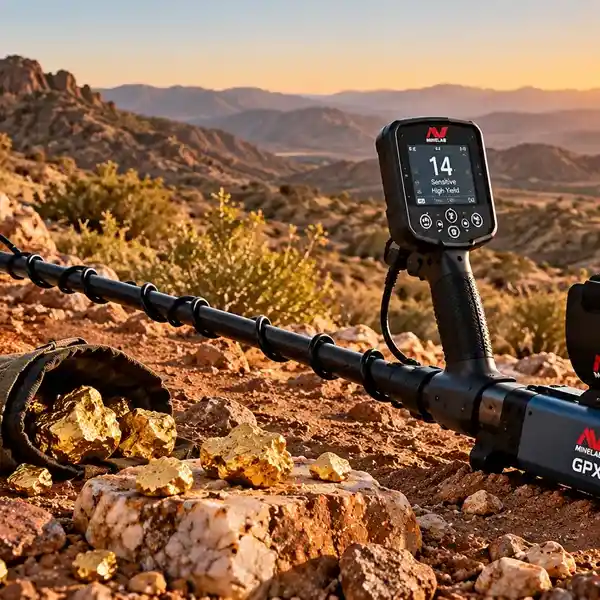
The Minelab GPX 6000 is a professional gold nugget detector designed for prospectors working across different natural-gold target sizes and ground conditions.
Its GeoSense-PI technology analyzes ground and target responses while the detector operates.
This approach supports gold-focused detection in mineralized environments and reduces some of the manual adjustment required during fieldwork.
The GPX 6000 also offers compatible coil configurations for different prospecting requirements.
Main Advantages
- GeoSense-PI technology for specialist natural-gold detection.
- Ground settings suitable for varied mineralization.
- Automatic ground handling and noise cancellation.
- Suitable for investigating different nugget sizes.
- Compatible search-coil options.
- Lightweight construction relative to many professional prospecting systems.
- Wireless audio capability.
- Practical for extensive goldfield searches when correctly configured.
Main Limitations
- Less conventional Target ID information than general-purpose coin detectors.
- Weak audio responses require experience and controlled technique.
- Search coil choice affects sensitivity and ground coverage.
- Optional equipment may be needed for particular applications.
- Its control box is splash- and rain-resistant rather than fully submersible.
GPX 6000 for Difficult Goldfields
A buyer regularly searching challenging mineralized ground may benefit from GPX 6000’s specialist PI design.
However, it is not appropriate to guarantee performance at a particular depth or assume the detector will locate every nugget size.
Instead, compare the system according to the actual soil, expected gold dimensions, coil selection, and available operator controls.
Review GPX 6000 for mineralized goldfields and confirm the included coil configuration, headphones, power equipment, warranty, and current US availability.
Buying recommendation: Choose GPX 6000 when professional natural-gold prospecting in challenging ground forms an important part of your regular fieldwork.
Key Gold Nugget Detection Technologies
Selecting the best gold nugget detector requires understanding the practical differences between high-frequency VLF, gold-focused multi-frequency systems, and Pulse Induction.
The technology should support the expected gold size and ground conditions rather than being chosen from a broad performance claim.
High-Frequency VLF Detection
High-frequency VLF detectors can provide useful sensitivity to small, low-conductivity gold targets.
Gold Monster 1000, Gold Finder 2000, and Goldmaster 24K belong to this general technology category, although their controls and ground-handling methods differ.
These platforms are relevant when:
- Fine and small natural gold is the main target.
- Ground conditions allow stable operation.
- Compact coils are useful around rocks.
- Lightweight equipment is important.
- The buyer values straightforward or adjustable controls.
However, severe mineralization can require sensitivity adjustments or another detector category.
Gold-Focused Multi-Frequency Technology
The GOLD MONSTER 2000 uses Minelab’s Multi-Au technology.
This combines simultaneous multi-frequency detection with a specialized hybrid ground-processing design.
Its practical buying role involves fine-gold sensitivity, target information, and operation across suitable changing ground conditions.
However, this does not mean every multi-frequency detector provides the same goldfield capability.
Likewise, the GOLD MONSTER 2000 should not be treated as an identical replacement for a dedicated GPX-series PI machine.
Pulse Induction Detection
Pulse Induction detectors can offer important advantages in mineralized goldfields.
SDC 2300, Garrett Axiom, and GPX 6000 represent different specialist PI designs.
Their main purchasing advantages may include:
- Ground handling in challenging mineralization.
- Specialist natural-gold prospecting modes.
- Different coil options where supported.
- Operation in selected salt-affected conditions.
- Capability suited to different nugget-size priorities.
However, PI technology does not eliminate every ground response.
It may also provide less conventional target discrimination, making audio interpretation particularly important.
Depth and Nugget Size
A gold nugget detector should never be selected from one universal depth claim.
Small nuggets and larger pieces of natural gold can produce significantly different responses.
The same target may also behave differently when its orientation, surrounding ground, or detector settings change.
Factors Affecting Gold Detection
Important performance variables include:
- Nugget weight and physical dimensions.
- Gold composition and conductivity.
- Thickness and orientation.
- Soil mineralization and moisture.
- Search-coil size and construction.
- Sensitivity and ground-balance settings.
- Electromagnetic interference.
- Coil height and sweep speed.
- Operator experience.
A tiny gold piece in a narrow bedrock crack creates a different detection problem from a larger nugget buried in mineralized soil.
Therefore, meaningful comparisons should identify the target and test conditions rather than promise a fixed detection depth.
Search Coil Size and Nugget Detection
Small coils can improve maneuverability around rocks and narrow cracks while supporting precise searching for smaller targets.
Medium coils provide a compromise between coverage and target sensitivity.
Larger coils may improve ground coverage and favor certain larger-target applications, but they can become difficult to control in restricted terrain.
The largest coil is not automatically the best option.
Before ordering additional coils, confirm compatibility and identify the specific prospecting problem they would solve.
Accuracy and Gold Target Identification
No conventional gold nugget detector can guarantee that a buried response represents natural gold before recovery.
Gold can produce signals similar to other non-ferrous materials, including lead, aluminum, and brass.
Likewise, some hot rocks and mineralized ground can generate unwanted responses.
Target identification and discrimination are useful aids, but they do not remove uncertainty.
Practical Signal Evaluation
When comparing detectors, prioritize:
- Repeatable target responses.
- Stable ground handling.
- Understandable audio.
- Consistent coil movement.
- Appropriate sensitivity.
- Effective hot-rock management.
- Ground-specific settings.
- Operator training and practice.
Discrimination can reduce some unwanted responses, but excessive filtering may also reject desirable weak targets.
Therefore, users should evaluate signals carefully rather than assuming that a numerical indicator identifies gold with certainty.
Best US Prospecting Conditions for Gold Nugget Detectors
A suitable prospecting detector should match the actual terrain rather than a generalized claim about an entire state.
Arizona, Nevada, and Colorado provide useful examples of why location-specific equipment selection matters.
Arizona Small-Gold Prospecting
An authorized Arizona prospecting site may involve exposed bedrock, rocky gullies, hot rocks, or difficult mineralization.
A buyer focused on very small nuggets may compare gold-focused VLF or Multi-Au systems first.
However, more challenging ground can justify examining specialist PI equipment.
The choice should follow the expected nugget size and actual ground response.
Nevada Mineralized Goldfields
Nevada prospecting projects can involve different levels of mineralization and terrain accessibility.
Professional buyers may prioritize stable operation, suitable coil coverage, and manageable equipment during long search sessions.
GPX 6000, Axiom, or another specialist PI option may deserve consideration when severe mineralization dominates.
However, not every Nevada site requires the same technology.
Verify land status, mining claims, and prospecting permissions before planning a search.
Colorado Rocky and Wet Terrain
A Colorado prospecting project may involve uneven ground, narrow search areas, or wet locations.
In these conditions, coil maneuverability, equipment weight, and water protection may influence the buying decision.
A compact waterproof specialist system such as SDC 2300 may suit some applications.
However, a lighter VLF detector can remain suitable when its technology matches the ground and expected target.
The specific site should determine the choice.
Best Uses Beyond Natural Gold
A gold nugget detector may also respond to other metallic objects, but that does not make it the most suitable device for every search.
Gold Jewelry
Gold jewelry, particularly rings on beaches, creates a different buying problem from natural nuggets.
Target identification, saltwater handling, and conventional discrimination may become more important.
Therefore, buyers mainly searching jewelry should compare appropriate multi-frequency conventional detectors before choosing a specialist nugget platform.
Large Buried Metallic Objects
A large buried metallic object may require another detector technology and coil configuration.
Professional large-target systems are designed for different search priorities from compact high-frequency nugget detectors.
Do not select a small-gold machine solely because the expected object contains gold.
Coins and Historical Relics
Conventional metal detectors generally provide more detailed discrimination and Target ID features for coins and relics.
A specialist nugget detector may respond to these objects, but a dedicated conventional detector can provide a more convenient workflow.
Wet-Ground Prospecting
Waterproofing matters when searching creeks or wet ground.
However, a waterproof coil does not make the complete detector safe for submersion.
Buyers should confirm the protection rating of the control box, coil, headphones, and connections separately.
Pros and Cons Comparison
The following comparison focuses on distinct purchasing advantages and practical limitations rather than repeating the specifications from the main detector table.
| Detector | Main Purchasing Advantage | Practical Limitation |
|---|---|---|
| GOLD MONSTER 2000 | Fine-gold sensitivity with target information and manageable controls | Compact standard coil and rainproof rather than submersible control housing |
| GOLD MONSTER 1000 | Straightforward specialist VLF prospecting | Less suitable for some severe mineralization conditions |
| Gold Finder 2000 | Simple high-frequency searching around small-gold locations | Fewer advanced controls for experienced users |
| Goldmaster 24K | Greater ground and threshold adjustment flexibility | Requires time to learn effective settings |
| SDC 2300 | Compact waterproof PI prospecting for difficult terrain | Fixed coil configuration and limited conventional discrimination |
| Garrett Axiom | Configurable PI prospecting with different modes and coils | Package selection and audio interpretation require attention |
| GPX 6000 | Specialist ground handling for varied natural-gold targets | Professional workflow and rainproof control housing limitations |
These advantages and limitations should guide buyers toward a suitable shortlist.
The goal is not to identify a universal winner.
Instead, choose the model whose strengths match the targets and ground you encounter most often.
How to Choose the Right Gold Nugget Detector
Buying the best gold nugget detector becomes easier when the decision follows a clear sequence.
Step 1 — Define the Nugget Size
Start by identifying whether your primary target is extremely small natural gold, mixed nugget sizes, or larger pieces.
Small shallow gold may favor a sensitive high-frequency platform.
However, difficult ground and another target-size range may justify specialist PI equipment.
Step 2 — Evaluate the Soil
Describe the expected mineralization and any hot rocks or conductive ground.
A detector that behaves well in mild soil may not operate identically in a highly mineralized goldfield.
Ground conditions should influence the technology before you choose the brand.
Step 3 — Assess the Terrain
Determine whether you will search open ground, narrow bedrock cracks, rocky gullies, or wet areas.
Restricted terrain may benefit from a compact coil.
Meanwhile, open ground can favor greater search coverage.
Step 4 — Match Your Experience
A beginner may prefer automatic ground handling and straightforward controls.
An experienced prospector may value additional threshold, sensitivity, and audio adjustments.
However, professional equipment is worthwhile only when its capabilities solve your actual prospecting requirements.
Step 5 — Confirm the Complete Package
Check the standard coil, compatible accessories, charging system, headphones, weather protection, warranty, and technical support.
Ask whether the selected package includes the equipment required for your planned fieldwork.
Step 6 — Compare Specialist Gold Categories
After narrowing the shortlist, compare nugget and ore detector options to review suitable equipment categories before requesting a specific recommendation.
Step 7 — Request Your US Configuration
Provide Goldot-Tec with your target size, soil conditions, terrain, experience, and delivery state.
Ask the team to confirm the exact detector configuration and current availability before completing your purchase.
Common Buying Mistakes to Avoid
Avoid these mistakes when selecting a gold nugget detector for US prospecting.
- Choosing by advertised depth alone: Compare realistic nugget sizes, ground conditions, and coil configurations instead of relying on a universal depth claim.
- Assuming the highest frequency is always best: High-frequency VLF systems can suit tiny gold, but severe mineralization may make another technology more practical.
- Buying the largest coil automatically: Match coil size to terrain and expected nugget dimensions rather than assuming a larger coil guarantees better performance.
- Relying entirely on discrimination: Treat Target ID as supporting information because weak gold and unwanted metal can produce overlapping responses.
- Ignoring equipment weight: Consider shaft balance, search duration, and transport requirements before ordering.
- Confusing waterproof coils with waterproof detectors: Check the entire system’s environmental limits.
- Comparing incomplete packages: Confirm included coils, power equipment, audio accessories, and warranty terms in writing.
- Ignoring prospecting permissions: Verify land ownership, mining claims, protected areas, and applicable search rules before beginning fieldwork.
Avoiding these problems can help buyers choose equipment that is better suited to their intended prospecting work.

Gold Nugget Detector Package Checklist
A gold nugget detector purchase should include more than the detector’s control unit.
Before accepting a package, confirm the following information:
- Exact detector model and version.
- Supplied search coil and size.
- Compatible additional coils when required.
- Battery and charging equipment.
- Headphones and audio connections.
- Waterproof and weather-protection limitations.
- Carrying equipment and shaft configuration.
- Manufacturer warranty documentation.
- Technical support and training options.
- Current availability and delivery arrangements.
A buyer preparing for extended prospecting trips should also consider charging access, spare-power requirements, and the availability of compatible replacement parts.
For professional PI users, coil compatibility and setup guidance may be particularly important.
For beginners, clear instructions and a manageable control system can make the first prospecting sessions easier.
Frequently Asked Questions
Which gold nugget detector is best for small natural gold?
Gold-focused high-frequency VLF detectors such as Gold Finder 2000 and Goldmaster 24K can be suitable for very small nuggets in appropriate ground. GOLD MONSTER 2000 also provides a specialist Multi-Au option. The best choice depends on mineralization, terrain, operating preferences, and coil configuration.
Should I choose a VLF or PI gold nugget detector?
High-frequency VLF technology can offer excellent small-gold sensitivity in suitable ground. Specialist PI systems may provide advantages in strongly mineralized or conductive environments. Compare the expected nugget size, soil conditions, available coils, and your experience before selecting a technology.
What should I confirm before ordering a gold nugget detector in the US?
Confirm the exact detector model, standard coil, charging equipment, headphones, environmental protection, warranty, and technical support. Share your prospecting terrain and US delivery state with Goldot-Tec so the team can recommend a suitable configuration and confirm current availability.
Choose Your Gold Nugget Detector with Goldot-Tec
The best gold nugget detector is the system that matches your natural-gold targets, ground conditions, and operating experience.
GOLD MONSTER 2000 and GOLD MONSTER 1000 provide different gold-focused approaches for buyers prioritizing small nuggets. Gold Finder 2000 offers straightforward high-frequency operation, while Garrett Goldmaster 24K provides additional ground controls.
For challenging prospecting environments, SDC 2300, Garrett Axiom, and GPX 6000 offer specialist PI technologies with different operating and package requirements.
However, no detector guarantees the recovery of gold or a fixed detection depth. Results depend on the target’s characteristics, mineralization, moisture, coil selection, settings, and operator technique.
Buying in the United States? Contact Goldot-Tec for Availability and a personalized gold nugget detector recommendation. Share your expected gold size, prospecting terrain, soil conditions, experience level, and delivery state. Ask the team to compare suitable models, confirm compatible coils and accessories, and prepare a complete package that matches your intended prospecting work before placing your order.