

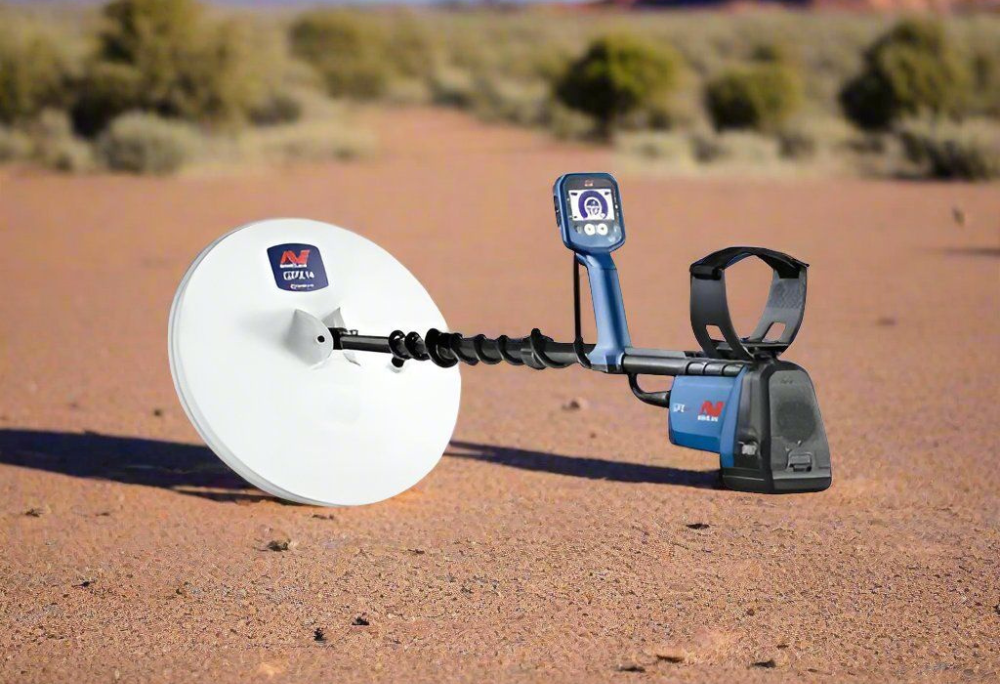
Choosing the right gold prospecting equipment can determine whether your field trip becomes a productive search or an expensive learning experience. Buyers in 2026 can choose from lightweight VLF gold detectors, advanced multi-frequency systems, pulse induction machines, different search coils, recovery tools, and essential safety accessories.
However, the most expensive detector is not automatically the best option for every prospector. Your ideal device depends on the expected gold size, soil mineralization, search location, experience level, and available budget. This commercial guide compares leading detector types and models to help you choose equipment that matches your actual prospecting conditions.
What This Keyword Means for Buyers
The term gold prospecting equipment refers to more than one metal detector. It describes the complete set of tools used to locate, identify, recover, and evaluate natural gold.
A practical prospecting setup may include:
- A dedicated gold prospecting detector
- One or more search coils
- Headphones or a wireless audio system
- A digging pick and recovery scoop
- A pinpointer for target recovery
- A gold pan or classifier
- Spare batteries or a portable charger
- Protective clothing and navigation tools
The detector remains the most important investment because it determines how effectively you can detect small nuggets, handle mineralized soil, and identify weak target responses.
Before comparing devices, decide whether your main goal is natural gold nuggets, buried treasure, coins, jewelry, or beach detecting. A specialized gold nugget detector may deliver excellent sensitivity to raw gold while offering fewer features for coins or saltwater beaches.
For a broader explanation of detector capability, buyers can also review Can You Use a Metal Detector to Find Gold? before selecting a machine.
To compare the most popular models before buying, explore our Best Gold Detector – Top 10 Ranked & Compared guide.
Top Detector Models to Consider
The following table compares several strong options for different types of buyers. Price categories are relative because final prices may change according to the country, included coils, shipping costs, taxes, and package contents.
| Detector Model | Technology | Best Use | Experience Level | Price Category |
|---|---|---|---|---|
| Minelab Gold Monster 1000 | 45 kHz VLF | Small nuggets and beginner prospecting | Beginner | Entry to Mid |
| Minelab Gold Monster 2000 | Multi-Au hybrid technology | Fine gold in mineralized ground | Beginner to Advanced | Upper Mid |
| Nokta Gold Finder 2000 | 61 kHz VLF | Small raw gold and simple operation | Beginner to Intermediate | Mid |
| Nokta Gold Kruzer | 61 kHz VLF | Tiny nuggets and wet environments | Intermediate | Mid |
| Garrett Axiom | Pulse Induction | Mineralized soil and deeper nuggets | Intermediate to Advanced | Premium |
| Minelab GPX 6000 | GeoSense-PI | Professional goldfields and difficult soil | Advanced | Premium |
| Nokta The Legend 2 | Simultaneous multi-frequency | Gold, coins, relics, and beaches | Intermediate | Mid |
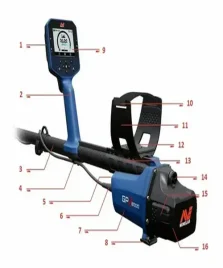
Minelab Gold Monster 1000
The Gold Monster 1000 is one of the most accessible dedicated gold detectors for beginners. It operates at 45 kHz and uses automatic ground balance, automatic noise cancellation, and adjustable sensitivity.
Its Gold Chance Indicator helps the user compare likely non-ferrous targets with iron or hot rocks. The detector weighs approximately 1.33 kg, while its small waterproof coil is suitable for searching narrow spaces and shallow bedrock cracks.
Best for: Beginners searching for small nuggets in moderately mineralized ground.
Main advantages:
- Simple automatic operation
- Strong sensitivity to small gold
- Lightweight construction
- Clear visual target guidance
- Two battery options
Possible disadvantages:
- Limited advanced manual control
- The control box is rain-resistant rather than fully submersible
- Pulse induction machines may perform more steadily in extremely mineralized soil
Buyers comparing this detector with a higher-frequency alternative should review Gold Monster 1000 vs Gold Finder 2000 Raw Gold Detector.
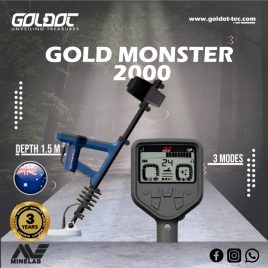
Minelab Gold Monster 2000
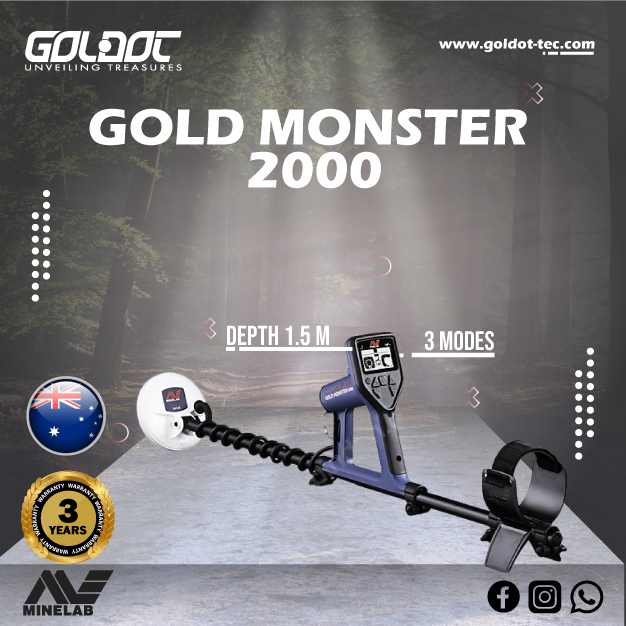
The Gold Monster 2000 is designed for buyers who want greater target information and improved ground handling without moving directly to a heavy professional PI system.
Its Multi-Au technology combines simultaneous multi-frequency sensitivity with a pulse-induction-based ground-handling engine. The model also includes automatic ground adjustment, manual Quick-Trak control, a Gold Chance Indicator, target identification, and Echo Wave audio.
The detector weighs about 1.25 kg, folds to a compact transport size, and uses a waterproof 5-inch search coil. The control box has an IP55 rainproof rating.
Best for: Fine gold, changing soil conditions, portable prospecting, and buyers seeking easier target interpretation.
Main advantages:
- High sensitivity to very small gold
- Lightweight carbon-fiber construction
- Automatic and manual ground adjustment
- Target ID and Gold Chance display
- Better handling of difficult ground than a basic VLF detector
Possible disadvantages:
- Higher cost than entry-level VLF machines
- Small standard coil covers less ground with each sweep
- Not intended as a general-purpose beach and coin detector
For a detailed model-focused analysis, read the Minelab Gold Monster 2000 Review – Still the King of Nuggets?
For a focused comparison of raw gold detectors, read The Ultimate Gold Nugget Metal Detector Showdown.
Nokta Gold Finder 2000
The Gold Finder 2000 is a 61 kHz detector created for straightforward raw-gold prospecting. It automatically manages ground balance and settings, allowing new users to begin detecting without navigating a complex menu.
The model also includes iron discrimination, a rainproof design, a retractable shaft, and wireless audio support.
Best for: Beginners who want high-frequency gold sensitivity with minimal setup.
Main advantages:
- Turn-on-and-go operation
- High-frequency sensitivity
- Wireless speaker support
- Iron discrimination
- Simple control system
Possible disadvantages:
- Fewer manual adjustments for advanced operators
- High-frequency VLF performance can become unstable in severe mineralization
- Less suitable for buyers wanting one detector for beaches, relics, and deep treasure
Nokta Gold Kruzer
The Gold Kruzer operates at 61 kHz and is designed to detect very small nuggets and micro jewelry. Its high frequency is especially useful when the main objective is locating fine pieces of gold that may produce weak signals.
Unlike many dedicated gold detectors, the Gold Kruzer offers a waterproof design, giving it additional value for shallow water, wet terrain, and demanding weather conditions.
Best for: Tiny nuggets, wet prospecting locations, exposed bedrock, and micro jewelry.
Main advantages:
- High sensitivity to tiny targets
- Waterproof construction
- Suitable for difficult ground and hot rocks
- Multiple settings for experienced operators
- Good value for specialist nugget hunting
Possible disadvantages:
- Requires more learning than fully automatic models
- May respond to very small metal trash
- High-frequency operation does not guarantee maximum depth on large targets
Garrett Axiom
Garrett Axiom is a pulse induction detector developed for serious gold prospecting. PI technology generally offers stronger stability in highly mineralized ground than conventional single-frequency VLF detectors.
The Axiom package can include different DD and mono coil options, wireless headphones, advanced ground handling, and multiple operating modes. Garrett positions it as its most powerful PI gold detector.
Best for: Difficult soil, professional fieldwork, larger nuggets, and prospectors upgrading from VLF technology.
Main advantages:
- Strong performance in mineralized ground
- Multiple coil configurations
- Suitable for small and larger gold
- Wireless audio
- Advanced ground and threshold controls
Possible disadvantages:
- Higher purchase price
- More controls to learn
- PI discrimination is usually less informative than target identification on multipurpose VLF detectors
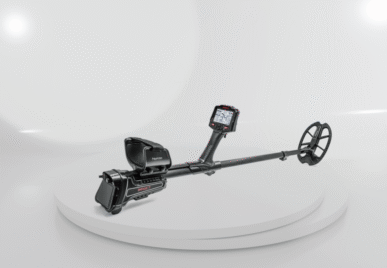
Minelab GPX 6000
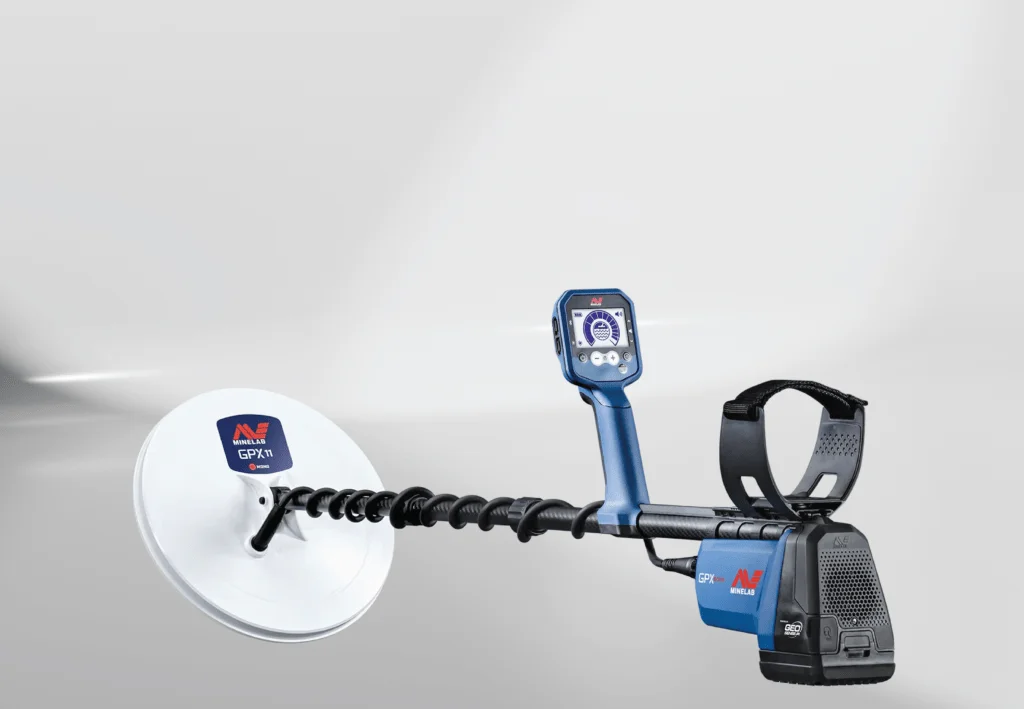
The GPX 6000 is a premium professional detector using GeoSense-PI technology. The system analyzes target and ground signals continuously to reduce soil noise and maintain a stable threshold in difficult goldfields.
It is designed to respond to small sub-gram pieces as well as larger and deeper nuggets. The detector weighs approximately 2.1 kg, includes automatic ground balance and noise cancellation, and supports coils designed for fine gold, salty ground, and larger targets.
Best for: Experienced prospectors, highly mineralized goldfields, extended field searches, and professional operations.
Main advantages:
- Advanced pulse induction performance
- Excellent stability in difficult soil
- Automatic operation reduces setup time
- Multiple coil choices
- Strong sensitivity across different nugget sizes
Possible disadvantages:
- Premium investment
- Limited target discrimination compared with coin detectors
- More performance than an occasional hobby user may require
Buyers comparing premium machines with more affordable options can use The Ultimate Gold Nugget Metal Detector Showdown as an additional internal resource.
To understand the practical differences between both devices, check Gold Monster 1000 vs Gold Finder 2000 raw gold detector.
Nokta The Legend 2
The Legend 2 is not exclusively a nugget detector, but it may be the better purchase for users who need one machine for several activities.
It uses simultaneous multi-frequency technology and includes modes for fields, parks, beaches, relics, and natural gold. It is also fully submersible to approximately five meters, making it more suitable for water and beach detecting than most dedicated nugget machines.
Best for: Gold prospecting, coins, jewelry, relics, beaches, and buyers who need one versatile detector.
Main advantages:
- Multiple search applications
- Suitable for saltwater beaches
- Waterproof design
- Target identification and discrimination
- Better versatility for hobby detectorists
Possible disadvantages:
- A dedicated high-frequency gold detector may be more sensitive to extremely fine nuggets
- More modes and settings require practice
- Not a replacement for a premium PI detector in severe mineralization
Key Features and Technologies
Understanding detector technology is more important than choosing a machine based only on marketing claims.
VLF Gold Detectors
Very Low Frequency detectors are popular because they are usually lightweight, affordable, responsive, and capable of providing useful discrimination.
High-frequency VLF models are particularly sensitive to small nuggets. However, increasing frequency may also increase sensitivity to mineralized ground, hot rocks, and tiny metallic waste.
VLF equipment is generally suitable for:
- Beginners
- Small and shallow nuggets
- Bedrock cracks
- Areas containing metal trash
- Locations with mild or moderate mineralization
Pulse Induction Detectors
Pulse induction detectors transmit powerful pulses into the ground and analyze the returning signal. They are commonly chosen for difficult mineralized soil and locations where conventional VLF detectors become noisy.
PI systems are generally suitable for:
- Professional prospectors
- Mineralized goldfields
- Larger or deeper nuggets
- Salt-affected terrain
- Long-term serious use
The main trade-off is that PI target identification and discrimination may be less precise than those of multipurpose VLF detectors.
Multi-Frequency Technology
Simultaneous multi-frequency systems process more than one frequency to provide improved stability across different targets and ground conditions.
This technology can be a strong option for buyers who search for gold during one trip and coins, jewelry, or beach targets during another.
Ground Balance
Ground balance helps the detector ignore natural minerals in the soil. Without proper ground balance, mineralized ground can create false signals that sound similar to real targets.
Automatic ground balance is useful for beginners, while manual or tracking controls give experienced users greater control when soil conditions change quickly.
Search Coil Selection
A search coil changes the behavior of a detector.
| Coil Type | Main Benefit | Recommended Use |
|---|---|---|
| Small coil | Sensitivity and target separation | Tiny nuggets and narrow spaces |
| Medium coil | Balanced depth and coverage | General prospecting |
| Large coil | Wider coverage and larger-target depth | Open ground and larger nuggets |
| DD coil | Stability in mineralized soil | Difficult or variable ground |
| Mono coil | Strong sensitivity and depth potential | PI prospecting in suitable soil |
The largest coil is not always the best. A small coil can locate fine gold between rocks that a larger coil may miss.
Depth Performance and Accuracy
Detector depth is one of the most misunderstood parts of buying gold mining equipment.
No manufacturer or dealer can provide one guaranteed depth that applies to every target. Detection depth changes according to:
- Gold size and shape
- Target orientation
- Soil mineralization
- Ground moisture
- Search coil size
- Detector technology
- Sensitivity settings
- Electromagnetic interference
- Operator technique
A tiny flake may only be detectable close to the surface, while a larger nugget can produce a response from much deeper ground. Laboratory air tests also cannot fully represent performance in mineralized soil.
Buyers should therefore compare ground handling, coil compatibility, signal stability, and sensitivity rather than selecting a detector based on one advertised depth number.
For a complete review of the device’s performance and features, read Minelab Gold Monster 2000 Review – Still the King of Nuggets?
Best Uses: Gold, Treasure, Coins, Beach
Different targets require different detector features.
Natural Gold Prospecting
Choose a dedicated high-frequency VLF or pulse induction detector. Important features include ground balance, small-target sensitivity, threshold stability, and suitable coil options.
Strong choices include:
- Gold Monster 1000
- Gold Monster 2000
- Gold Finder 2000
- Gold Kruzer
- Garrett Axiom
- GPX 6000
Treasure and Relic Searching
A detector with target ID, discrimination, different search modes, and medium-to-large coil options is usually more practical.
A specialized gold detector can find metallic treasure, but it may not provide enough information to separate valuable targets from common iron.
Coin and Jewelry Detecting
Choose a detector with numeric target identification, notch discrimination, pinpoint mode, and accurate responses in trashy locations.
Multipurpose models offer more value than dedicated nugget detectors for parks, farms, and historical sites.
Beach Detecting
Saltwater beaches can create severe ground responses. A simultaneous multi-frequency detector or suitable PI machine is usually preferable.
The detector must also have the correct waterproof rating. A waterproof coil does not mean the control box can be submerged.
Price Range and Value Comparison
Instead of buying according to price alone, compare the total package.
Entry-Level Equipment
Entry-level packages are appropriate for beginners, occasional users, and buyers exploring areas with relatively manageable soil.
They normally provide:
- Automatic ground balance
- Basic discrimination
- One or two coils
- Lightweight construction
- Simple audio and visual indicators
The Gold Monster 1000 is a common example of an accessible dedicated option.
Mid-Range Equipment
Mid-range detectors offer stronger processing, better target information, waterproofing, wireless audio, or more advanced ground controls.
Models such as the Gold Finder 2000, Gold Kruzer, Gold Monster 2000, and multipurpose simultaneous multi-frequency machines may fall into this category depending on the package and local market.
Premium Equipment
Premium equipment is designed for serious field use and difficult soil. The cost may include advanced pulse induction technology, professional coil options, stronger construction, and better mineralization handling.
Garrett Axiom and Minelab GPX 6000 are examples of machines intended for buyers who can benefit from premium field performance.
A professional detector is good value only when its capabilities match your search locations. Paying for advanced PI technology may not be necessary when your main activity is occasional coin hunting or beginner prospecting in mild soil.
Pros and Cons of Leading Options
| Buyer Priority | Recommended Type | Main Advantage | Main Limitation |
|---|---|---|---|
| Easy beginner operation | Automatic VLF | Fast setup and lower learning curve | Less control in complex ground |
| Detecting tiny nuggets | High-frequency VLF | Excellent sensitivity to fine gold | Can react strongly to minerals |
| Highly mineralized soil | Pulse induction | Stable operation and depth potential | Higher cost and weaker discrimination |
| Gold, coins, and beaches | Multi-frequency detector | Versatile search modes | Less specialized than a dedicated gold machine |
| Professional prospecting | Premium PI system | Strong all-round goldfield performance | Significant investment |
| Wet locations | Fully waterproof detector | Safer operation near water | Waterproof rating varies by component |
For a wider ranked comparison before purchasing, review Best Gold Detector – Top 10 Ranked & Compared.
How to Choose the Right Device
A successful purchase begins with the search location rather than the detector brand.
Define Your Primary Target
Decide whether you are searching mainly for tiny natural nuggets, larger gold, buried treasure, coins, or jewelry. A detector optimized for one target category may provide limited advantages in another.
Evaluate the Ground
Research whether the location has black sand, iron minerals, hot rocks, salt, or rapidly changing soil. Difficult ground may justify a pulse induction detector or a machine with advanced ground tracking.
Match the Detector to Your Experience
Beginners normally benefit from automatic ground balance and simple menus. Advanced operators may prefer manual threshold, sensitivity, recovery speed, and ground controls.
Compare the Complete Package
Confirm what is included in the advertised price:
- Search coils
- Headphones
- Batteries and chargers
- Carry bag
- Coil covers
- Warranty
- Training
- Shipping
- Technical support
A lower detector price may become less attractive after purchasing essential accessories separately.
Confirm Authenticity and Warranty
Purchase through a trusted supplier that provides a serial number, valid warranty, original accessories, and after-sales support.
Counterfeit or unofficially modified equipment may deliver unstable performance and may not qualify for manufacturer service.
Request a Current Quotation
Prices and available packages can change between countries. Request a quotation that clearly states the detector model, included accessories, warranty conditions, delivery cost, and expected delivery time.
Common Buying Mistakes to Avoid
One frequent mistake is selecting a detector only because it claims extreme depth. Depth claims without information about the target size, soil, and coil have little practical value.
Another mistake is purchasing a specialized nugget detector for beach jewelry or coin hunting. The detector may find the target, but a multipurpose model could offer better target ID and discrimination.
Buyers should also avoid:
- Ignoring local soil mineralization
- Assuming every part of the detector is waterproof
- Buying the largest available coil first
- Using maximum sensitivity in unstable ground
- Choosing a professional machine without learning its audio
- Purchasing from an unauthorized seller
- Forgetting the cost of batteries and accessories
- Expecting the detector to identify gold with absolute certainty
Even an advanced detector cannot confirm that every non-ferrous signal is gold. Careful recovery and target inspection remain essential.
To learn whether metal detectors can locate natural gold, visit CAN YOU USE A METAL DETECTOR TO FIND GOLD?
Final Recommendation
The best gold prospecting equipment is the equipment that fits your target, soil, experience, and expected frequency of use.
For a beginner focused mainly on small natural gold, the Gold Monster 1000 or Gold Finder 2000 offers simple operation and strong high-frequency sensitivity.
For buyers wanting improved target information and advanced handling of mineralized soil in a lightweight design, the Gold Monster 2000 is a strong upgrade.
The Gold Kruzer is suitable for users who value high-frequency sensitivity and waterproof construction, while The Legend 2 provides better overall value for people who want to search for gold, coins, relics, jewelry, and beach targets with one device.
For serious prospecting in difficult goldfields, Garrett Axiom and Minelab GPX 6000 provide the advantages of pulse induction technology. The GPX 6000 is especially appropriate for professional users who need stability across different nugget sizes and challenging soil.
Before ordering, compare the complete package and request professional advice based on the ground conditions in your country. A carefully matched detector can provide better long-term value than choosing equipment based only on price or advertised depth.
Frequently Asked Questions
What equipment do I need to start gold prospecting?
A beginner normally needs a suitable gold detector, headphones, a digging pick, a recovery scoop, spare power, protective equipment, and a gold pan for checking soil or concentrates.
Which detector is best for small gold nuggets?
High-frequency VLF detectors such as the Gold Monster series, Gold Finder 2000, and Gold Kruzer are designed to provide strong responses to small nuggets.
Is a pulse induction detector better for gold prospecting?
Pulse induction is often better in highly mineralized or salt-affected ground. However, a VLF detector may provide better discrimination, lower weight, and greater sensitivity to certain fine targets.
How deep can gold prospecting equipment detect?
There is no fixed depth. Performance depends on target size, soil mineralization, coil size, target orientation, settings, and detector technology.
Can one detector find gold, coins, and treasure?
Yes. A multipurpose detector can search for all three, but a dedicated gold detector may provide better sensitivity or ground handling in natural goldfields.
Are gold prospecting detectors waterproof?
Some models are fully waterproof, while others only have waterproof coils or rain-resistant control boxes. Always check the rating of each component before entering water.
Should I choose a large or small search coil?
Choose a small coil for tiny nuggets, narrow spaces, and target separation. Choose a larger coil for wider coverage and improved response to larger targets.
How can I avoid buying a counterfeit detector?
Purchase from a trusted supplier, verify the serial number, check the warranty, inspect the package contents, and avoid offers priced far below the normal market range.