


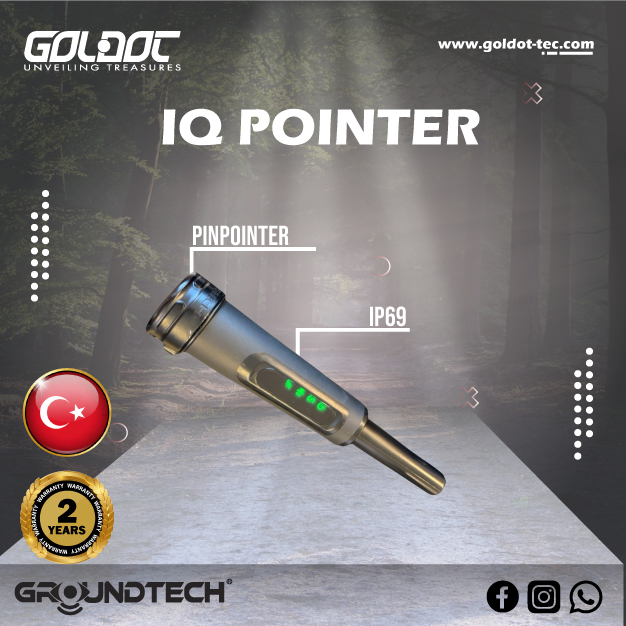
A Groundtech IQ Pointer depth test should help a buyer understand how the device behaves during actual target recovery, not create an unrealistic promise about a fixed number of centimeters or inches. The IQ Pointer is a close-range pinpointer designed to help locate gold, coins, relics, jewelry, and other metal targets after a primary detector has already identified the general search area. Goldot-Tec lists it for holes, soil, sand, rocks, and narrow spaces, making recovery performance more important than a headline maximum-depth figure.
For that reason, a useful test should compare air-test response, in-ground behavior, target size, target orientation, soil conditions, signal repeatability, and the speed with which the user can center the target. These are also the main factors emphasized in the testing framework provided for this article.
The most important point for a buyer is simple: there is no single guaranteed detection depth that applies to every coin, nugget, relic, soil type, or field condition. Target dimensions, metal composition, mineralization, moisture, orientation, surrounding metal, operating technique, and user experience can all change the practical recovery range.

What a Commercial Depth Test Should Prove
A commercial depth test should answer a practical question: Can the IQ Pointer repeatedly help you locate the type of targets you normally recover at close range?
That is different from trying to achieve the largest possible number in a controlled demonstration.
Goldot-Tec classifies the IQ Pointer as a close-range pinpointer, while its main purpose is precise target recovery after a conventional detector has found the general target location. The product page specifically positions it as a recovery support tool rather than a replacement for a primary metal detector.
Use Coins, Nuggets and Relic-Sized Test Pieces
A meaningful test should use targets related to the buyer’s actual detecting goals.
For coin hunting, test several common coin-sized metal objects.
For gold prospecting, include small pieces that reasonably represent the type of gold targets you expect to recover after your main gold detector has already produced a signal.
For relic hunting, include different shapes and sizes because irregular targets may respond differently from flat coins.
Jewelry can also be useful because rings, chains, and other objects present different dimensions and orientations.
Do not compare results from a large metal object with results from a tiny target and assume they represent the same recovery depth. A larger conductive target will normally create a different response from a very small piece of metal.
A good commercial test should therefore establish repeatability, practical centering, and recovery speed rather than advertise one universal maximum distance.
Separate Air-Test Results from In-Ground Performance
An air test is useful, but it should never be treated as a complete representation of field performance.
In an air test, there is no soil around the object. This removes several variables that can influence a detector or pinpointer in real conditions.
An in-ground test introduces soil composition, mineralization, moisture, target orientation, nearby metallic contamination, and the physical limitations of working inside a hole.
Keep Orientation and Burial Method Consistent
If you want to compare results fairly, control as many variables as possible.
Place the same target in the same orientation for each repeated test. If you test a coin flat during one pass and on edge during another, you are no longer measuring the same condition.
A simple evaluation can include:
- A controlled air test.
- The same target in neutral soil.
- A second test in more difficult ground.
- Several repeated passes.
- Different target orientations.
- Tests inside a hole and in removed soil.
The purpose is not to publish an impressive maximum figure. It is to find the point at which the response becomes consistent enough to guide recovery.
When you are ready to check the actual unit, specifications, and current buying options, you can view the IQ Pointer product and current package directly on Goldot-Tec before ordering.
This also prevents buyers from making decisions based on old videos, outdated package descriptions, or measurements made using different test targets.
Select Targets That Reflect Your Search Goals
Target selection can change the apparent result of a depth test dramatically.
A large metal object is not a fair benchmark for someone primarily recovering tiny targets. Likewise, testing only a very small object does not show how the pointer may respond to a larger coin or relic.
The IQ Pointer is listed for gold, coins, relics, and jewelry, so a balanced test should reflect those categories.
Record the First Reliable Response, Not a Flicker
One common mistake in detector demonstrations is counting the first weak or inconsistent reaction as the usable detection range.
That can make a test look impressive without telling the buyer whether the response is actually useful.
Instead, determine where the pointer produces a response that can be repeated.
For example:
- Approach the target slowly.
- Mark the first clear response.
- Move away.
- Approach again.
- Repeat from another direction.
- Confirm whether the same approximate position produces the response again.
If a reaction happens once and disappears during the next several passes, it should not be treated as reliable field performance.
For target recovery, repeatability is generally more valuable than an occasional response at a greater distance.
A detectorist trying to recover a small coin from loose soil needs a signal that can consistently guide them toward the object. A one-time flicker offers little practical value.
Measure Reach Across Contrasting Ground Conditions
Soil conditions are one of the biggest reasons buyers should be cautious about fixed depth claims.
Goldot-Tec’s own support material explains that detector performance is affected by factors including target size, target composition, soil mineralization, technology, settings, and user technique.
The same principle is important when evaluating close-range recovery equipment.
Test Dry Soil, Damp Sand and Mineralized Material
If those environments reflect where you normally detect, compare them separately.
Dry neutral soil can provide a useful baseline.
Damp soil changes the surrounding environment and may influence target response.
Sand introduces a different recovery problem because the target can move as material collapses or is removed.
Mineralized soil can make detector operation more challenging and should be included when it reflects your usual prospecting conditions.
Rocky terrain should be evaluated primarily for usability and target centering because the ability to reach into narrow cracks may matter more than maximum range.
The Groundtech IQ Pointer product page specifically identifies holes, soil, sand, rocks, and narrow spaces as operating areas.
A buyer who mainly searches beaches should therefore evaluate different conditions from a prospecting user working in rocky mineralized terrain.
This is why another user’s depth-test number should be treated as a reference point, not a performance guarantee.
Examine Sensitivity Without Creating False Signals
Maximum sensitivity does not automatically equal maximum useful performance.
A setting that makes the device unstable can slow recovery rather than improve it.
The objective is to obtain a clear, repeatable response while keeping unwanted or inconsistent signals under control.
Repeat Each Pass at Several Sensitivity Levels
Where the device and operating instructions allow sensitivity adjustment, use a controlled process rather than immediately choosing the strongest possible setting.
Begin with a stable configuration and test the same known target repeatedly.
If you increase sensitivity, check whether the additional response is actually reliable.
Ask:
- Does the pointer respond in approximately the same position each time?
- Does it remain quiet away from the target?
- Does nearby metal influence the result?
- Does performance change inside the actual hole?
- Can you identify the target center quickly?
A longer but unstable response may be less useful than a slightly shorter, highly repeatable response.
Testing should therefore focus on usable recovery range, not simply maximum signal distance.
If instability appears, move away from digging tools, the main detector coil, a vehicle, or other large metallic objects and repeat the test.
This is especially important because a pinpointer is often used in an environment full of potential nearby interference: shovels, hand tools, detector shafts, equipment, and metallic debris.
Compare Repeatable Detection with Target Centering
Depth alone does not determine whether a pinpointer is effective.
A pinpointer exists to narrow down the target location. If a device responds from slightly farther away but makes it difficult to identify where the object actually sits, the extra response range may not improve recovery.
Goldot-Tec describes the IQ Pointer as a tool for checking the bottom and sides of a hole, removed soil, rocky cracks, and narrow areas where a standard detector coil cannot easily operate.
Check Edge Detection Along Hole Walls
One useful field test is placing a known target against the side of a test hole rather than directly below the pointer.
Move the device through a repeatable sequence:
- Check the bottom.
- Move around the left wall.
- Check the right wall.
- Test the front and rear edges.
- Scan removed soil separately.
This reflects a real recovery problem. A target that appeared centered from the surface may actually sit in the sidewall after excavation begins.
Your performance measurement should therefore include how quickly you can narrow the target to a small area.
A good test asks:
How quickly did I locate the object?
not only:
How far away did the first signal appear?
If you want to see how the IQ Pointer sits among other recovery devices, compare Goldot pinpointers built for close-range recovery before making the final purchase decision. Goldot-Tec currently lists multiple pinpointer options in that category, so buyers are not limited to evaluating one device in isolation.
Translate Test Results into the Right Buying Decision
A depth test is only useful if it helps you decide whether the product fits your actual workflow.
Consider three buyer profiles.
Judge Recovery Speed Alongside Maximum Distance
Coin and relic hunters
These users may value rapid target centering and reduced risk of damaging a find. Goldot-Tec notes that precise recovery can help reduce unnecessary digging and accidental shovel damage.
Gold prospectors
A pinpointer may be useful during the final recovery stage after the main gold detector has identified the target area. It should not be confused with a primary gold detector designed to scan the wider ground.
Beginners
Beginners may benefit from a simple recovery tool because it makes the relationship between the original detector signal and the final target location easier to understand. Goldot-Tec lists the IQ Pointer for users from beginners through professionals.
However, if your main requirement is finding targets before digging, a pinpointer alone is not the correct purchase.
A full-size detector performs the initial search. The IQ Pointer performs close-range recovery.
That distinction should determine the buying decision more than any isolated depth-test number.
Understanding IQ Pointer Performance Versus Other Detector Technologies
The Groundtech IQ Pointer should not be evaluated against technologies designed for completely different jobs.
A buyer looking for deep underground exploration may accidentally compare pinpointer range with a VLF detector, PI detector, 3D ground scanner, GPR system, or long-range device. Those comparisons are misleading because the technologies have different purposes.
Do Not Compare Pinpointer Depth with VLF, PI, 3D, GPR or Long-Range Systems
VLF detectors are conventional primary metal detectors commonly used for coins, jewelry, relics, and certain gold-prospecting applications. They search a much wider area than a handheld recovery pointer.
Pulse Induction detectors use a different detection principle and are often selected for specialized detecting tasks, including certain mineralized-ground and gold-prospecting applications.
3D imaging or ground-scanning systems gather subsurface measurements and present data for interpretation. Their function is not equivalent to locating a small object inside freshly removed soil.
GPR systems use radar-based subsurface investigation methods and are designed for an entirely different class of underground analysis.
Long-range systems are intended for broad directional search applications according to the design of the particular system.
Goldot-Tec’s support center specifically separates VLF, Pulse Induction, 3D imaging, GPR-related underground technologies, and long-range systems into different technology and buying categories.
The IQ Pointer belongs in the close-range recovery category. That is the benchmark against which it should be evaluated.
Arrange a Demonstration or Expert Recommendation
For buyers who want more confidence than a video or article can provide, testing the device personally is much more useful.
Goldot-Tec states on the IQ Pointer product page that customers can test devices at its headquarters and that training and technical support are available. The site also lists a dedicated support center for product guidance, detector selection, troubleshooting, and buying assistance.
Verify Availability and Training Before Checkout
Before purchasing, prepare a few details for the support team:
- Your current primary detector.
- Your main target type.
- Typical terrain.
- Whether you are a beginner or experienced detectorist.
- The type of recovery problems you encounter.
- Whether you want to compare alternative pinpointers.
- Whether you need a demonstration or operating guidance.
You can then request detector testing and technical assistance from Goldot-Tec and ask for a recommendation that matches your actual field requirements.
This is particularly useful if you are trying to decide whether the IQ Pointer is enough for your workflow or whether your real need is a different primary detector technology.
A demonstration also allows you to conduct a more meaningful depth test using representative targets instead of relying exclusively on online results.
A Better Way to Interpret a Groundtech IQ Pointer Depth Test
When evaluating any test result, prioritize five things:
Repeatability: Does the target trigger a reliable response repeatedly?
Target relevance: Was the test object similar to what you normally search for?
Ground relevance: Was the test conducted in conditions comparable to your own terrain?
Centering ability: Could the user quickly identify the actual target location?
Recovery speed: Did the pointer reduce the amount of soil searching and unnecessary digging?
A test that performs well across these criteria is much more useful than an unsupported statement claiming a universal maximum depth.
Remember that the IQ Pointer’s role begins after your primary detector has already narrowed the search area. Goldot-Tec describes the main detector as the wide-area search device and the IQ Pointer as the precise close-range recovery tool.
That makes practical accuracy and repeatable target centering central to the buying decision.
Who Should Buy the Groundtech IQ Pointer?
The IQ Pointer is most relevant for detectorists who already have a primary detector and want a dedicated tool to make target recovery faster and more controlled.
It can be suitable for:
- Gold prospectors recovering targets after an initial detector signal.
- Coin hunters working in small plugs and holes.
- Relic hunters who want to reduce unnecessary digging.
- Jewelry hunters checking loose soil or sand.
- Users working around rocks, roots, cracks, and narrow spaces.
- Beginners who want a dedicated recovery tool.
- Experienced detectorists looking to improve recovery efficiency.
It is less suitable as a standalone solution for anyone expecting to walk across a large field and discover unknown targets without using a main detector.
If your requirement involves wide-area metal detection, significant depth exploration, subsurface imaging, or another specialized application, ask Goldot-Tec to compare the appropriate technologies before you buy.
Frequently Asked Questions
What is the maximum Groundtech IQ Pointer detection depth?
Goldot-Tec’s current IQ Pointer product information does not publish one universal guaranteed depth figure. A responsible depth evaluation should consider target size, material, orientation, soil conditions, mineralization, surrounding objects, and testing method. The useful figure is the repeatable close-range recovery response for your intended targets rather than an unsupported maximum number.
Is the Groundtech IQ Pointer suitable for gold recovery?
Yes, for the final close-range recovery stage. Goldot-Tec lists gold among its target applications and explains that the IQ Pointer can help locate small gold pieces after initial detection. It does not replace a primary gold detector used to search the wider area.
Can I test the IQ Pointer before buying?
Goldot-Tec states that devices can be tested at its Istanbul headquarters and that demonstrations, training, and technical assistance are available. Contact the company before visiting to confirm the current testing arrangements and device availability.
Test the IQ Pointer Properly Before You Order
A Groundtech IQ Pointer depth test should give you confidence in the device’s real recovery performance, not encourage you to buy based on an exaggerated depth figure.
Test multiple target sizes, separate air tests from in-ground tests, repeat every measurement, change ground conditions when relevant, and measure how quickly you can center the target. Most importantly, compare the results with the way you actually detect.
If you already use a primary detector and need a dedicated tool for checking holes, removed soil, sand, rocks, and narrow spaces, the IQ Pointer may fit naturally into your recovery workflow.
For the final buying decision, contact Goldot-Tec to confirm current availability, package details, training, warranty terms, and whether the IQ Pointer is the right recovery tool for your target type and terrain. You can also request a comparison with another pinpointer or detector technology before completing the order.