

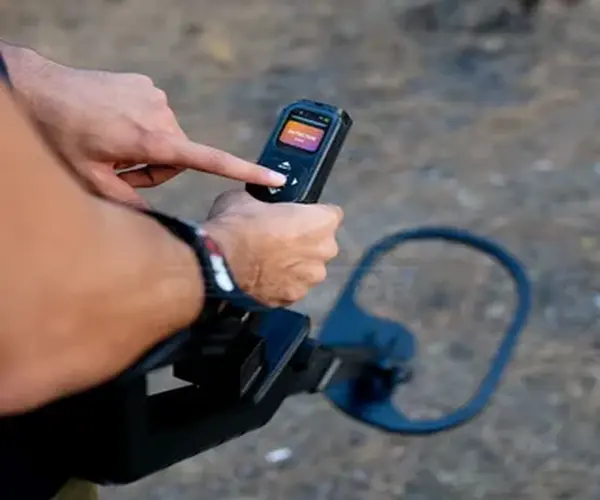
The right Lorenz Deepmax Z2 settings guide should help you create a stable detector first. Maximum sensitivity should never become your first goal.
The Lorenz DEEPMAX Z2 uses a professional pulse-based metal-detection system. Its setup can change with the coil, target size, soil and local interference.
A setting that works well on one field may perform poorly at another site.
Large frame coils also need a different approach from smaller search coils. A professional looking for large buried metal has different priorities from someone searching for smaller targets.
That makes tuning part of the buying decision.
Before you order the detector, think about the conditions where you will use it most. Consider target scale, mineralization, electromagnetic interference and available coil options.
Good settings should produce a stable response that you can understand.
They should not create constant noise in exchange for theoretical depth.
Results also depend on target size, target composition, soil, coil choice and operator technique. No control setting can guarantee a specific depth or discovery.
If you are evaluating the detector, review the Deepmax Z2 controls and purchase package before selecting your final configuration.
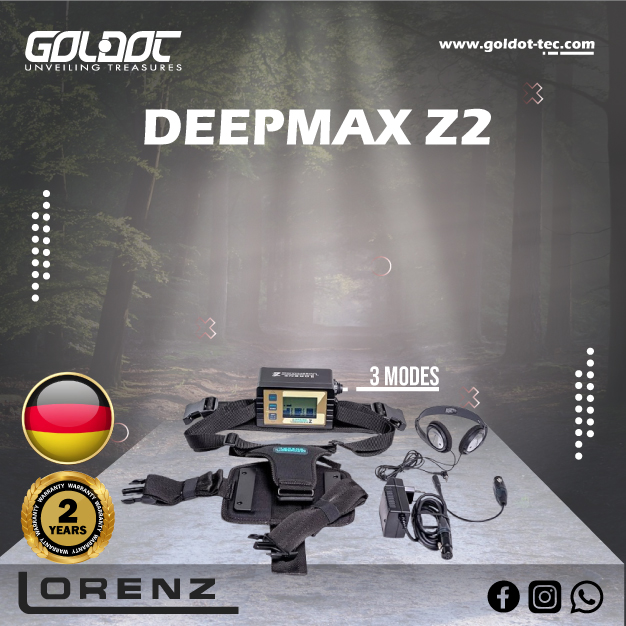
Build a Quiet Z2 Baseline Before Chasing Maximum Depth
Start every serious setup session with stability.
Do not immediately push sensitivity toward its highest level.
First, learn how the detector sounds over the current ground.
A quiet baseline gives you a reference. You can then judge whether each adjustment improves or damages performance.
Check the Search Environment First
Walk around the area before changing detector controls.
Look for possible interference sources such as:
- Power lines.
- Electrical equipment.
- Vehicles.
- Radio transmitters.
- Metal fences.
- Nearby detectors.
- Large surface metal.
- Underground infrastructure.
Move away from obvious EMI when possible.
Then assemble the detector with the coil you plan to use.
Do not tune one coil and assume the same response will apply to another.
Begin Below the Instability Threshold
Increase detector performance gradually.
Stop when background noise begins to interfere with target interpretation.
Then reduce the setting slightly.
This approach often gives you a more useful search profile than simply selecting the highest available sensitivity.
A stable detector helps you hear repeatable responses.
Constant chatter can hide weak signals instead.
Professional operators should value signal clarity over impressive control settings.
Select the Coil Before Finalizing Your Z2 Settings
Coil selection changes the detector’s search behavior.
For that reason, choose the coil before you spend time fine-tuning the detector.
The DEEPMAX Z2 supports several Lorenz coil configurations.
Small coils suit different targets from large frames.
Use Smaller Search Coils for Smaller Targets
Compact coils make sense when small and medium metallic objects matter.
They also offer easier handling around obstacles.
A smaller coil may suit:
- Small metallic targets.
- Gold nuggets.
- Coins.
- Restricted terrain.
- Areas with several nearby targets.
- Searches that require tighter location control.
Do not expect a small coil to behave like a large frame.
Its strength comes from another search profile.
Use Frame Coils When Large Targets Drive the Search
Large frames shift the detector toward larger buried metal.
They also cover more ground during each search pass.
This configuration can suit:
- Large metallic objects.
- Deep-object investigation.
- Open ground.
- Professional large-target searches.
- Areas where tiny surface objects create unwanted distractions.
Larger loops can reduce sensitivity to very small objects.
That trade-off can help when large targets form your main objective.
Choose the coil that matches your real target.
Then build the detector settings around that coil.
Adjust Sensitivity for Stability, Not for a Headline Number
Sensitivity has a direct effect on the way the detector reacts.
Too little sensitivity may weaken useful responses.
Too much can create instability.
The correct level sits between those extremes.
Raise Sensitivity in Small Steps
Start from a stable setting.
Increase sensitivity gradually.
After each change, listen to the background response.
Ask:
- Did the detector become noisy?
- Did ground response increase?
- Did EMI become stronger?
- Did the known test target improve?
- Can I still identify a repeatable signal?
If extra sensitivity only produces noise, reduce it again.
That setting offers little practical value.
Adjust Around Soil Conditions
Different ground can require different sensitivity.
Highly mineralized terrain may demand a more conservative setup.
Mild ground may allow stronger settings.
Wet or conductive soil can also change detector behavior.
Do not use one sensitivity level across every location.
Test the actual ground.
Then select the highest useful setting that keeps the detector understandable.
This approach supports professional search work better than chasing maximum gain.
Use Delay and Response Controls With a Clear Target Goal
Pulse-based detectors use timing and response behavior to manage the relationship between targets, ground and signal decay.
Do not copy one setup from another user’s video without understanding the target.
Your own coil and soil can require another approach.
Favor Faster Target Response When Smaller Objects Matter
Settings that preserve earlier target information can increase response to smaller objects.
However, difficult ground may also become more noticeable.
This creates a trade-off.
Small-target hunters often accept more ground sensitivity because tiny responses matter to them.
Large-object searches may need another balance.
Use More Ground-Rejecting Behavior When Stability Matters
A deeper large-target project may benefit from settings that reduce unwanted ground response.
This can improve field stability in difficult conditions.
However, stronger rejection may also reduce response to some small targets.
That result may be acceptable when small targets do not matter.
The buying lesson is important.
Do not judge the Z2 from one universal settings profile.
Its value comes from adjusting the detector around different coils, targets and ground conditions.
Configure Ground Compensation for Stable Search Passes
Ground response can mimic or hide metallic signals.
Mineralized soil creates one of the biggest challenges for serious metal detection.
The Z2 provides controls that help the operator manage ground effects.
Use them carefully.
Watch for Broad Ground Responses
A metallic target often produces a more localized response than a broad ground change.
However, field conditions vary.
Pay attention when the detector reacts across a large area.
Ask whether the response follows:
- A visible soil change.
- Highly mineralized ground.
- Wet soil.
- A geological boundary.
- A specific point beneath the coil.
Do not immediately identify every broad response as a large buried object.
Repeat the pass.
Then approach from another direction.
Change One Parameter at a Time
This rule matters more than any “perfect” setup.
Adjust one control.
Repeat the same search line.
Compare the result.
If the detector improves, keep the change.
If performance becomes worse, return to the earlier setting.
Changing several controls together makes troubleshooting difficult.
You may create a better response without knowing which adjustment helped.
A professional setup needs repeatable logic.
Set Audio to Preserve Faint Deep-Target Information
Audio gives the operator important information.
Do not treat volume as a depth control.
Higher volume only changes how loudly you hear the detector.
It does not create a stronger underground target.
Use a Comfortable Listening Level
Set the audio high enough to hear subtle changes.
Avoid an uncomfortable level that makes every background response distracting.
Headphones can help in windy or noisy environments.
They also make faint signal changes easier to compare.
The goal is clear audio.
You should hear:
- Stable background behavior.
- Repeatable target changes.
- Broad ground responses.
- Sharp interference.
- Differences between weak and strong signals.
Learning these patterns takes practice.
Training can shorten that learning process.
Compare Faint Signals From Opposite Directions
A weak response deserves another pass.
Turn and approach the same location from another direction.
Listen to the signal width.
Check whether the response appears over the same point.
A repeatable signal deserves more attention than one isolated sound.
Do not classify the target by audio alone.
The signal may indicate metal, but audio cannot guarantee gold or another specific material.
Control Electromagnetic Interference Before Increasing Power
EMI can make a powerful detector difficult to use.
This problem often appears near developed areas.
Electrical systems may create unstable or repeating noise.
Test Another Location Before Changing the Detector
Move several meters away when possible.
Check whether the noise changes.
If the detector becomes quiet, the original site may contain strong EMI.
Changing sensitivity can help, but location still matters.
You may also need a different coil configuration for demanding environments.
Lorenz offers specialist coils for some interference conditions.
Do not buy those accessories automatically.
Choose them when your normal sites justify them.
Do Not Mistake EMI for Deep Metal
Electrical interference can sound convincing.
Repeated electronic noise may lead inexperienced users toward false targets.
Check whether the signal moves with the detector.
Turn ninety degrees.
Walk away.
Return to the point.
A real underground response should remain linked to the target location.
Interference often behaves differently.
Learning this distinction can save hours of unnecessary searching.
Retune After Changing Coils or Search Locations
Do not assume that your previous settings remain ideal.
A new coil changes the detector response.
A new site changes the ground.
Both changes deserve another baseline test.
Save Separate Notes for Small Coils and Frame Coils
Field notes can save time.
Create a simple record for each common configuration.
Record:
- Coil type.
- Site conditions.
- Ground behavior.
- Sensitivity range that remained stable.
- Ground settings.
- Audio preference.
- EMI conditions.
- Test-target response.
- Any useful observations.
These notes give you a starting point on future searches.
They should not become fixed presets.
Always check the actual site.
Retune When Ground Conditions Change
You may not need to travel to another region before retuning.
One field can contain several soil types.
Mineralization may change over a short distance.
Moisture can vary too.
If detector behavior changes, stop and check the ground.
Do not automatically assume that the target density increased.
Rebuild a stable response when necessary.
Then continue searching.
Validate Every Z2 Setup With Known Test Objects
A known test target gives you a reference.
Use one during setup.
This simple step can show whether an adjustment actually improved detection.
Test Before and After Every Major Change
Choose a metallic test object that fits your search goal.
A tiny test target offers little value when your project focuses on very large buried objects.
Likewise, a massive metal object does not tell you much about small-target sensitivity.
Match the test to the intended search.
Run the detector over it before adjusting controls.
Make one change.
Then repeat the test.
Compare the response.
This method gives you real feedback instead of assumptions.
Use Cross-Sweeps on Suspected Targets
When you find a possible target, mark the location.
Approach it from another direction.
Try to determine:
- Whether the response repeats.
- Where the strongest point occurs.
- How wide the response sounds.
- Whether nearby ground behaves similarly.
- Whether the signal changes with direction.
- Whether EMI could explain the response.
Do not rely on one sweep.
Cross-checking improves confidence.
It still does not guarantee target identity or exact depth.
Tune Frame Coil Searches Differently From Small-Coil Work
Frame coils deserve their own workflow.
They target another search scale.
The operator must also manage the physical frame carefully.
Keep Sweep Height and Geometry Consistent
Maintain a stable frame position.
Avoid unnecessary tilting.
Keep movement controlled.
Large loops can respond differently when geometry changes during the pass.
Open terrain usually makes this easier.
Rocky or overgrown ground can complicate frame operation.
In difficult terrain, a smaller coil may produce more reliable practical results.
This should affect your purchasing decision.
A large frame offers little value if you cannot operate it consistently at your normal sites.
Focus on Broad Repeatable Responses
Frame-coil searches often target large metal.
Pay attention to signal width and repeatability.
Return from the opposite direction.
Then compare the response.
A large target may produce a wider detection zone than a compact object.
Ground changes can also create broad responses.
That is why cross-checking matters.
Do not excavate based on signal width alone.
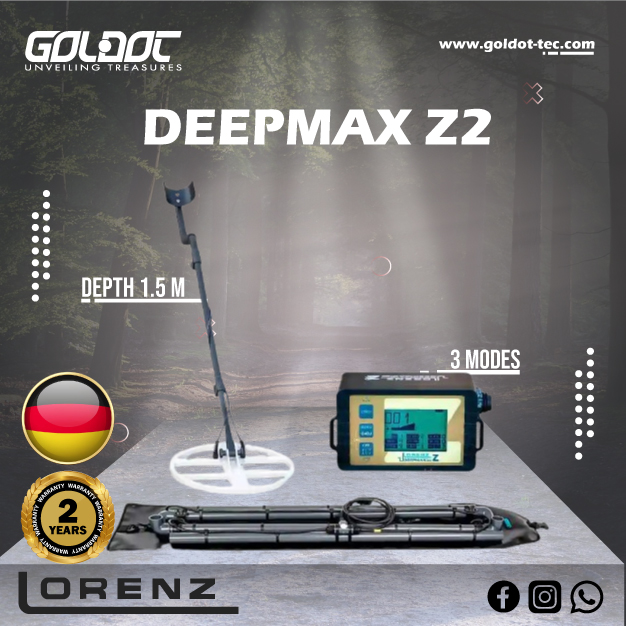
Understand What Z2 Settings Cannot Change
Good tuning improves detector performance.
It cannot change the basic technology.
The DEEPMAX Z2 remains a pulse-based metal detector.
Settings cannot turn it into a GPR or 3D ground scanner.
Z2 Versus VLF
VLF detectors often focus on coins, relics and small gold.
Many models also provide strong discrimination and target-separation tools.
The Z2 follows another approach.
Its pulse-based platform suits professional deep-metal work and challenging ground.
A VLF detector may suit you better when small-target separation drives the search.
Z2 Versus 3D Ground Imaging
3D scanners collect spatial sensor information.
Software then creates a visual representation.
Z2 data-logging options do not change its core detection technology.
Choose a dedicated imaging scanner when visual anomaly mapping forms the main goal.
Choose the Z2 when metal detection forms the main goal.
Z2 Versus GPR
GPR sends radar energy into the ground.
It measures reflected radar signals from underground changes.
The DEEPMAX Z2 detects metal through a pulse-based electromagnetic system.
It does not create a radargram.
Professional geological or structural radar work needs a true GPR platform.
Z2 Versus Long-Range Systems
Long-range systems use a different search strategy.
They aim to investigate broader areas from a distance.
The Z2 requires the coil or frame to move through the search area.
Do not compare these systems as if they perform the same job.
If you want to compare professional detector technologies, browse Goldot’s professional Lorenz detector range before selecting your package.
Decide Whether the Lorenz Z2 Fits Your Search Style
Settings knowledge can also tell you whether you should buy the detector.
The Z2 suits users who accept a professional tuning process.
It may fit your work when you need:
- Pulse-based metal detection.
- Large-target search capability.
- Several coil options.
- Frame-coil searching.
- Operation in mineralized ground.
- Adjustable field behavior.
- Professional search flexibility.
- Optional data-logging workflows.
A simpler detector may suit another user.
For example, a lightweight VLF detector may make more sense for casual coin hunting.
A 3D scanner may suit visual anomaly work better.
GPR becomes the stronger option when radar surveying drives the project.
Buy the technology that answers your real search question.
Receive Professional Z2 Setup Guidance From Goldot-Tec
Professional equipment delivers more value when users understand the controls.
Goldot-Tec can help buyers select a Z2 package around the intended field work.
Do not request “the strongest settings.”
Explain your search conditions instead.
Share Your Field Conditions Before Ordering
Tell the Goldot-Tec team about:
- Main target type.
- Expected target size.
- Typical terrain.
- Mineralization.
- Search-area dimensions.
- EMI conditions.
- Preferred coil.
- Need for frame searching.
- Previous PI experience.
- Need for data logging.
These details make setup advice more useful.
They also help you avoid unnecessary accessories.
Request a Setup Session With Your Chosen Package
A setup session can cover the coil you actually purchased.
That matters because small coils and frame coils do not share the same ideal field profile.
Ask for help with:
- Stable sensitivity.
- Ground-response control.
- Delay and response behavior.
- Audio interpretation.
- EMI diagnosis.
- Frame handling.
- Test-target validation.
- Retuning after site changes.
You can request technical setup support for demanding ground when you need assistance with your detector.
Contact Goldot-Tec before completing the order to confirm the current package, compatible coils, training options and availability.
Lorenz Deepmax Z2 Settings FAQs
Should I run Lorenz Deepmax Z2 sensitivity at the maximum setting?
No. Maximum sensitivity can create extra ground noise or EMI in some locations. Start with a stable detector. Increase sensitivity gradually and stop before instability begins to hide useful target signals. The best setting depends on the coil, ground and search objective.
Do I need different settings when I change from a small coil to a frame coil?
Yes. Coil size changes target response, coverage and sensitivity characteristics. Recheck the detector whenever you change coils. Build a new baseline and test the setup with a suitable target. Keep separate field notes for the configurations you use most.
Can the correct Z2 settings guarantee maximum depth or gold detection?
No. No settings profile can guarantee a specific detection depth or confirm gold before recovery. Results depend on target size, metal composition, ground mineralization, coil selection, EMI, detector configuration and operator technique. Use repeatable tests rather than relying on one depth claim.
Build a Stable Z2 Setup Before You Search for Maximum Performance
The best lesson from this Lorenz Deepmax Z2 settings guide is simple: start with stability before pushing for maximum performance.
Choose the correct coil first, establish a quiet baseline, and increase sensitivity gradually. Control the ground response before chasing faint signals, and pay close attention to the audio response.
When a target seems questionable, repeat the scan from another direction. Retune the detector whenever you change coils or move into significantly different soil conditions.
Most importantly, change one parameter at a time. This makes it easier to understand how each adjustment affects the detector and helps you identify the settings that work best for your specific ground.
The Z2 can support demanding professional metal detection work, but even advanced equipment requires the right field setup. Target size, soil mineralization, coil selection, and search conditions should all influence your adjustments.
Avoid copying another operator’s settings without testing them on your own ground. Likewise, do not choose the Z2 based on a single promised depth figure. Its pulse-based search technology, coil options, and field controls should match the type of work you actually perform.
For a more suitable setup, contact Goldot-Tec with details about your target type, terrain, and preferred coil configuration. Ask for a project-based Z2 recommendation, current package confirmation, and technical setup guidance.
Goldot-Tec can also help you compare Lorenz models or alternative detector technologies if the Z2 does not fully match your project requirements.