
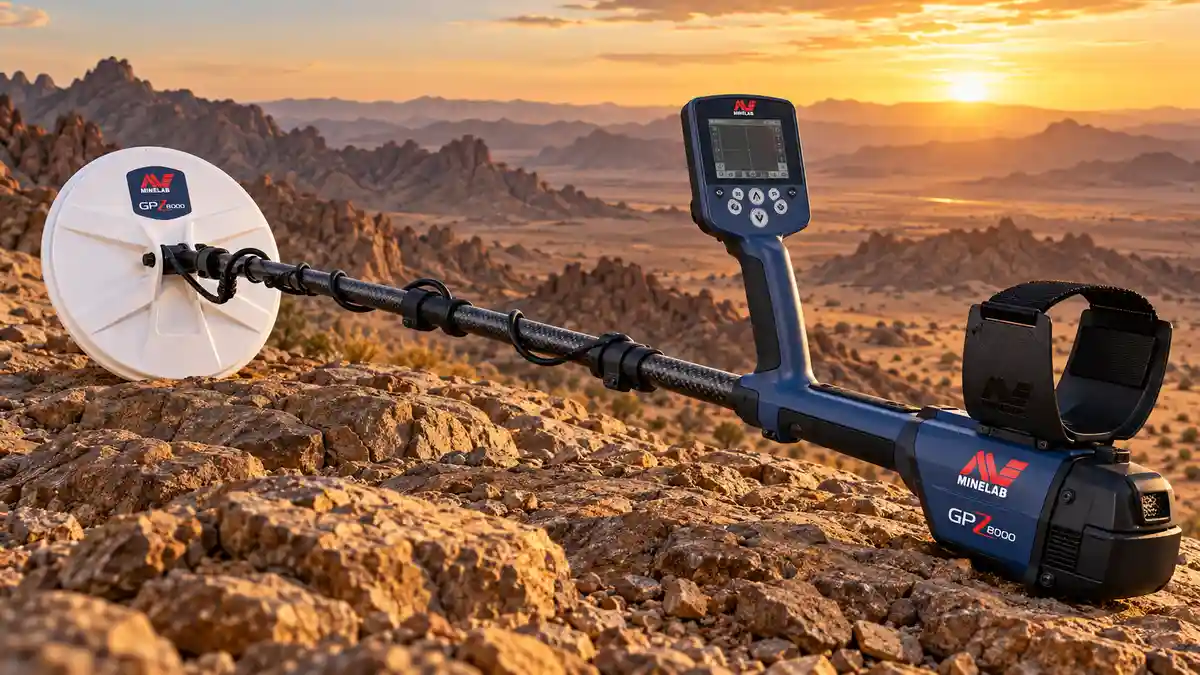
The Minelab GPZ 8000 is a specialist natural-gold detector for buyers who want to prepare a complete prospecting setup for US goldfields. Choosing the right package begins with the expected nugget size, mineralization, terrain, trip duration, and operator experience. These details determine whether the standard coil is sufficient and which power, audio, and carrying accessories you need.
The GPZ 8000 uses GeoZVT technology, Echo Sonic Pro audio, and Minelab’s Z-Set concentric toroidal coil system. It also provides different ground modes, adjustable sensitivity, and removable batteries. However, these features only become useful when the detector is configured for the conditions you expect to encounter.
For example, a permitted Nevada prospecting trip across open ground may prioritize broad search coverage. Meanwhile, an Alaska trip involving difficult access can make transport, battery planning, and equipment protection especially important.
This guide focuses on building your GPZ 8000 package rather than repeating a technical performance review or a separate quotation guide. It explains how to select the coil, prepare the detector, organize your field equipment, and confirm the exact configuration before purchasing.
Review the Minelab GPZ 8000 product configuration before requesting your Goldot-Tec package, and confirm which components are included in the current US offer.
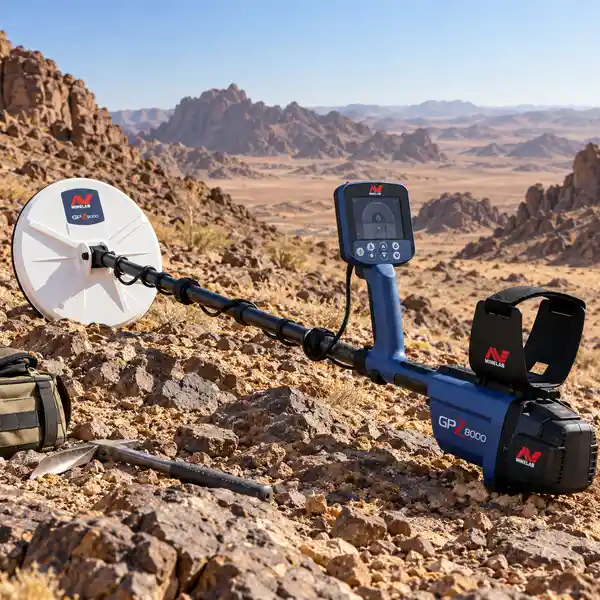
GPZ 8000 Setup for US Prospecting Plans
A useful GPZ 8000 setup starts before the detector reaches the goldfield.
First, identify the natural-gold targets you expect to search for. Next, describe the terrain and ground conditions. Then select the appropriate coil, power equipment, and supporting accessories.
This approach helps prevent a premium detector purchase from becoming an inconvenient field setup.
Define Your Primary Gold Target
Natural gold varies considerably in size, thickness, and shape.
Therefore, the word gold alone is not enough to describe your prospecting requirements.
Before requesting a package, identify whether you expect:
- Small natural-gold nuggets.
- A mixture of nugget sizes.
- Medium or larger natural-gold targets.
- Previously searched gold-bearing ground.
- Open prospecting areas.
- Vegetation-heavy or restricted terrain.
These details help determine which Z-Set coil should receive priority.
A buyer interested in smaller nuggets around rocks may require a different search footprint from someone covering wide ground where larger targets are the main concern.
However, a coil designed for one target range does not guarantee a discovery or a fixed detection depth.
Describe Your Normal Ground
The GPZ 8000 provides four manufacturer-documented search modes:
- Difficult.
- Difficult Deep.
- Normal Deep.
- Normal Extra Deep.
These modes address different ground and target-response priorities.
However, their names should not be treated as promises that one setting will always provide greater usable depth.
Mineralization, conductive soil, moisture, and electromagnetic interference can affect detector stability.
The correct operating mode should follow actual field conditions rather than a general assumption about a region.
For example, two Nevada sites may require different settings even when they are located within the same broad goldfield.
Match Experience to the Platform
The GPZ 8000 is designed for serious natural-gold prospecting.
Therefore, buyers should expect a learning period.
Automatic and Auto+ sensitivity settings can simplify part of the setup, while manual sensitivity and noise cancellation give experienced operators additional control.
However, adjusting several settings at once can make it difficult to identify the cause of an unstable response.
Start with a controlled configuration, learn the detector’s normal audio behavior, and change settings for a clear reason.
Professional equipment becomes more useful when the operator understands both its capabilities and its limitations.
Confirm the Correct Detector Category
GPZ 8000 is a specialist direct metal-detection platform using GeoZVT technology.
It should not be described as a conventional VLF detector, a GeoSense-PI machine, a 3D ground scanner, or Ground Penetrating Radar.
Its main purpose is natural-gold prospecting rather than locating empty cavities or producing structural underground images.
If your main target involves something other than natural gold, a different technology may be more appropriate.
After identifying your target and soil conditions, you can explore the specialist natural-gold detector range to confirm whether GPZ 8000 is the right category before finalizing the package.
Matching Coils to Target and Terrain
The GPZ 8000 coil system forms one of the most important parts of the buying decision.
Minelab provides three Z-Set concentric toroidal coils:
- Z13 — 13 inches.
- Z17 — 17 inches.
- Z18 — 18 inches.
Each coil serves a different combination of ground conditions, expected targets, coverage, and handling requirements.
Therefore, do not automatically assume that the largest coil creates the best prospecting setup.
Z13 for Restricted Terrain
The Z13 is designed for vegetation-heavy terrain and small-to-medium gold.
Its smaller footprint can make movement easier around obstacles.
For example, rocks, shrubs, uneven ground, and narrow search lanes may restrict the movement of a larger coil.
In these conditions, controlled coil placement can become particularly important.
The Z13 may also make extended searching more manageable when constant direction changes are necessary.
However, it covers a smaller area per sweep than the larger Z-Set options.
Choose this coil when its maneuverability and target priorities match your regular prospecting conditions.
Z17 for Conductive Ground and EMI
The Z17 measures 17 inches and is positioned by Minelab for conductive ground and locations with high electromagnetic interference.
It also targets small-to-medium gold.
Therefore, it deserves consideration when ground or interference conditions form a significant part of your prospecting plan.
The Z17 provides a different balance of coverage and operating priorities from Z13 and Z18.
However, buyers should not select it simply because its size falls between the other coils.
Explain the expected ground conditions to Goldot-Tec and confirm whether the Z17 addresses a real problem at your site.
Z18 for Open Ground and Coverage
The Z18 measures 18 inches and comes with Minelab’s published GPZ 8000 Single Coil Pack.
The manufacturer positions it around broad coverage, highly mineralized ground, and medium-to-large gold targets, with an emphasis on depth-oriented searching.
Therefore, it can suit open prospecting areas where there is enough space to control the coil.
However, the larger coil can become less convenient around dense vegetation, rocks, and narrow working areas.
Long sessions may also increase the importance of correctly adjusting the detector’s support equipment.
Buyers should evaluate their terrain before assuming that the supplied Z18 is ideal for every trip.
Z-Set Coil Selection Table
| Z-Set Coil | Suitable Terrain or Priority | Main Practical Advantage | Handling Limitation | Package Status |
|---|---|---|---|---|
| Z13 — 13 inches | Vegetation-heavy ground, confined spaces, small-to-medium gold | Easier maneuverability and controlled movement | Less coverage per sweep than larger coils | Optional unless explicitly included in the quote |
| Z17 — 17 inches | Conductive ground, high EMI, small-to-medium gold | Ground-specific configuration with broader coverage than Z13 | Larger footprint may be less convenient in restricted areas | Optional unless explicitly included in the quote |
| Z18 — 18 inches | Open ground, wide coverage, medium-to-large gold | Broad search coverage and depth-oriented application | Requires more operating space and careful handling | Included in Minelab’s published Single Coil Pack; confirm the dealer offer |
The table identifies manufacturer-intended applications rather than guaranteed detection performance.
Actual results still depend on target characteristics, soil conditions, detector settings, and operator technique.
Do You Need More Than One Coil?
A second coil can add useful flexibility.
However, it also adds equipment, transportation requirements, and package complexity.
Before requesting an additional coil, ask whether you regularly search locations where the standard Z18 does not provide the most practical handling or ground response.
For example, a prospector who frequently moves between open ground and dense vegetation may benefit from another Z-Set option.
Meanwhile, a buyer who mainly works spacious ground may prefer to learn the supplied Z18 first.
Do not assume that Z13 and Z17 come with every GPZ 8000 offer.
Ask Goldot-Tec whether the proposed package is the Single Coil Pack or another explicitly documented configuration.
Battery Planning Before a Prospecting Trip
Power preparation becomes especially important when prospecting far from convenient charging facilities.
Minelab’s published GPZ 8000 Single Coil Pack includes two removable lithium-ion batteries.
Each battery is rated at 7.2 V and 46 Wh.
The manufacturer describes the system as suitable for all-day detecting with its two-battery arrangement.
However, actual runtime depends on operating conditions and equipment use.
Therefore, a reliable trip plan should not depend on one unsupported fixed runtime claim.
Step 1 — Charge Both Batteries
Before leaving home, fully charge both battery packs according to Minelab’s instructions.
Allow enough time to complete charging without rushing immediately before departure.
Inspect the battery housings and contacts for visible damage.
Damaged batteries should not be used until the issue has been properly assessed.
Step 2 — Test Both Batteries
Fit the first battery and confirm that the detector powers on normally.
Then repeat the check with the second battery.
This simple test can reveal a connection or power problem before you reach a remote location.
If an unexpected problem appears, resolve it before leaving.
Do not assume that a charged indicator alone confirms that every battery connection works correctly.
Step 3 — Confirm Charging Equipment
The manufacturer’s published package includes USB-C charging equipment, a universal AC charger, and a DC vehicle-charging arrangement.
However, US buyers should confirm the actual charging accessories supplied by Goldot-Tec.
For example, a multi-day trip with vehicle access may benefit from an appropriate DC charging setup.
A remote project without vehicle charging requires another power plan.
Use only compatible charging equipment and follow the manufacturer’s battery-handling instructions.
Step 4 — Plan Battery Rotation
Decide how the two batteries will be used during the trip.
A practical approach is to start with a fully charged battery and keep the second ready as a replacement.
If approved charging facilities are available, plan when charging can occur safely.
However, do not assume that both packs will provide identical runtime under every temperature or operating condition.
Step 5 — Protect Batteries During Transport
Extreme temperatures and physical damage can affect battery safety and performance.
Therefore, protect battery packs during transport.
Avoid unnecessary heat exposure, moisture entering charging contacts, and contact with metal objects that could damage electrical connections.
Use the manufacturer’s handling and storage guidance rather than improvising field-charging arrangements.
Step 6 — Recheck Power Before Departure
On the day of the trip, confirm that:
- Both batteries are charged and operational.
- The correct charger is packed.
- USB-C cables are present.
- Vehicle charging equipment is included when needed.
- Battery connections are clean and undamaged.
- The planned charging location is available.
- Equipment is stored safely for transport.
This preparation can prevent a remote field session from becoming an avoidable equipment problem.
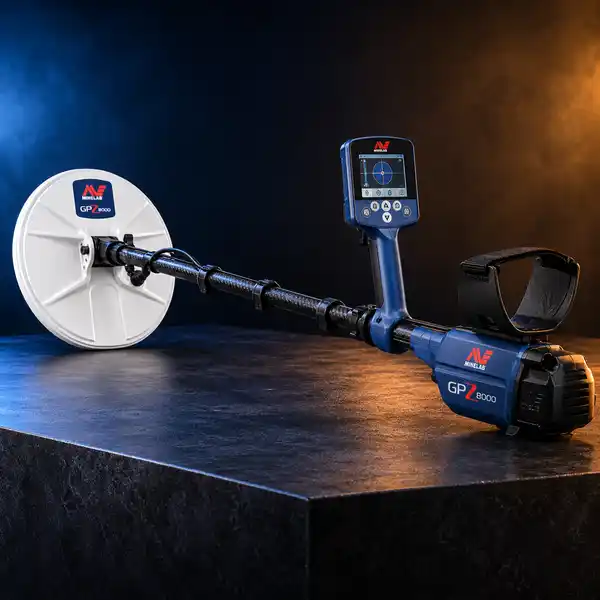
GPZ 8000 Operating Limits
Premium prospecting equipment still has environmental limits.
These specifications should influence trip planning, especially when working in remote or changing conditions.
Operating Temperature
Minelab specifies an operating temperature range of -10°C to +50°C, approximately 14°F to 122°F.
This provides broad operating flexibility.
However, the range is an equipment specification, not a guarantee that prospecting is safe throughout those conditions.
High temperatures, severe cold, and environmental exposure can affect both the detector and its operator.
Therefore, plan field sessions around safe conditions rather than using the equipment limit as a target.
Storage Temperature
The published storage range is -20°C to +70°C, approximately -4°F to 158°F.
This should not be interpreted as a recommendation to store the detector at temperature extremes.
Controlled storage is preferable whenever practical.
Protect the control unit, batteries, and accessories from unnecessary environmental stress during travel.
Waterproof Limit
Minelab specifies the GPZ 8000 detector, coil, and WM14 module as waterproof to 1 meter for less than 30 minutes.
This is a limited immersion rating.
It does not make GPZ 8000 an unlimited underwater detector or a specialist deep-diving platform.
Do not intentionally exceed the manufacturer’s operating conditions.
If your normal prospecting requires prolonged or deeper immersion, consider equipment designed for that application.
Detection Depth Is Different
The water-protection specification is not a claim about underground gold-detection depth.
Actual target detection depends on:
- Gold size, shape, and orientation.
- Ground mineralization.
- Conductive soil and moisture.
- Coil configuration.
- Sensitivity and ground settings.
- Electromagnetic interference.
- Coil movement and operator experience.
No single detection-depth figure can represent every natural-gold target.
Therefore, select the coil and settings around the field conditions rather than relying on a universal performance promise.
Nevada Prospecting Trip Preparation
Nevada provides a useful example of why prospecting equipment should be configured for the actual site.
However, the state should not be treated as one uniform detecting environment.
Terrain, mineralization, vegetation, access, and mining claims can vary substantially.
Check the Site Before Selecting a Coil
A broad, relatively open area may favor the Z18 when coverage and medium-to-large gold priorities are important.
However, a site with dense vegetation or difficult obstacles may make the Z13 more convenient.
If conductive ground or electromagnetic interference becomes a persistent issue, Z17 may deserve consideration.
Therefore, choose the coil based on the site rather than simply selecting equipment because the trip takes place in Nevada.
A useful preparation note should identify:
- Estimated search-area size.
- Open or restricted terrain.
- Vegetation and rock coverage.
- Known mineralization.
- Possible electrical interference.
- Expected nugget-size priorities.
- Typical length of field sessions.
These details help Goldot-Tec recommend a configuration suited to the project.
Confirm Mining Claim Status
Access is another important part of the prospecting plan.
Before searching, check the land ownership, current mining-claim status, and applicable permissions.
A detector purchase does not create authorization to prospect on someone else’s claim or recover protected materials.
Use current official land-management and claim information when preparing the exact location.
This step should occur before finalizing the trip or equipment deployment.
Prepare for Long Open-Ground Sessions
Some Nevada prospecting trips may involve extensive walking.
In these conditions, ergonomic setup becomes important.
Minelab includes the PRO-SWING 125 Harness and GA10 Guide Arm in its published Single Coil Pack.
These components help distribute weight and support controlled coil movement.
However, they must be adjusted to the operator.
Before leaving, practice walking and sweeping with the complete setup.
The first long field session should not become an experiment in harness fitting.
Alaska Prospecting Preparation
Alaska creates a different hypothetical US preparation scenario.
Distance, transport, weather, site access, and available charging facilities can influence the equipment package.
Therefore, a buyer should plan the complete field system rather than only the detector.
Verify Land and Authorization
Alaska contains federal, state, private, and claimed land with different access rules.
Therefore, confirm the status of the exact intended location.
Some prospecting activities may require permission or additional authorization.
Do not assume that all publicly accessible land permits metal detecting or mineral recovery.
The correct equipment does not replace the need for lawful access.
Plan Equipment Transport
The GPZ 8000 weighs approximately 2.78 kg in the manufacturer’s specified operating configuration.
However, the complete field load can include much more:
- Two battery packs.
- Charging accessories.
- Headphones and WM14 module.
- Harness components.
- Digging and recovery tools.
- Protective clothing.
- Water and safety equipment.
- Optional coils and transport protection.
Therefore, transportation planning should use the total field load rather than the detector weight alone.
In remote locations, an unnecessary accessory can create additional carrying demands.
Choose equipment based on the expected work.
Prepare for Cold and Weather
Minelab specifies operation down to -10°C, but actual conditions vary significantly by location and season.
Therefore, check conditions for the specific trip.
Protect batteries and electronics during transport and allow for appropriate charging and storage conditions.
Also distinguish equipment capability from operator safety.
A detector may remain within its published range when the environment is unsuitable for prolonged human exposure.
Plan Both Batteries Strategically
Remote access can increase the importance of the supplied two-battery arrangement.
Charge and test both batteries before departure.
Then identify whether approved charging facilities will be available.
If vehicle charging forms part of the plan, check the actual charger and compatible connections before traveling.
For a remote trip without charging access, estimate your working schedule conservatively.
Do not assume that battery operation will be identical in every environment.
Ground Setting Preparation
The GPZ 8000 offers several ground-oriented settings.
However, new owners should not begin by changing multiple controls without a clear reason.
A structured setup method makes it easier to understand the detector.
Begin With Ground Observation
Start by assessing detector behavior at the actual site.
Listen for normal ground responses and changes caused by movement.
Observe whether the detector remains stable with the initial configuration.
If it operates consistently, unnecessary adjustments can make learning harder.
The goal is to understand the baseline before changing settings.
Use Sensitivity With Purpose
Minelab provides manual sensitivity levels from 1 to 10, along with Auto and Auto+.
Automatic settings may be useful during initial familiarization.
Experienced operators can use manual adjustment when ground or target-response conditions justify it.
However, maximum sensitivity is not automatically the most useful setting.
An unstable detector may make faint repeatable targets harder to evaluate.
Therefore, prioritize consistent operation.
Use Noise Cancel When Needed
The detector supports automatic and manual Noise Cancel.
Electromagnetic interference can vary between locations.
A setting that works in one area may not be suitable elsewhere.
Use noise cancellation when interference creates a genuine operating problem.
Then observe whether the adjustment improves stability.
Do not repeatedly change settings without evaluating their effects.
Learn the Ground Modes
The four documented search modes provide different operating priorities.
However, mode selection should be learned through manufacturer guidance and practical field experience.
Buyers should become familiar with the controls before depending on them during a remote trip.
Understanding how the detector behaves on known test targets and local ground is more useful than assuming a mode name predicts performance.
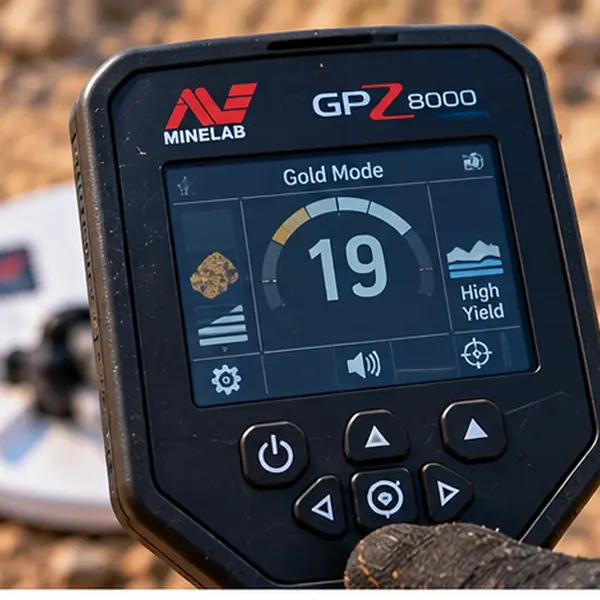
Echo Sonic Pro Audio Preparation
The GPZ 8000 uses Minelab’s Echo Sonic Pro audio system.
The manufacturer describes layered sound and enhanced stereo separation intended to help operators interpret target responses.
For the buyer, the key point is that audio forms part of the prospecting method.
Practice Before a Major Trip
Do not make a remote Nevada or Alaska trip your first opportunity to learn the detector’s audio behavior.
Instead, practice in a permitted location with known metallic test targets.
A useful familiarization routine includes:
- Set up the detector according to the manufacturer instructions.
- Listen to the normal operating threshold.
- Sweep over an appropriate known test target.
- Repeat the response from another direction.
- Observe how coil speed and height influence the signal.
- Compare the response with normal ground noise.
- Record which adjustments improve or reduce stability.
This exercise supports operator learning rather than producing a universal depth test.
Wired and Wireless Options
The manufacturer’s published package includes wired audiophile headphones and the WM14 low-latency wireless audio module.
These provide different listening arrangements.
However, buyers should confirm the exact audio equipment supplied with the Goldot-Tec order.
Test both options before departure.
This allows you to identify any connection or setup issues while technical assistance is easier to obtain.
Build Consistent Audio Habits
Subtle metallic responses may require careful attention.
Changing volume, sensitivity, and other settings repeatedly can make interpretation more difficult.
Therefore, practice with a stable setup and learn the sound of repeatable targets.
Audio should support a disciplined prospecting workflow rather than create unrealistic expectations of guaranteed gold identification.
Transport and Ergonomic Preparation
The detector’s working configuration includes more than its control unit.
For longer prospecting sessions, shaft adjustment, harness support, carrying equipment, and coil handling become important.
Adjust the Hybrid Shaft
Minelab uses a hybrid shaft construction combining carbon fiber and fiberglass.
The shaft design helps maintain alignment and reduce unwanted movement.
Before your first serious outing, adjust its length to the operator’s height and preferred stance.
Then test the coil movement over a representative surface.
The aim is a controlled sweep without unnecessary wrist or shoulder strain.
Set Up the PRO-SWING 125 Harness
The PRO-SWING 125 transfers part of the detector’s weight through the hips.
This can improve comfort during longer sessions.
However, correct adjustment is essential.
The manufacturer’s package includes hip-strut components and supporting hardware.
Use these components to establish a comfortable fit before traveling.
A poorly adjusted harness may reduce the benefit of the support system.
Test the GA10 Guide Arm
The GA10 Guide Arm supports controlled detector movement.
After fitting the harness and shaft, test how the guide arm works with the selected coil.
Make adjustments before beginning a long search.
A field day should focus on prospecting rather than learning how to assemble equipment.
Confirm Transport Protection
The complete setup should be protected during vehicle travel or other transportation.
Check whether a suitable carrying solution is already available.
If another protective case or bag is needed, confirm its compatibility before adding it to the package.
Transport accessories should serve the planned trip rather than simply increase the bundle size.
Package Contents to Confirm Before Buying
A US buyer should request the exact GPZ 8000 package in writing.
Do not assume that every product image represents the equipment included with an individual offer.
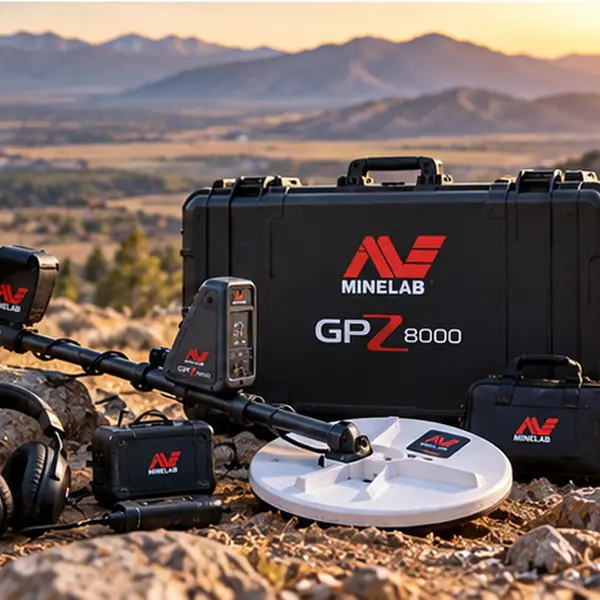
Minelab’s published Single Coil Pack provides a useful reference, but Goldot-Tec should confirm the actual configuration before payment.
Current Single Coil Pack Checklist
| Package Component | Manufacturer’s Published Single Coil Pack | Goldot-Tec Order Check |
|---|---|---|
| GPZ 8000 detector | Included | Confirm exact model and configuration |
| Z18 18-inch coil | Included | Confirm coil version |
| Z13 13-inch coil | Not listed in Single Coil Pack | Confirm separately if requested |
| Z17 17-inch coil | Not listed in Single Coil Pack | Confirm separately if requested |
| Rechargeable lithium-ion batteries | Two included | Confirm quantity and condition |
| PRO-SWING 125 Harness | Included | Confirm harness and fittings |
| Hip-strut components | Included | Confirm supplied lengths and sockets |
| Bungee equipment | Included | Confirm cord and hooks |
| GA10 Guide Arm | Included | Confirm full assembly |
| Wired audiophile headphones | Included | Confirm audio equipment |
| WM14 wireless audio module | Included | Confirm module and accessories |
| Universal USB-C AC charger | Included | Confirm charging equipment |
| USB-C charging cables | Included | Confirm required cables |
| USB-C DC car charger | Included | Confirm compatible vehicle-charging parts |
| Battery charging adaptor equipment | Included | Confirm exact components |
| Screen protector kit | Included | Confirm supplied protection |
The table distinguishes the manufacturer’s package reference from what must be confirmed in a dealer’s written offer.
Optional Coil Planning
Z13 and Z17 should be treated as additional coil options unless Goldot-Tec explicitly includes them in a particular configuration.
A buyer who wants all three Z-Set coils should ask for written confirmation of the complete bundle.
Do not assume the presence of optional coils from a general promotional description.
Also confirm availability and compatibility before ordering.
GPZ 7000 coils should not be assumed compatible with the GPZ 8000’s Z-Set system.
Warranty Confirmation
Minelab publishes a three-year warranty for the GPZ 8000 control box and coil, noting that regional coverage may vary.
Therefore, ask Goldot-Tec to confirm the terms applicable to your US order.
Battery coverage and accessory conditions should also be checked separately.
Request the supporting documentation and ask how service or technical assistance should be arranged if necessary.
Preserve Your Purchase Records
After delivery, retain:
- Purchase invoice.
- Detector serial information.
- Itemized package list.
- Warranty documentation.
- Delivery and shipping records.
- Applicable technical-support instructions.
These records can assist with future service requests and help verify what equipment was supplied.
GPZ 8000 Setup vs GPZ 8000 Review
The setup guide and technical review should answer different purchasing questions.
This page focuses on configuration, power preparation, coils, transport, and included equipment.
The review should help the buyer decide whether GPZ 8000 is technically suitable for the planned prospecting work.
Use This Guide for Package Preparation
This article is intended for buyers who need to decide:
- Which Z-Set coil matches the terrain.
- Whether the standard package is sufficient.
- How to prepare both batteries.
- Which charging accessories are needed.
- How to configure audio and ergonomic support.
- What equipment should be packed for Nevada or Alaska.
- Which components must be confirmed before ordering.
These are field-preparation and package-selection decisions.
Use the Review for Performance Assessment
If you still need to evaluate the detector’s capabilities, limitations, and suitability, read the detailed GPZ 8000 performance review.
That resource can help with the technical buying decision.
Once you decide the GPZ 8000 meets your prospecting needs, return to this guide to plan the complete setup.
This separation avoids repeating the same performance discussion across different articles.
Keep Upgrade Decisions Separate
Buyers who already own an older GPZ platform may have different questions involving technology, accessories, and operating preferences.
Those questions should be resolved before ordering a new package.
The correct sequence is to choose the detector, confirm its field role, and then select the necessary Z-Set equipment.
When Another Detector May Fit Better
GPZ 8000 is a specialist natural-gold detector.
Therefore, another system may offer more practical value for certain buyers.
General Coins and Jewelry
If your main searches involve parks, coins, modern jewelry, and recreational beaches, a conventional multi-frequency detector may offer more useful discrimination and target information.
GPZ 8000 should not be purchased as a universal detector simply because it is a professional gold platform.
Choose it when natural-gold prospecting is the central activity.
Simpler Gold Prospecting
Some buyers may prefer a lighter or more straightforward prospecting setup.
For example, those beginning nugget detecting may value automatic controls and less equipment to carry.
The correct decision depends on target size, soil conditions, search frequency, and experience.
A simpler model can be more practical when the specialist capabilities of GPZ 8000 are not necessary.
Different Professional Prospecting Platforms
Experienced buyers may also compare GPZ 8000 with professional PI equipment.
The GPX 6000 prospecting alternative uses GeoSense-PI technology, a different approach from GPZ 8000’s GeoZVT platform.
Therefore, the two detectors should be evaluated according to their technologies, coil configurations, ground handling, operator preferences, and complete field setups.
Do not compare them through a single universal depth claim.
A buyer already experienced with PI operation may prefer a familiar workflow, while another may specifically want the GPZ 8000’s Z-Set system.
Projects Involving Cavities or Structures
GPZ 8000 is not designed to provide professional three-dimensional maps of empty tunnels or cavities.
Those projects require a separate assessment of suitable scanning or geophysical methods.
Do not purchase a specialist gold detector for a nonmetallic investigation simply because the expected feature is deep underground.
Prepurchase GPZ 8000 Checklist
Before requesting your package, prepare a short prospecting specification.
The following numbered checklist helps Goldot-Tec understand what you need without repeating the full technical review.
- Define the natural-gold target. Explain whether small nuggets, mixed sizes, or medium-to-large gold form the main priority.
- Describe the prospecting ground. Include mineralization, conductive soil, expected electromagnetic interference, and any known changes between sites.
- Assess terrain and coverage. State whether you normally search open ground, dense vegetation, rocky locations, or narrow working areas.
- Choose the primary coil. Decide whether the supplied Z18 suits most searches or whether Z13 or Z17 solves a more important field requirement.
- Confirm optional coils. Request written confirmation if additional Z-Set coils are required, and do not assume they are included.
- Prepare the power system. Confirm both batteries, USB-C charging equipment, the AC charger, and vehicle-charging accessories where needed.
- Choose the audio setup. Check the wired headphones, WM14 wireless module, and your preferred field listening method.
- Review ergonomic equipment. Confirm the PRO-SWING 125 Harness, GA10 Guide Arm, hip-strut parts, and bungee hardware.
- Plan transport. Consider the complete field kit, carrying protection, trip duration, and charging access.
- Check operating limits. Review temperature, immersion restrictions, equipment care, and battery-handling instructions.
- Confirm site authorization. Check land access, mining claims, and applicable prospecting permissions for the exact Nevada, Alaska, or other US location.
- Verify the order. Request the current model, package contents, warranty terms, available support, and US delivery options in writing.
Completing this checklist provides a clearer basis for the purchase.
It also reduces the risk of ordering an accessory that does not serve a regular prospecting purpose.
Confirm the Package Before Requesting a Quote
Once the equipment requirements are clear, verify the proposed package with Goldot-Tec.
The written offer should distinguish the standard detector configuration from additional coils or accessories.
For a separate discussion of the quotation itself, review the GPZ 8000 package quotation factors.
This guide helps you decide what equipment to request, while the quotation guide helps you evaluate the terms of the proposed purchase.
Frequently Asked Questions
Which GPZ 8000 coil configuration should I choose for US prospecting?
Start with the intended terrain and target size. Minelab’s published Single Coil Pack includes Z18 for broad coverage and medium-to-large gold priorities. Z13 may suit vegetation-heavy ground and smaller targets, while Z17 is positioned for conductive ground and high EMI. Confirm optional coil availability and exact package contents with Goldot-Tec.
What equipment should I prepare before using the GPZ 8000 on a remote trip?
Charge and test both batteries, verify the required charging equipment, test wired and wireless audio, adjust the shaft and PRO-SWING harness, and become familiar with the search modes. Also check weather conditions, transport arrangements, and legal access to the exact prospecting location.
Should I request the standard package or additional accessories?
Choose the standard configuration when the included Z18 and supplied equipment suit most planned searches. Consider additional Z-Set coils only when they solve a recurring terrain or ground problem. Ask Goldot-Tec to confirm the actual detector, accessories, warranty, support, availability, and delivery arrangements before ordering.
Build Your Minelab GPZ 8000 US Prospecting Package
The Minelab GPZ 8000 should be configured around your prospecting plan rather than a generic list of premium features.
Start with the expected gold size and actual ground conditions.
Next, decide whether the supplied Z18 coil suits your normal terrain or whether the Z13 or Z17 provides a more practical additional configuration.
Then prepare the two-battery system, charging equipment, Echo Sonic Pro audio, and ergonomic support.
For Nevada prospecting, open-ground coverage and site access may influence the coil decision. For Alaska, transportation and reliable power planning may take greater priority.
However, neither state example guarantees a particular detecting result.
The practical value of the GPZ 8000 comes from matching its specialist capabilities to the target, ground, and operator.
Buying in the United States? Contact Goldot-Tec for Availability and request a Minelab GPZ 8000 package built around your prospecting plans. Share your target size, terrain, expected mineralization, preferred Z-Set coil, trip requirements, and delivery state. Ask the team to confirm the batteries, chargers, audio equipment, harness, optional accessories, warranty, and available shipping arrangements before completing your order.