

Anyone searching for okm exp 7000 professional plus reviews usually wants more than a specification sheet. The real question is whether this professional ground-scanning platform fits a serious survey workflow, how difficult it is to operate consistently, and whether its specialist modes provide useful information for the underground project being planned.
Goldot-Tec presents the OKM eXp 7000 Professional Plus as a German system combining 3D ground scanning with VLF metal detection. Its documented setup includes the SuperSense X7 sensor system, an 8.4-inch touchscreen control unit, a Windows tablet running Visualizer 3D Studio, wireless data transfer, and eight operating modes.
This review focuses on field workflow, usability, interpretation, strengths, limitations, and buyer fit rather than treating one depth figure as proof of universal performance.
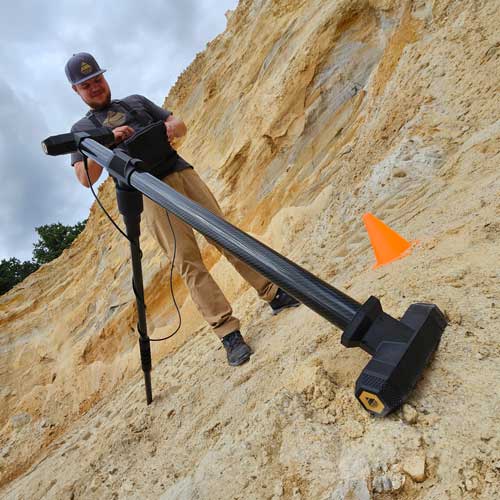
OKM EXP 7000 Professional Plus: Who It Is Built For
The strongest theme across okm exp 7000 professional plus reviews should be specialization. This is not primarily a fast recreational coin detector. Goldot-Tec describes it as a professional exploration platform combining conventional VLF functions with imaging and survey modes.
It is most relevant to users working on:
- Professional treasure surveys
- Underground chambers and tunnels
- Large buried objects
- Archaeological investigation
- Natural-gold and mineralized zones
- Detailed pre-excavation mapping
Goldot’s own 2026 detector ranking similarly positions the eXp 7000 as highly capable but specialized, with more training and field discipline required than ordinary recreational detecting.
Understanding the Professional Scanning Workflow
A useful okm exp 7000 professional plus reviews article should explain how the system is used, not just list modes.
Goldot documents eight operating modes:
- 3D Ground Scan
- Magnetometer
- Mineral Scan
- Tunnel Scan
- Live Scan
- Pinpointer
- VLF Metal Detection
- 3D VLF Scan
These modes support different stages of a survey. Magnetometer mode can help identify ferrous contamination before a detailed scan. VLF Metal Detection is intended for relatively shallow conventional targets, while 3D Ground Scan is designed for structured subsurface imaging.
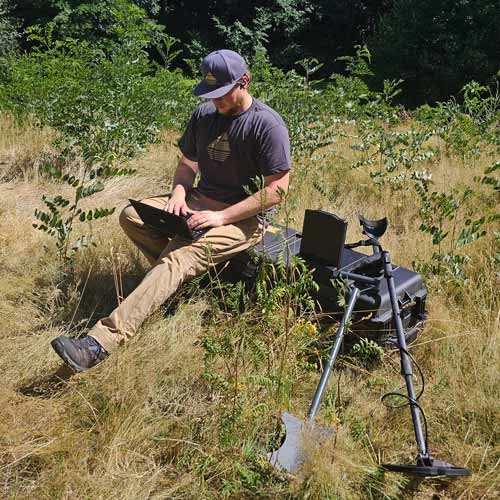
The SuperSense X7 is the central scanning sensor, and collected information can be displayed on the control unit and analyzed through the included Windows tablet.
Field Setup and Survey Preparation
Many okm exp 7000 professional plus reviews focus heavily on technology, but field preparation directly affects the usefulness of the resulting scan.
Before starting:
- Mark survey boundaries.
- Choose fixed reference points.
- Record scan direction.
- Note visible metal and underground utilities.
- Keep scan lanes consistent.
- Label every saved scan clearly.
A professional survey needs to be repeatable. If an anomaly is important enough to justify further investigation, the operator should be able to return to the same physical position and reproduce the scan.
Working With Scan Data and Visual Interpretation
Goldot-Tec lists Visualizer 3D Studio as part of the Professional Plus package. The software allows collected scan data to be reviewed as three-dimensional representations of underground anomalies.
For okm exp 7000 professional plus reviews, one distinction is essential: a 3D result is a processed visualization of sensor measurements, not an underground photograph.
The operator should ask:
- Does the anomaly remain in the same location during a repeat scan?
- Does it appear when scanning from another direction?
- Could nearby iron influence the result?
- Could mineralized soil create a similar response?
- Does another detection method confirm the suspected area?
Interpretation should follow measurement rather than replace it.
Detection Depth: Read the Published Figure in Context
Goldot publishes a maximum scanning depth of up to 25 meters under optimal conditions and describes the system for tunnels, cavities, large buried objects, and underground structures.
A responsible okm exp 7000 professional plus reviews guide should not convert that statement into “every target can be detected at 25 meters.”
A large cavity creates a fundamentally different sensor response from:
- A coin
- A small gold object
- A narrow metallic item
- A large buried container
- A tunnel or chamber
Soil composition, target dimensions, mineralization, scan technique, sensor choice, and operating mode can all affect results.
The better question is not simply “how deep can it detect?” but:
What target, under what ground conditions, produced that response?
That provides much more useful information for a professional buying decision.
Usability for Experienced Operators
The eXp 7000 uses a touchscreen interface, wireless data communication, Bluetooth audio, and a Windows tablet. Those features can simplify the physical control workflow, but ease of interface is not the same as ease of interpretation.
Experienced operators still need to learn:
- Building clean survey grids
- Selecting the appropriate mode
- Maintaining consistent sensor movement
- Recognizing weak or questionable anomalies
- Comparing repeated scans
- Reading Visualizer 3D results
- Knowing when secondary confirmation is necessary
This is why training should be considered part of the ownership workflow rather than an optional extra.
Goldot also states that product testing, training, and technical support are available for its detector customers.
Strengths in Structured Ground-Survey Projects
The strongest points found in okm exp 7000 professional plus reviews are most relevant to complex subsurface investigation.
Multiple Detection Methods
The system combines 3D scanning, VLF functions, Mineral Scan, Magnetometer, Tunnel Scan, Live Scan, and Pinpointer functions within one platform.
This reduces the need to approach every site using one identical scanning method.
Real-Time and Post-Scan Analysis
Live Scan provides immediate field feedback, while Visualizer 3D Studio supports more detailed review after the survey.
This can be useful when the operator wants to compare several scans rather than make a decision from one response.
Cavity and Tunnel Investigation
Tunnel Scan gives the system a purpose that ordinary coin detectors do not address. Goldot specifically documents this mode for voids such as tunnels, caves, bunkers, and chambers.
Natural-Gold Investigation
Mineral Scan is documented for gold prospecting and mineralized zones, giving the system a specialist workflow beyond buried-object searching.
Limitations Buyers Should Understand Before Ordering
A balanced okm exp 7000 professional plus reviews guide also needs to explain where the platform may be excessive.
Potential limitations include:
- More training than a conventional detector
- Greater setup and transport requirements
- Scan quality depends on operator consistency
- 3D results require interpretation
- Multiple components require charging and organization
- Not optimized for rapid recreational searching
Goldot’s own ranking notes that correct scan lines and controlled sensor movement are important and that the system may be unnecessary for ordinary coin hunting.
These limitations are not necessarily design flaws. They reflect the professional type of work the system is designed to perform.
Package, Training, and Support Considerations
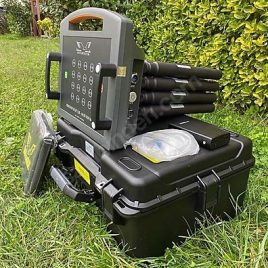
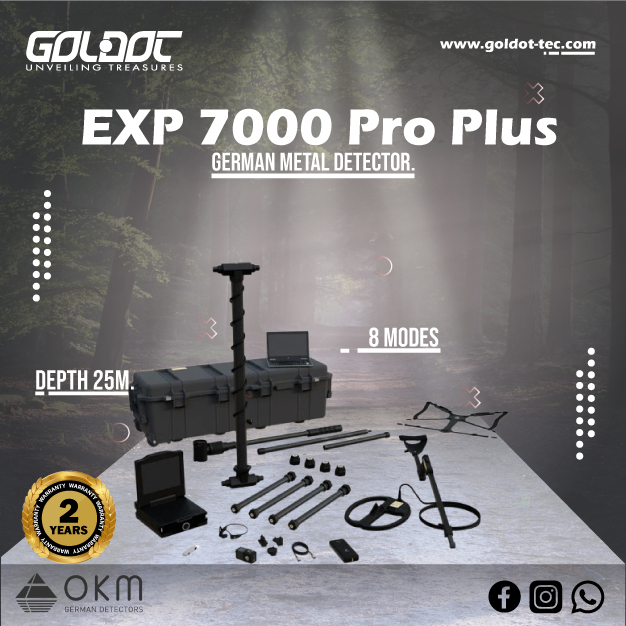
Goldot documents a Professional Plus package containing:
- eXp 7000 control unit
- Super Sensor
- Telescopic rod assembly
- Windows tablet
- Visualizer 3D Studio license
- Bluetooth headphones
- Rechargeable power pack and charger
- Travel adapter
- USB flash drive containing manuals
- Protective case
For okm exp 7000 professional plus reviews, package completeness matters because missing software, sensors, charging equipment, or tablet access can materially change how useful the system is in the field.
Before ordering, confirm the supplied components, software access, training arrangement, technical-support path, and warranty terms for the exact unit.
You can review the dedicated OKM EXP 7000 Professional Plus product information here: OKM EXP 7000 Professional Plus
EXP 7000 Professional Plus vs Simpler OKM Options
Goldot’s wider range includes Rover C4, Rover UC, Fusion Professional, eXp 5500, eXp 6000 Pro, and other specialist systems.
The eXp 7000 makes its strongest case when the buyer genuinely needs a combination of:
- 3D scanning
- VLF detection
- Mineral investigation
- Tunnel and cavity modes
- Live visualization
- Professional software analysis
A simpler scanner may be enough when the job mainly requires structured 3D imaging.
Likewise, a conventional detector is usually more practical when the real objective is coins, jewelry, or individual shallow metallic targets.
The broader product family can be reviewed through OKM metal detectors before choosing the most complex platform.
Final Review: Is It the Right Professional System?
The best conclusion for okm exp 7000 professional plus reviews is not that every professional needs this detector.
The eXp 7000 makes sense when a project benefits from multiple sensing workflows, detailed 3D visualization, cavity investigation, mineral scanning, and conventional VLF capability within one professional platform.
Its strongest advantage is versatility across structured underground projects.
Its biggest requirement is operator discipline.
Good results depend on:
- Clear survey planning
- Consistent movement
- Correct operating-mode selection
- Careful interpretation
- Repeat scanning
- Realistic expectations
If the search involves tunnels, cavities, large underground anomalies, mineralized gold zones, or detailed pre-excavation analysis, the eXp 7000 deserves serious consideration.
If the task is mainly fast recreational detecting, a simpler detector may offer a more efficient workflow.
Frequently Asked Questions
Is the OKM eXp 7000 Professional Plus suitable for beginners?
It can be learned, but Goldot positions it as a professional system. New operators should expect training in survey setup, mode selection, scan consistency, and software interpretation rather than only basic detector controls.
How many operating modes does the eXp 7000 have?
Goldot documents eight modes: 3D Ground Scan, Magnetometer, Mineral Scan, Tunnel Scan, Live Scan, Pinpointer, VLF Metal Detection, and 3D VLF Scan.
Does the eXp 7000 detect tunnels and cavities?
Yes. Goldot specifically documents Tunnel Scan for underground voids such as tunnels, caves, bunkers, chambers, and similar structures.
Is Visualizer 3D Studio included?
Goldot lists a Windows tablet and Visualizer 3D Studio license in the documented Professional Plus package.
Can it also perform conventional metal detection?
Yes. VLF Metal Detection is documented for near-surface metallic targets, while 3D VLF Scan adds visual mapping of shallow metallic targets.
Should important scan results be repeated?
Yes. A repeatable anomaly at the same physical location provides stronger evidence than one isolated scan. Important areas should be rescanned and, where appropriate, checked with another suitable detection method.
Conclusion
Across okm exp 7000 professional plus reviews, the most important takeaway is that the eXp 7000 is a professional survey platform rather than simply a deeper recreational detector.
Its eight operating modes, SuperSense X7 system, VLF capability, touchscreen control, wireless workflow, Windows tablet, and Visualizer 3D Studio create a broad toolkit for structured underground investigation.
The platform is strongest when the operator has a clear project, a controlled survey method, and enough training to separate measurement from interpretation. For tunnels, cavities, mineral zones, large anomalies, and complex pre-excavation work, its versatility is the main attraction. For simpler search goals, a more focused detector may provide an easier and faster workflow.