

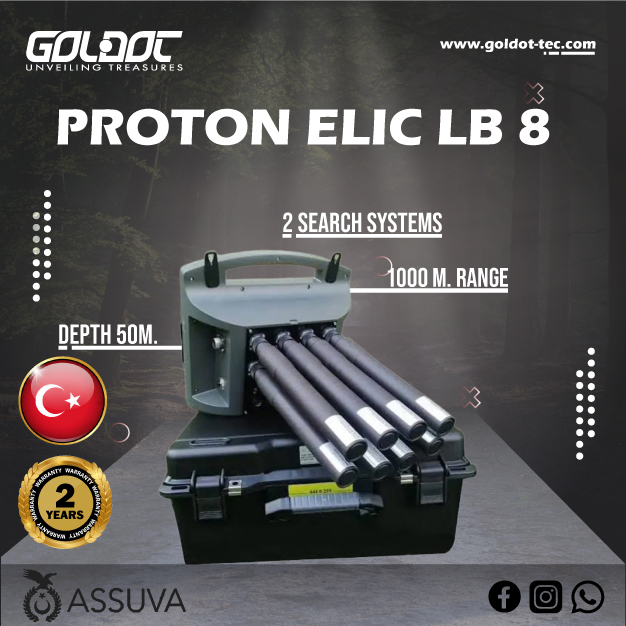
This proton elic lb 8 review examines the LB-8 as a professional underground investigation platform rather than a conventional coil-based metal detector. The system combines thermal sensing, magnetic-field measurement, visual LED indications, software-assisted analysis, and manufacturer-described 3D/4D presentation functions for investigating metallic anomalies, cavities, tunnels, and other underground features.
Goldot-Tec currently lists the Proton Elic LB 8 within its imaging, electromagnetic, and treasure-detection categories. The manufacturer, Assuva Savunma Sanayi, also continues to list Proton Elic LB-8 within its current product catalog.
However, one issue deserves attention from the beginning of any proton elic lb 8 review: current manufacturer documentation contains conflicting descriptions of the magnetic sensor count. One section describes an adaptive LB-8 with eight sensors, while another section on the same page states that the system uses four cesium magnetic multi-sensors together with a customized LiDAR and 64-pixel thermal sensor.
Buyers should therefore verify the exact hardware revision, serial number, sensor configuration, software version, and package before treating any online specification as universal for every LB-8.
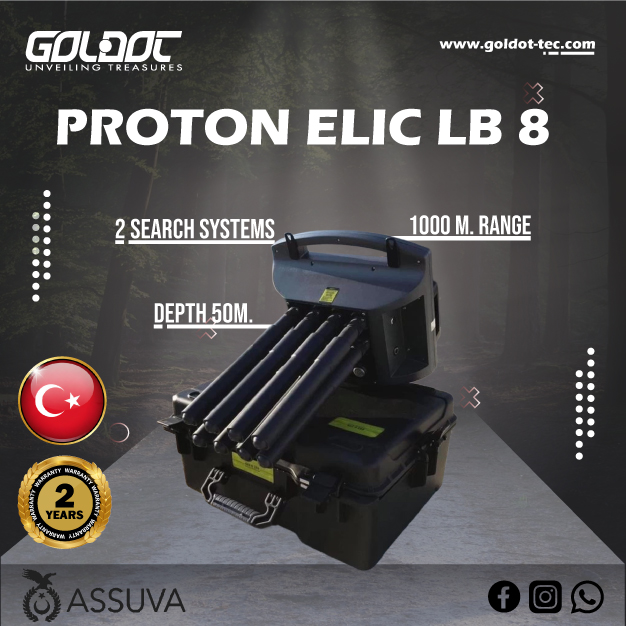
Proton Elic LB 8: Model Position and Intended User
The proton elic lb 8 review is most useful for buyers considering structured underground scanning rather than fast recreational coin hunting.
Assuva describes the LB-8 as a new-generation Proton Elic system for detecting or investigating:
- Metallic anomalies
- Cavities
- Tunnels
- Rooms and storage-like underground structures
- Buried metals
- Indoor or cave-related searches
The system combines magnetic measurements with a 64-pixel thermal imager and manufacturer-described software analysis.
This makes the LB-8 more relevant to:
- Professional treasure-search projects
- Underground anomaly investigations
- Archaeological-style surveys
- Larger buried structures
- Cave and tunnel-related searches
- Users comfortable interpreting sensor data
Someone mainly searching parks for coins, rings, and individual shallow targets would generally benefit more from a conventional detector.
Sensor Configuration Requires Verification
The biggest technical issue in this proton elic lb 8 review is the conflicting sensor documentation.
Assuva’s LB-8 page states that the adaptive model contains eight sensors and describes two LEDs for each sensor, giving sixteen LEDs in total. The same page later states that the LB-8 includes four cesium magnetic multi-sensors.
Because those descriptions do not align cleanly, a buyer should request a model-specific technical sheet for the exact unit being offered.
Before purchase, confirm:
| Specification | What to Verify |
|---|---|
| Exact version | LB-8 model year or hardware revision |
| Magnetic sensors | Physical number fitted to the unit |
| Thermal system | 64-pixel sensor |
| LiDAR | Confirm whether included on that revision |
| LED indicators | Number and layout |
| Software | Exact edition and version |
| Serial number | Matches invoice and hardware |
| PC requirements | Included or buyer supplied |
| Warranty | Product-specific written terms |
Do not accept a seller simply copying specifications from another Proton Elic generation.
Thermal Imaging System
The manufacturer documents a thermal system arranged as 4 rows × 16 columns, giving 64 pixels, with a 60-degree viewing angle.
A balanced proton elic lb 8 review should explain what that means carefully.
The thermal sensor does not create a photographic underground image. It measures thermal differences within its field of view and contributes information that the operator or software must interpret.
A thermal difference may deserve further investigation, but it should not automatically be labeled as:
- Gold
- A metal box
- A tunnel
- A treasure chamber
Environmental conditions can also create temperature differences.
Useful field notes therefore include:
- Time of day
- Sun exposure
- Soil moisture
- Recently disturbed ground
- Surface material
- Nearby structures
The manufacturer’s technical specifications also warn against direct sunlight exposure, which reinforces the importance of controlled operating conditions.
Magnetic Sensors and LED Feedback
Assuva describes the magnetic system as measuring DC magnetic-field strength at the sensor position.
The LB-8 uses visual LEDs to provide immediate feedback. The manufacturer’s current description says red illumination is associated with metallic targets while blue illumination is associated with cavities or tunnels.
This can help reduce constant reliance on a computer during preliminary field work.
However, color-coded feedback should be interpreted conservatively.
A red LED does not prove that the object is a specific valuable metal. Likewise, a blue response does not prove that a tunnel exists.
The useful question is whether the indication:
- Appears repeatedly.
- Remains connected to the same physical location.
- Survives a controlled rescan.
- Can be confirmed using another appropriate method.
Preparing a Clean Survey Area
A professional proton elic lb 8 review should include field technique because operator consistency can influence how useful the results become.
Before scanning:
- Define the survey boundaries.
- Choose a fixed starting point.
- Record nearby metal.
- Note vehicles, fencing, and electrical infrastructure.
- Observe soil and terrain changes.
- Reduce unnecessary metal carried near the active sensors.
- Check battery status.
- Confirm software or display connectivity where needed.
Do not randomly walk across the area and then try to reconstruct the location of an interesting response afterward.
Every suspicious anomaly should correspond to a known point in the search area.
Proton Elic LB 8 helps users explore advanced underground imaging and scanning capabilities for buried targets Proton Elic LB 8.
Keeping a Stable Scan Path
If the proton elic lb 8 review is being used to decide whether the system fits structured survey work, scan repeatability should be a major consideration.
Maintain:
- Similar device orientation
- Consistent walking direction
- Controlled movement
- Defined reference points
- Similar sensor position
When an interesting reading appears, mark the location and complete the original pass.
Then return and repeat it.
This is stronger than immediately turning toward the suspected target and changing the operating geometry.
Compare From Another Direction
Where the official operating procedure allows it, check the suspected zone from another direction.
The graphical result may not look identical, but a real physical anomaly should remain associated with approximately the same location.
Proton Elic Software and 3D/4D Workflow
Assuva describes proprietary software capable of manufacturer-described 3D and 4D presentation, with functions associated with metal discrimination, depth-related analysis, distance information, and DAT/GRID file conversion. The manufacturer also describes a customized LiDAR component intended to help calculate target position.
These are manufacturer-described functions and should not be interpreted as independently validated field accuracy.
A useful workflow is:
- Collect the initial sensor data.
- Label the project.
- Record field position and direction.
- Transfer or open the data in the appropriate software.
- Review the anomaly.
- Compare it with a repeat scan.
- Preserve the original files before applying extensive processing.
The proton elic lb 8 review should therefore treat software as an interpretation tool, not as a system that automatically proves target identity.
Computer Inclusion and Software Verification
One important buying question is whether a computer is included.
The manufacturer’s LB-8 description says the LED system can minimize PC use, implying that PC-based analysis is part of the wider workflow. However, the current manufacturer material retrieved does not clearly establish that every LB-8 package includes a computer.
Before ordering, confirm:
- Is a laptop or tablet included?
- Which operating system is required?
- Which Proton Elic software version is supplied?
- Is software activation permanent?
- Can the software move to another computer?
- Are updates included?
- Can DAT and GRID files be exported?
- Is remote software support available?
Do not judge package completeness from gallery photographs alone.
Interpreting Anomalies Conservatively
A strong proton elic lb 8 review should separate raw measurements from interpretation.
When software displays an unusual zone, ask:
- Does the anomaly repeat?
- Is it in the same position?
- Could surface metal influence it?
- Could soil mineralization contribute?
- Could thermal conditions explain it?
- Does another detector confirm the zone?
The objective is to narrow uncertainty gradually.
One colorful scan should not automatically lead to excavation.
Avoid Single-Scan Conclusions
A practical confirmation sequence is:
First scan → mark anomaly → repeat same direction → compare → scan from another direction → use secondary confirmation.
This process is more useful than selecting the most impressive image and ignoring contradictory scans.
Range and Depth Claims Need Context
Assuva publishes substantial maximum range and depth claims for the LB-8, but also associates them with good soil conditions and correct operation.
A responsible proton elic lb 8 review should not translate those figures into a guarantee for every target.
Actual response can vary according to:
- Target dimensions
- Target material
- Soil conditions
- Mineralization
- Orientation
- Environmental interference
- Operator technique
- Sensor mode
A large underground room cannot be compared directly with a small coin.
When a seller demonstrates depth performance, ask what the target was, how its depth was established, whether the operator knew its location, and whether the result can be repeated blind.
Field Usability and Operator Training
The LB-8 may look relatively straightforward when only the LED panel is considered, but professional use involves more than reading red and blue lights.
A new operator must learn:
- Sensor behavior
- Site preparation
- Magnetic interference
- Thermal conditions
- Stable movement
- Software operation
- File organization
- Repeat scanning
- Conservative interpretation
Goldot’s broader imaging category emphasizes training and 3D scan-analysis support for professional scanners.
Training should ideally include unknown or ambiguous targets rather than only demonstrations where everyone already knows what is underground.
Practical Strengths of the Proton Elic LB 8
Based on the documented system architecture, the main strengths relevant to this proton elic lb 8 review include:
- Combined thermal and magnetic sensing
- Immediate LED field feedback
- Manufacturer-described 3D/4D software
- Customized LiDAR documented by Assuva
- Indoor/cave search menu
- Ability to store and analyze scan-related data
- Position within the professional Proton Elic ecosystem
The combination can suit users who want more than a conventional audio detector.
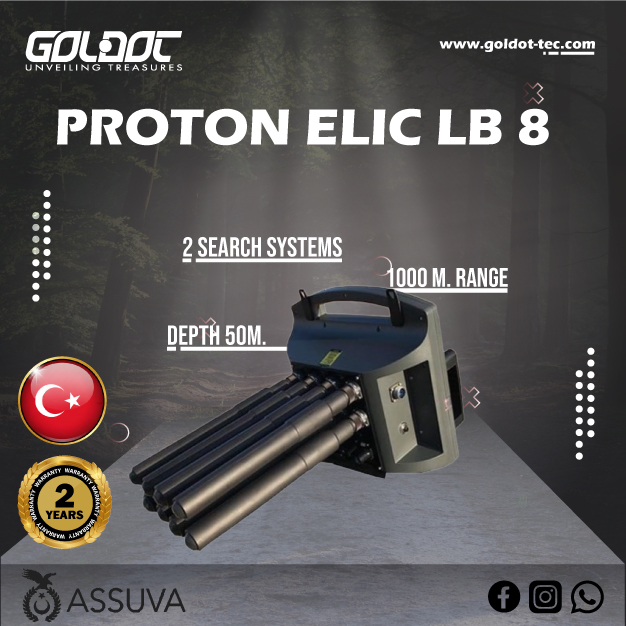
Limitations and Sources of Misreading
The LB-8 also has important limitations buyers should understand.
Documentation Inconsistency
The manufacturer currently gives conflicting sensor counts on the same product page. This is a strong reason to confirm the exact revision before payment.
Not Waterproof
Assuva’s technical specifications explicitly state that the LB-8 does not have water resistance.
That matters for wet environments and transport.
Environmental Effects
Thermal changes, nearby metal, magnetic interference, and ground conditions may complicate readings.
Interpretation Requirement
Software visualization does not remove the need for operator judgment.
Secondary Confirmation
Major excavation decisions should ideally use another appropriate method.
Proton Elic LB 8 vs LB 16
The proton elic lb 8 review becomes clearer when compared with the current LB-16 documentation.
| Area | Proton Elic LB-8 | Proton Elic LB-16 |
|---|---|---|
| Thermal system | 64-pixel, 4×16 | 64-pixel, 4×16 |
| Magnetic sensors | Manufacturer page contains conflicting 8 / 4 descriptions | Goldot documents 16 JEO PHASE sensors |
| LED feedback | Manufacturer describes 16 LEDs | Goldot documents 32 LEDs |
| LiDAR | Manufacturer documents customized LiDAR | Not listed as the central LB-16 sensor |
| Extra system | 3D/4D software workflow | Optional IF Doppler Radar |
| Connectivity | Software-based workflow | Bluetooth + PC analysis documented |
| Buyer priority | Verify exact hardware revision | Larger documented sensor array |
More sensors do not automatically make one model better for every project. The buyer should identify whether the additional sensing points or optional LB-16 functions solve a genuine field requirement.
Final Buyer Checklist
Before purchasing after reading a proton elic lb 8 review, confirm:
- Exact LB-8 revision
- Serial number
- Actual magnetic sensor count
- 64-pixel thermal system
- LiDAR inclusion
- LED configuration
- Software version
- Computer inclusion or requirements
- File export capability
- Battery and charger
- Carrying equipment
- User manual
- Training
- Warranty
- Repair contact
- Water-resistance limitations
- Secondary confirmation plan
Also confirm local rules before scanning or excavating archaeological, protected, or privately owned sites.
Frequently Asked Questions
Is Proton Elic LB-8 an 8-sensor scanner?
The manufacturer page currently contains conflicting wording. One section states that the adaptive LB-8 has eight sensors, while another describes four cesium magnetic multi-sensors. Verify the exact hardware revision before purchasing.
Does Proton Elic LB-8 use thermal imaging?
Yes. Assuva documents a 64-pixel thermal sensor arranged in four rows by sixteen columns with a 60-degree viewing angle.
Does LB-8 support 3D and 4D imaging?
Assuva describes proprietary software providing 3D/4D presentation together with analysis and file-conversion functions. These should be treated as manufacturer-described capabilities rather than guaranteed target-identification accuracy.
Is a computer included?
The current documentation reviewed describes PC/software use but does not clearly confirm that a computer is included in every package. Obtain a written package list from the seller.
Is Proton Elic LB-8 waterproof?
No. Assuva’s current technical specifications state that the system does not have water resistance.
Should LB-8 results be confirmed before excavation?
Yes. Repeat the scan under controlled conditions, approach suspicious areas from another direction where appropriate, and use another suitable detection method before making a significant excavation decision.
Conclusion
The main conclusion of this proton elic lb 8 review is that the LB-8 should be evaluated as a multi-sensor survey system whose usefulness depends heavily on hardware verification, operator consistency, software interpretation, and repeat scanning.
Its manufacturer documents a 64-pixel thermal system, magnetic sensing, visual LED feedback, customized LiDAR, and a dedicated 3D/4D software workflow. At the same time, the conflicting sensor-count descriptions make exact model verification especially important.
The LB-8 can make sense for structured underground investigation where thermal, magnetic, and software-assisted information are useful. It is less appropriate for buyers who expect a simple sweep-and-dig detector or who want one color-coded scan to prove a specific buried target.
For a stronger purchasing decision, verify the exact device, document the package and software, receive proper training, build repeatable scan procedures, and confirm important anomalies using an independent method.