The Klayzer Max 2D and KS Analysis KS 900 are sometimes placed in the same “top rated gold detectors” list. That hides the decision a buyer actually has to make. Klayzer Max 2D is a coil-based VLF metal detector with a live 2D signal display. KS 900 is a ground-penetrating radar (GPR) platform for structured subsurface surveys. They do not collect the same kind of data or answer the same question. This guide compares their workflows, limits and total package requirements so you can choose the method that fits your site.
A VLF coil detector responds to metallic targets as you sweep over the ground. Its visual display can help interpret the response, but a waveform is not a photograph of a buried object or a chemical test for gold. A GPR system transmits and records electromagnetic reflections along survey lines. Its radargram can reveal subsurface contrasts, but a reflected shape does not by itself prove that the feature is metal, a cavity or gold. Search depth and reliability depend on target size, soil conductivity, moisture, survey geometry and the operator. Neither product should be described as guaranteeing a particular treasure or a fixed detection depth.
The Klayzer Max 2D product page describes a VLF detector with a Double-D search coil, ground balance, iron rejection and a live 2D graph of the target signal. The manufacturer also describes audio, numeric target ID and color-based indications. In practical terms, you move the coil consistently over the ground, set ground balance for the site and investigate repeatable responses. The 2D graph supports interpretation of a coil response; it is not equivalent to a GPR map covering a plot.
Klayzer’s manufacturer states up to 3 m for suitable targets, with depth varying by target size. Treat that as a conditional manufacturer claim, not the expected depth for small natural gold. A gold ring, coin and large cache present very different targets. The maker says the search coil can be immersed to 1 m, but the control unit must remain dry. Confirm the exact coil and package with the seller before assuming waterproof operation beyond the coil.
Choose this class of detector when the main task is to find and recover metallic targets by direct sweeping. It is more natural for checking a known area and pinpointing a repeatable metal response than for mapping a broad subsurface profile. Ground mineralization can still challenge any VLF setup; test the device with known targets in similar soil before deciding that its discrimination or depth readout is sufficient for your site.
The KS Analysis KS 900 product listing presents it as a ground-penetrating radar. The operator collects data along planned survey lines, reviews the profiles and checks whether an anomaly repeats across adjacent passes. Radar interpretation requires more than looking for a colored shape: the survey needs a defined grid, consistent motion and an understanding of the local geology and moisture. Conductive ground can reduce penetration. A radar response may come from several types of subsurface contrast, and a suspected target needs independent confirmation.
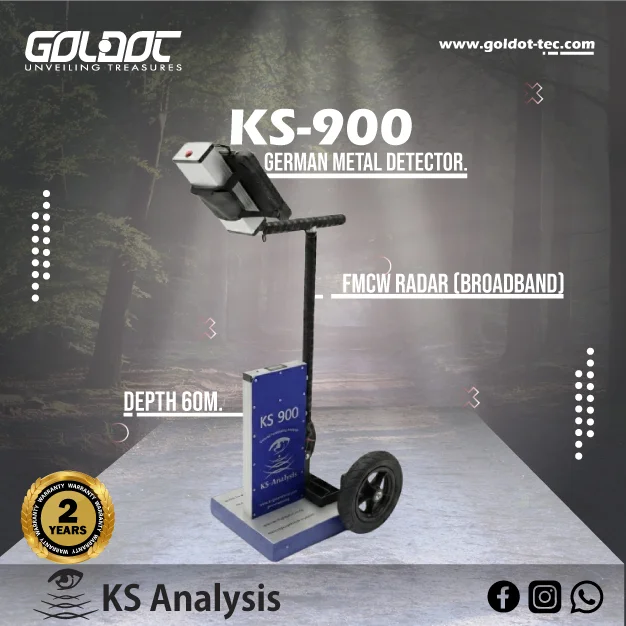
KS 900 is a stronger candidate when the question is where a buried structure, disturbed zone or other anomaly might lie across a planned site. It is not an entry-level long-range locator and should not be sold as a shortcut to identify gold from a distance. If you are considering it, review the KS 900 GPR review and our guide to reading KS 900 radar images before requesting a demonstration.
| Question | Klayzer Max 2D | KS 900 |
|---|---|---|
| Primary method | VLF metal detection with a search coil | Ground-penetrating radar survey |
| Primary output | Repeatable target response, audio/ID and live 2D signal graph | Radar profiles and interpreted subsurface anomalies |
| Best starting task | Direct search for metallic targets and recovery | Planned investigation of a site or buried structure |
| Typical operator work | Ground balance, controlled coil sweep and target checks | Survey grid, consistent data collection and profile interpretation |
| Meaning of an indication | A likely metal response that still requires recovery or confirmation | A contrast in subsurface data that may have several causes |
| Buyer needs to confirm | Coils, target tests, control-unit water protection and warranty | Antenna/sensor, software, training, data export and support |
Use a known metal target close to the size you expect to find. Test in representative soil at a documented burial depth, with an empty control location. Have an operator sweep at a consistent height and speed, then repeat after changing direction. Record signal stability, ID behavior and the displayed depth estimate. Test unwanted iron separately. Do not use one large surface target to prove performance on small buried gold.
Define a survey grid across a known feature and an empty control area. Collect parallel lines with consistent spacing and motion, then have the operator explain the radar profiles without being told the target location. Check whether the suspected anomaly repeats in neighboring lines and whether its interpretation agrees with an independent method. Ask to see raw and processed data, the software workflow and a written explanation of uncertainty. A single attractive image is not enough to establish a reliable result.
These devices have different costs because the equipment and operator work are different. Request a written quote for the exact edition, sensors or coils, batteries, software, training, shipping and warranty. Ask whether the seller will demonstrate the workflow on your type of site. Do not use an old “premium versus mid-range” label as a substitute for a current itemized price, and do not assume that either device will pay for itself through discoveries.
Choose Klayzer Max 2D if your job is direct metal detection and you can validate its response in your ground with representative targets. Choose KS 900 if your job is a structured radar survey and you have the training or support to interpret the collected data. Some professional projects may use both methods in sequence: a radar survey to identify a zone of interest and a coil detector to check for metal where appropriate. That workflow still needs permits, safe excavation planning and independent confirmation. For the technical difference between coil technologies, see our VLF versus PI guide.
No. Goldot lists it as a ground-penetrating radar. It is used for planned subsurface survey and interpretation, not the same directional workflow as a long-range locator.
Its live graph visualizes the detector response. It should not be read as a literal picture of the object or as proof that the metal is gold.
That cannot be answered from marketing ranges or a generic ranking. Test a representative small target in your ground. A coil-based detector is the more direct starting category for small metal targets; a GPR survey answers a different question.
No. Depth varies with target dimensions, ground, settings and method. Ask for a demonstration on a relevant target and keep the manufacturer’s conditions attached to any quoted figure.
Decision: Match the measurement method to the question. Request the current manual and package for each device, then judge the result from a controlled demonstration rather than unsupported “top-rated” claims.