

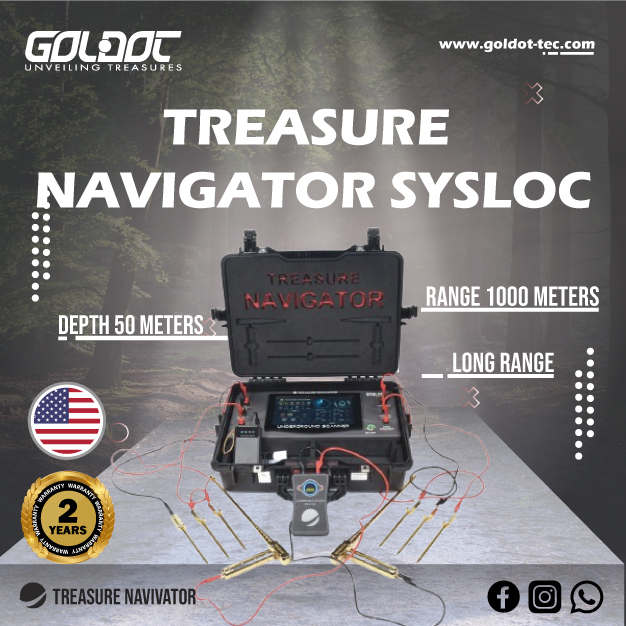
This treasure navigator sysloc review 2026 examines the Sysloc as a long-range area-scanning system rather than treating it like a conventional coil metal detector. Buyers researching this category typically want to know whether the device can help narrow large search areas, how its directional and anomaly information should be interpreted, what environmental conditions may affect results, and how advertised range or depth claims can be evaluated responsibly.
Goldot-Tec currently lists Treasure Navigator Sysloc as a professional long-range field-scanning device for broad-area reconnaissance, target orientation, depth-trend analysis, and anomaly detection. Its product page also documents ground balancing, noise reduction, signal-strength information, metal-related assessment, and wireless-headphone support.
However, a careful treasure navigator sysloc review 2026 should separate seller-published specifications from independently verified performance. Range, depth, discrimination, and target-direction claims should be treated as capabilities to test under controlled conditions rather than guaranteed results for every site.
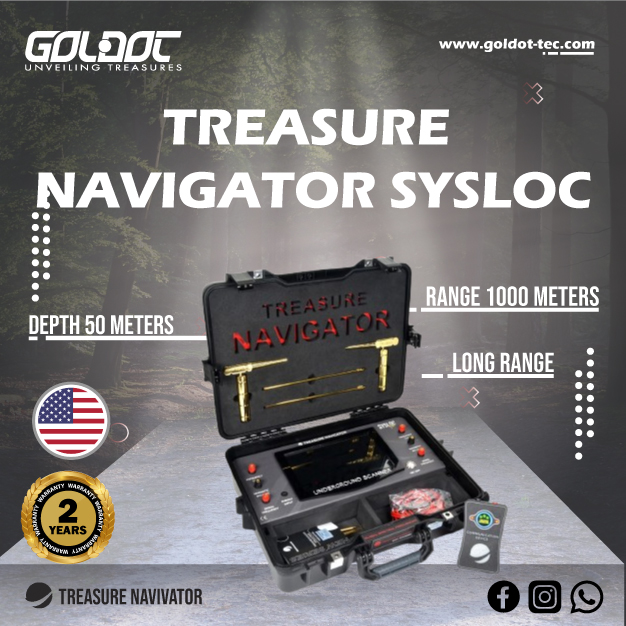
Treasure Navigator Sysloc Review 2026: What the Product Is
Treasure Navigator Sysloc belongs to the long-range locator category. Goldot describes it as an area-scanning system intended to help users investigate large open spaces before committing time to detailed close-range scanning.
The current Goldot page documents four main search functions:
- Wide Area Scanning
- Target Orientation
- Depth Analysis
- Anomaly Detection
The system is described as providing information about signal strength, ground stability, density differences, and possible depth trends while using intelligent ground balancing and interference reduction.
The manufacturer’s current catalog also lists Treasure Navigator Sysloc and Treasure Navigator Sysloc Prime as separate products. That distinction matters because detailed manufacturer material found for the Prime version discusses the Spiral Frequency System, so buyers should not automatically transfer every Prime-specific feature to the standard Sysloc without confirming the exact model.
How the Search Systems Fit Into a Field Workflow
The most practical way to understand this treasure navigator sysloc review 2026 is to see Sysloc as a reconnaissance tool.
A sensible workflow begins with a broad survey rather than expecting the locator to provide the final excavation point immediately.
Stage 1: Wide-Area Reconnaissance
Start by defining the boundaries of the search area.
Record:
- Start and finish points
- Search direction
- Visible surface metal
- Power lines or electrical equipment
- Vehicles and machinery
- Terrain changes
- Soil moisture
- Known structures
The Wide Area Scanning function can then be used to identify zones that deserve more attention.
Stage 2: Directional Follow-Up
When a response appears, do not immediately change direction and chase it.
Complete the original pass, record the suspected zone, then repeat the approach from the same starting position.
Target Orientation Mode is described by Goldot as using signal intensity to indicate a possible direction toward a target.
The key word is possible. Directional guidance becomes more useful when it repeats from controlled starting points.
Stage 3: Close Confirmation
Once a smaller search zone has been established, use another suitable detector or survey method to confirm it before excavation.
This is particularly important with long-range systems because directional reconnaissance and close-range target confirmation answer different questions.
Evaluating Published Range and Depth Claims Responsibly
Range and depth are likely to attract the most attention in any treasure navigator sysloc review 2026, but the current Goldot page itself contains inconsistent figures.
The introductory product text references one set of range and depth values and describes five systems, while the detailed product section later provides different figures and lists four intelligent search functions.
That inconsistency means a buyer should request the current manufacturer technical sheet for the exact Sysloc being offered before relying on one number.
More importantly, a maximum published depth does not mean every target can be located at that depth.
Performance can depend on:
- Target size
- Target composition
- Target orientation
- Burial history
- Soil mineralization
- Ground moisture
- Nearby metallic interference
- Operator position
- Search mode
- Testing method
A large buried structure cannot be compared directly with a small coin.
The same principle applies to horizontal range. Open terrain, environmental interference, target dimensions, and operator technique may all change real-world results.
How to Design a Repeatable Field Test
One of the strongest improvements buyers can make to a treasure navigator sysloc review 2026 is replacing demonstrations with controlled tests.
A useful field test should include both target and no-target locations.
Use an Unknown Target Position
The operator should not know where the target has been placed.
Another person should prepare several possible search zones.
Some should contain the test target and others should remain empty.
Define the Target
Record:
- Target material
- Physical dimensions
- Burial depth
- Orientation
- Ground conditions
Without these details, a successful demonstration cannot be reproduced.
Repeat the Test
Run multiple trials.
Record:
- Correct target directions
- Misses
- False indications
- No-target responses
- Changes in direction
- Estimated depth trend
A single successful pass is not enough to demonstrate reliable field performance.
Include Control Tests
No-target trials are especially important.
A device that points toward a target during ten target trials but also indicates a target in most empty trials provides less useful information than the successful demonstrations alone suggest.
Controls, Setup, and Operator Learning Curve
Goldot describes the control panel as showing signal strength, ground stability, selected mode, and depth-related trends. The product page also lists wireless headphone support and an adjustable field-oriented design.
That suggests the physical operating interface is intended to be relatively accessible.
The more difficult part is interpretation.
A new operator must learn to distinguish:
- Repeatable directional information
- Weak or unstable signals
- Environmental interference
- Ground-related changes
- Target-related changes
- Operator-induced movement
For this reason, the learning curve in this treasure navigator sysloc review 2026 should be considered moderate to high if the user wants evidence-based results rather than simply following every movement of the locator.
Ground Balance and Environmental Interference
Goldot specifically documents intelligent ground balancing and noise reduction for Sysloc.
Even with those functions, field conditions should still be recorded carefully.
Potential interference sources include:
- Metal fences
- Vehicles
- Surface scrap
- Electrical installations
- Reinforced structures
- Utility lines
- Other detectors
- Strong mineral changes
Do not assume ground balance can completely remove every environmental influence.
A better approach is to note potential interference before scanning and then test whether a suspected target indication remains after the survey direction or starting position changes.
Suitable Targets and Search Environments
The Goldot page presents Sysloc for treasure hunting, extensive land surveys, preliminary geophysical exploration, metal-related assessment, and broad target guidance.
The system makes the most practical sense in:
- Large open fields
- Desert environments
- Broad undeveloped terrain
- Large rural search areas
- Sites requiring preliminary reconnaissance
Its advantages may be reduced in heavily cluttered environments containing large amounts of modern metal.
Urban ruins, dense construction zones, parking areas, or sites beside large metallic structures can create a much more complicated interpretation problem.
Package Contents Buyers Should Confirm
A responsible treasure navigator sysloc review 2026 should not invent package contents that are missing from the current technical table.
Before buying, request a written inventory that confirms:
- Main Sysloc control unit
- Receiver or locator components
- Antennas or rods
- Battery or power system
- Charging equipment
- Wireless headphones if included
- Transport case
- User manual
- Training materials
- Warranty documentation
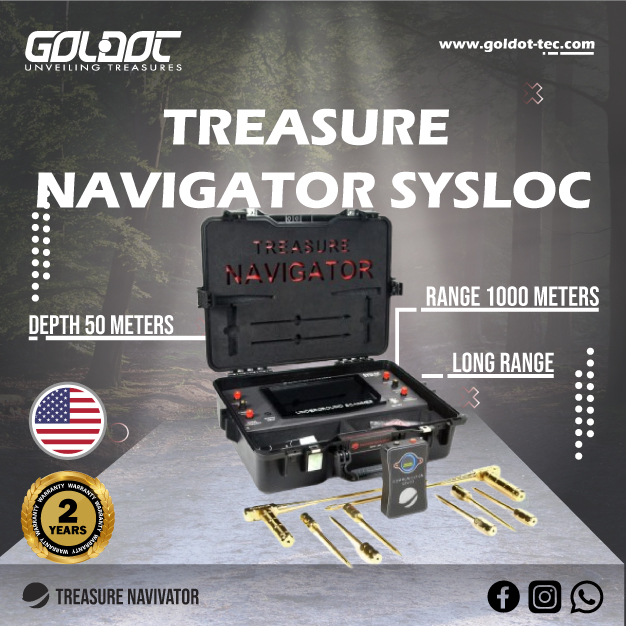
Goldot’s gallery clearly shows the device supplied in a transport-style case with multiple components, but photographs alone should not be used as the final package specification.
Practical Strengths and Important Limitations
The strongest editorial case for Sysloc is its role as a preliminary search tool.
Practical Strengths
- Designed for broad-area reconnaissance
- Multiple search functions
- Directional target guidance
- Ground and interference-management features
- Depth-trend information
- Portable field-oriented package
- Can help prioritize smaller follow-up zones
Important Limitations
The main limitation is that long-range indications require verification.
The current Goldot product page also contains specification inconsistencies, making model and documentation verification especially important.
Another limitation is target interpretation. Goldot describes metal discrimination as a rough assessment based on signal parameters rather than laboratory-level material identification.
A field operator should therefore avoid assuming that a signal confirms gold or another specific valuable metal without secondary evidence.
Treasure Navigator vs Conventional Metal Detectors
This treasure navigator sysloc review 2026 should not frame Sysloc and conventional detectors as direct substitutes.
| Requirement | Treasure Navigator Sysloc | Conventional Detector |
|---|---|---|
| Wide-area reconnaissance | Primary purpose | Limited |
| Directional guidance | Documented function | Usually not |
| Detailed close target recovery | Requires follow-up | Strong |
| Numerical Target ID | Different workflow | Common |
| Pinpointing small objects | Secondary confirmation useful | Common strength |
| Dense trash environments | More difficult to interpret | Smaller coils can help |
| Final recovery location | Confirmation recommended | Usually direct |
A practical workflow may use Sysloc to narrow a broad area and then employ a conventional detector for close verification.
Goldot’s wider long range metal detectors category can also help buyers understand how this product class differs from conventional detectors.
Seller, Warranty, Training, and Authenticity Checks
The current Goldot listing identifies itself as a certified dealer and lists product-specific warranty information. Goldot also advertises training and technical support.
Before ordering, confirm:
- Exact model: Sysloc or Sysloc Prime
- Serial number
- Written technical specification
- Current package contents
- Training format
- Warranty coverage
- Repair location
- Replacement-part availability
- Return conditions
Manufacturer catalog information confirms that Sysloc and Sysloc Prime are separate entries, so this model check is essential.
The dedicated Treasure Navigator Sysloc product page should be compared directly with the written quotation supplied before payment.
Final Verdict: Who Should Consider the Sysloc?
The final conclusion of this treasure navigator sysloc review 2026 is that Sysloc is most relevant to buyers who understand long-range locating as an initial reconnaissance method rather than a guaranteed target-identification system.
It may suit:
- Experienced treasure-search teams
- Users surveying large open sites
- Operators willing to perform repeat testing
- Buyers who will confirm anomalies with another detector
- Projects where reducing a large search area has real value
It is less suitable for someone who mainly wants quick recovery of individual coins, jewelry, or small relics in parks or modern trash.
Frequently Asked Questions
Is Treasure Navigator Sysloc the same as Sysloc Prime?
No. The manufacturer’s current catalog lists Treasure Navigator Sysloc and Treasure Navigator Sysloc Prime separately. Prime-specific features should therefore not automatically be attributed to the standard Sysloc.
Does Sysloc have multiple search modes?
Yes. Goldot currently documents Wide Area Scanning, Target Orientation, Depth Analysis, and Anomaly Detection.
Are the published depth and range guaranteed?
No. They are seller-published specifications and should be verified under defined field conditions. Goldot’s current page also contains conflicting range/depth statements, which makes obtaining the current technical sheet especially important.
How should Sysloc be field tested?
Use blind target locations, empty control locations, known target size and burial conditions, multiple repetitions, and written recording of hits, misses, and false indications.
Can Sysloc replace a conventional metal detector?
Not for every task. Sysloc is better treated as a wide-area reconnaissance system, while conventional detectors are generally more practical for close target recovery and pinpointing.
What is the strongest buying check before ordering?
Confirm the exact model, serial number, current specification sheet, complete package, warranty, training, and the ability to perform or observe a repeatable controlled field test.
Conclusion
A balanced treasure navigator sysloc review 2026 should recognize the intended advantage of the system without turning advertised specifications into guaranteed field performance.
Goldot presents Sysloc as a professional long-range reconnaissance platform with directional guidance, anomaly detection, ground balancing, depth-trend analysis, and metal-related signal interpretation.
Its best use is likely as the first stage of a larger search workflow: survey a broad area, identify repeatable zones, approach them again under controlled conditions, and then confirm the result using a suitable close-range detector or other independent method.
For buyers prepared to work that way, Sysloc may provide a structured wide-area search tool. For buyers expecting one pass to identify an exact deep target with certainty, expectations should be adjusted before purchase.