

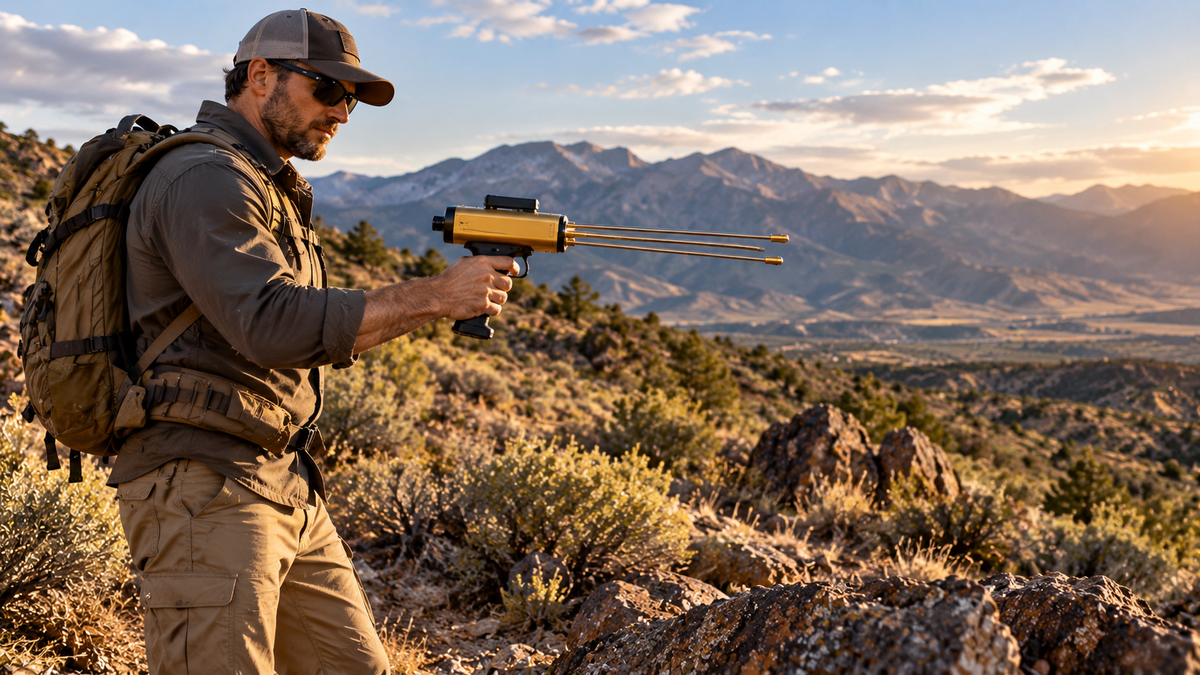
The AVCI E80 Professional Gold Scanner should be verified before it becomes part of a US survey project. Current seller-facing information presents the Avcı E-80 as an electronic, laser-focused long-range area scanner rather than a conventional search-coil metal detector or professional 3D imaging system.
Therefore, the buying decision should start with model identity, operating evidence, package details, training, and a clear method for confirming any indicated area. Goldot-Tec should also confirm the exact unit and current sourcing before you place an order.
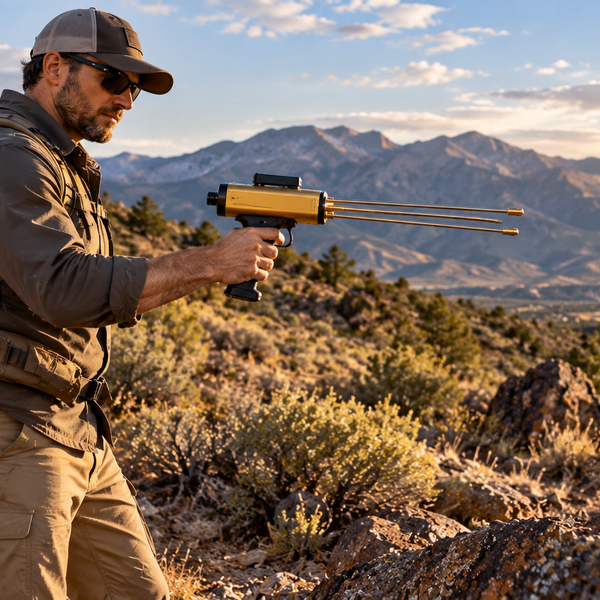
AVCI E80 Assessment for US Projects
The first question is not how far the E80 can search.
Instead, ask whether its operating method solves a real project problem.
Treat It as a Long-Range Locator
Goldot currently places E80 within its Long Range Systems catalog.
That classification matters.
A conventional VLF or PI detector produces a direct response when its search field interacts with metal. Meanwhile, a professional 3D scanner collects structured ground measurements for later interpretation.
The E80 follows another workflow.
Current seller material describes it as a long-range area-scanning device with electronic and laser-focused operation.
Therefore, use it as a preliminary reconnaissance system rather than a close-range recovery detector.
Do Not Treat “Scanner” as 3D Imaging
The term “scanner” can create the wrong expectation.
Publicly accessible E80 documentation does not establish that the system creates a measured 3D subsurface image.
It also does not document a structured scan grid, imaging probe, 3D visualization software, or geophysical sensor array comparable with dedicated ground scanners.
Therefore, buyers who need underground imaging should compare a different product category.
You can explore professional ground scanning systems when structured subsurface visualization is the real project requirement.
Define the Project Before the Product
A suitable project brief should answer several questions.
What do you expect to locate?
How large is the search area?
Is the suspected target metallic?
Do you need direct target confirmation?
Will another detector be available for verification?
Who will operate the E80?
What evidence must exist before excavation?
These answers determine whether a long-range locator even belongs in the workflow.
Verify the Exact AVCI E80 Identity
E80 is a short model name.
Therefore, US buyers should not assume that every online listing describes the same hardware revision, package, or manufacturer attribution.
Confirm the Exact Model Name
Ask Goldot-Tec to identify the unit in writing as:
AVCI E80.
Avcı E-80.
Or the exact current commercial model name shown on the supplied documentation.
The invoice, serial label, manual, and package should match.
Do not rely only on a photograph.
Confirm the Brand and Source
Current Asya Dedektör material lists an Avcı E-80 product.
However, reseller naming is not fully standardized.
Therefore, request written confirmation of:
Brand.
Manufacturer or supplier.
Country of origin.
Current hardware revision.
Serial number.
Product documentation.
This matters because operating instructions from another E80-branded device may not apply.
Confirm the Revision
A model name can remain the same while hardware or package details change.
Therefore, ask whether the offered E80 is the current revision.
If the seller mentions a year or version, request supporting documentation.
Do not assume that an older online article describes the unit currently offered.
Evidence and Configuration Checks Before Ordering
The publicly available product information leaves several technical questions unanswered.
Therefore, buyers should verify them before payment.
Ask What the Device Actually Measures
Current seller descriptions refer to electronic scanning, laser focusing, magnetic structures, precious metals, and underground features.
However, the accessible primary material does not provide a sufficiently detailed sensor architecture.
Therefore, this article does not assign undocumented:
Operating frequencies.
Magnetometer specifications.
Processor type.
Sensitivity range.
Target-ID scale.
Ground-balance method.
Depth algorithm.
3D imaging technology.
Ask Goldot-Tec to explain the current operating method using documentation supplied with the exact unit.
Ask How Direction Is Indicated
A long-range locator only becomes useful when the operator understands how the device indicates an area of interest.
Therefore, ask for a demonstration covering:
Power-on procedure.
Required calibration.
Operator position.
Search direction.
Target-mode selection, if available.
Directional indication.
Reset procedure.
Repeat testing.
A buyer should understand the workflow before ordering.
Ask What Cannot Be Confirmed
A responsible demonstration should also explain limitations.
For example, can the system identify gold specifically?
Can it distinguish gold from another conductive metal?
Can it identify an empty cavity?
What environmental factors can influence the response?
If these questions cannot be supported by documentation, do not treat the claims as confirmed specifications.
Do Not Buy From a Range Claim Alone
Long-range performance is one of the main marketing themes around the E80.
However, an advertised range does not establish reliable detection under every site condition.
Target Size Matters
A large metallic target and a small gold object should not create the same buying expectation.
Therefore, any demonstration needs to identify the target dimensions.
Without that information, the range figure has little practical value.
Ground Conditions Matter
Soil conditions can vary between sites.
Mineralization may affect some detection systems.
Wet ground can create another environment.
Surface metal and infrastructure may also complicate testing.
Therefore, ask what conditions were used in any demonstration supporting a performance claim.
False Responses Matter Too
A useful test does not record successful indications only.
It should also measure what happens when no target is present.
Otherwise, the buyer cannot judge false-positive behavior.
Therefore, empty control tests should form part of the evidence.
Build a Controlled Demonstration
A controlled demonstration gives a buyer more useful information than a promotional video.
The test should challenge the device rather than confirm what everyone already expects.
Use Known Target and Empty Areas
Prepare several test zones.
Some should contain a known target.
Others should contain no test target.
The operator should not always know which zone contains the target.
This creates a stronger test.
Keep the Operator Position Consistent
During repeated trials, keep the following factors as consistent as practical:
Starting point.
Grip.
Body position.
Search direction.
Device configuration.
Antenna arrangement.
Nearby equipment.
This reduces unnecessary variables.
Repeat the Result
One directional response should not determine the purchase.
Return to the starting point.
Then repeat the test.
Afterwards, approach the suspected zone from another suitable direction.
A useful response should show some degree of repeatability.
Record Misses and False Indications
Do not record successful-looking passes only.
Also document:
Missed targets.
Wrong directions.
Responses in empty areas.
Results that cannot be repeated.
This gives the buyer a more balanced picture.
Colorado Survey Project Planning
Consider a hypothetical authorized Colorado project involving a large site with an uncertain underground target.
The E80 could be considered for preliminary area reconnaissance.
However, the survey should include a confirmation plan from the beginning.
Define the Colorado Search Question
First, identify the suspected target category.
Is the project searching for metal?
A structure?
A broad anomaly?
The answer changes the verification method.
Inspect the Site
Colorado terrain can vary widely.
Therefore, do not treat the state as one uniform search environment.
Document the actual site.
Useful notes include:
Rocky areas.
Slopes.
Nearby structures.
Vehicles.
Fences.
Utility equipment.
Overhead electrical infrastructure.
Wet or disturbed ground.
The purpose is to identify variables that could affect interpretation.
Narrow the Survey Zone
Do not walk randomly across the entire property.
Instead, divide the site into defined zones.
Record starting positions.
Then use the same operating method in each section.
If the E80 repeatedly points toward one area, mark that zone for another test.
Confirm Before Excavation
An E80 indication should not become the final excavation decision.
For a suspected metallic target, use an appropriate direct metal detector.
If the project involves a structural anomaly, another survey technology may fit better.
Goldot-Tec’s deep scan metal detector guide explains how PI detection, 3D scanning, and other survey methods solve different project questions.
Texas Scanner Project Needs
Now consider a hypothetical authorized Texas site.
The buying process should still begin with the project rather than the device.
Confirm Site Permission
Private property requires owner authorization.
Public areas can apply separate rules.
Therefore, make sure the intended survey is allowed before ordering equipment for the project.
Decide Whether Long-Range Reconnaissance Adds Value
Suppose the Texas project already has a very small suspected target zone.
In that case, a long-range locator may add little value.
A direct detector or scanner may provide a clearer workflow.
However, a large property with only broad historical clues creates a different problem.
Preliminary area reconnaissance may then have a defined role.
Separate Searching From Confirmation
The first stage can narrow the area.
The second stage should verify the target.
Do not merge those steps.
A locator may indicate a direction.
A direct detector should then test for metal where appropriate.
A scanner may provide another measurement if the project concerns a structure or cavity.
This layered workflow creates stronger evidence.
Repeatability Should Drive the Buyer Assessment
A reliable project needs reproducible observations.
Therefore, repeatability should receive more attention than promotional terminology.
Same Zone, Multiple Attempts
If several controlled attempts repeatedly identify the same physical zone, the result deserves further investigation.
However, that still does not prove target composition.
It only strengthens the case for another test.
Different Zone Every Time
If each attempt points in a different direction, confidence should fall.
Do not reinterpret every new response as a different hidden target.
Instead, question the measurement.
Use Another Operator
Where practical, a second trained operator can repeat the process.
However, the second operator should not receive unnecessary information about the first result.
This reduces expectation bias.
Keep Written Records
For each important test, record:
Date.
Time.
Starting point.
Device setup.
Search direction.
Environmental conditions.
Indicated zone.
Repeat result.
Confirmation result.
This makes the project reviewable.
Environmental Variables Need Testing
The accessible public documentation does not provide detailed environmental compensation data for the E80.
Therefore, buyers should test rather than assume.
Surface Metal
Vehicles, fences, large metal structures, and surface scrap can complicate a search site.
Record them before testing.
If possible, change one variable and repeat the trial.
For example, move a vehicle away and see whether the indication remains.
Electronics
Mobile phones, other detectors, and nearby electrical equipment may introduce another variable.
Again, the point is not to claim that every device interferes with E80.
The goal is to make the test controlled.
Weather and Ground
Document wet ground, recent excavation, and major surface changes.
If results differ between two days, these notes can help explain why.
Package Verification Before Payment
Publicly accessible E80 documentation does not provide a complete standard package table.
Therefore, Goldot-Tec should confirm every included component before you order.
Main Hardware
Ask for a written list covering:
Main E80 unit.
Every antenna or rod.
Handle components.
Power equipment.
Charging equipment.
Carrying case or bag.
User manual.
Warranty documentation.
Do not infer package contents from photographs.
Power Requirements
The current public documentation does not provide enough detail to safely state a universal battery specification.
Therefore, ask Goldot-Tec to identify the exact power source.
Also confirm US charger compatibility.
This matters before international sourcing.
Documentation
Ask for the manual for the exact version.
If training material exists, request it as well.
The operating instructions should match the serial-numbered unit you receive.
Availability Needs Separate Confirmation
Goldot currently displays E80 within its Long Range Systems catalog.
However, a category listing alone should not determine the purchase.
Catalog Presence Is Not the Full Availability Check
Before ordering, ask Goldot-Tec to confirm:
Current stock or sourcing status.
Exact revision.
Package contents.
Warranty.
Lead time.
US delivery options.
A listing can remain online while sourcing conditions change.
Therefore, request current confirmation.
Do Not Use the Imaging Category as Proof of E80 Availability
Goldot also offers a large imaging-detector category.
However, that category contains many different technologies.
It does not prove that the E80 is an imaging scanner.
Likewise, category availability does not establish the exact E80 package.
Use categories to compare alternatives, not as technical proof.
Training Requirements
Physical operation may appear simple.
However, interpreting a long-range locator requires discipline.
Training Should Cover the Search Method
Ask whether training explains:
Correct stance.
Starting position.
Device handling.
Directional response.
Resetting between tests.
Repeat testing.
Environmental variables.
Record keeping.
These skills matter more than simply learning where the power control is located.
Training Should Cover False Indications
A useful training session should not show successful targets only.
Ask the trainer to explain what an uncertain response looks like.
Also ask how to reject a poor result.
This can protect the buyer from overinterpreting normal movement.
Training Should Include Confirmation
Any long-range workflow should finish with a second method.
Therefore, training should explain when to switch to direct detection or structured scanning.
This makes the E80 part of a broader project rather than a stand-alone excavation decision tool.
When Another System Makes More Sense
The E80 is not automatically the correct choice for every project.
A different technology may provide clearer evidence.
Conventional Metal Detector
Choose a conventional detector when the target zone is already narrow and you need direct metallic response.
Coins, jewelry, relics, and smaller individual targets generally fit this workflow better.
Pulse Induction
PI can make more sense for larger metal or mineralized ground.
It also provides a direct target response rather than long-range directional reconnaissance.
3D Ground Scanner
Choose structured ground scanning when the project focuses on underground anomalies, possible voids, chambers, or survey visualization.
However, remember that 3D output represents measured data rather than an underground photograph.
GPR
Some structural or geological projects may require Ground Penetrating Radar.
Again, this is a separate technology.
Do not purchase E80 because the project actually needs radar-style subsurface information.
Suitable Alternative Categories
A strong buying assessment should explain what to compare before committing.
Long-Range Systems
If broad-area reconnaissance is genuinely needed, compare E80 with other Goldot-Tec long-range detector options.
Evaluate:
Operating method.
Available documentation.
Training.
Repeatability.
Package details.
Evidence quality.
Do not compare advertised range alone.
Imaging Systems
If the project requires structured ground data, use the imaging category instead.
Look at measurement method, sensor type, scan workflow, software, and training.
These are more important than the word “professional.”
Direct Detection Systems
If the project needs confirmation of metal, compare direct metal-detection technology.
The right detector may depend on target size and ground conditions.
This can provide a stronger second-stage tool after preliminary reconnaissance.
AVCI E80 Purchase Risk Assessment
A professional buyer should identify uncertainty before ordering.
Model-Identity Risk
E80 naming can be inconsistent across reseller content.
Therefore, confirm the exact version and source.
Technical-Documentation Risk
The accessible product page does not publish a complete engineering specification set.
Therefore, do not invent missing technical details.
Request documentation.
Performance-Evidence Risk
Published long-range claims do not provide a complete controlled test protocol.
Therefore, ask for repeatable evidence.
Package Risk
Package contents are not sufficiently standardized in public documentation.
Get the equipment list in writing.
Project-Fit Risk
A long-range locator may not solve the project question.
Therefore, compare alternatives before ordering.
US Project Purchase Checklist
Use a short checklist before committing to the E80.
Model
Confirm:
Exact model name.
Brand or manufacturer attribution.
Current revision.
Serial number.
Correct manual.
Project
Define:
Target type.
Survey size.
Terrain.
Search objective.
Required confirmation method.
Evidence
Request:
Controlled demonstration.
Known-target test.
Empty control trials.
Repeated passes.
Blind or partially blind testing where practical.
Package
Confirm:
Main device.
Antennas or rods.
Power system.
Charger.
Carrying equipment.
Manual.
Warranty.
Training.
US Order
Ask Goldot-Tec to confirm:
Current sourcing.
Availability.
Exact package.
Delivery options for your state.
After-sales support.
Only then should you decide whether the E80 matches the project.
Frequently Asked Questions
How do I confirm the exact AVCI E80 version before buying?
Ask Goldot-Tec to provide the exact model name, current hardware revision, serial number, brand or manufacturer attribution, matching user manual, complete package list, and written warranty terms. Do not assume that every E80 listing describes identical hardware. Also confirm current sourcing and US delivery before ordering.
What training should I request for the E80?
Training should cover device setup, operator position, directional response, repeat testing, reset procedures, environmental variables, record keeping, and controlled demonstrations. It should also explain how to challenge a response rather than accept every indication. Most importantly, ask how an E80 result should be confirmed with another appropriate detector or survey method.
What alternative should I consider if the E80 does not fit my project?
Choose the alternative according to the question you need to answer. A conventional or PI detector can provide direct metallic confirmation. A professional 3D scanner can suit structured underground-anomaly surveys, while GPR may serve certain structural or geological investigations. If broad-area reconnaissance is still required, compare other long-range systems and evaluate documentation, training, package contents, and repeatability before selecting one.
AVCI E80 US Purchase Advice
The AVCI E80 Professional Gold Scanner is better assessed as a long-range reconnaissance system than as a conventional detector or documented 3D ground scanner. Verify the exact unit, challenge its responses with controlled testing, and confirm the package before relying on it for a US project.
Buying in the United States? Ask Goldot-Tec about current sourcing, availability and delivery options for your state. Send the team your Colorado, Texas, or other authorized project requirements, then request model verification, training details, package confirmation, and suitable alternatives before you order.