


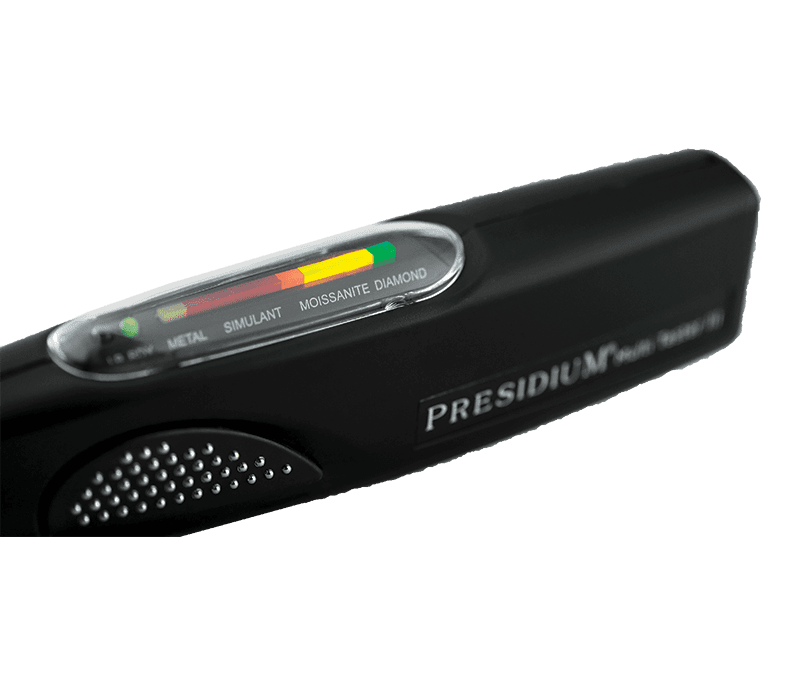
This Presidium Multi Tester III review examines the PMuT III as a compact screening instrument for colorless diamonds, moissanites, and common diamond simulants. It is not a metal detector, underground scanner, or general-purpose gemstone identification laboratory. Its job is much narrower: use thermal and electrical properties to help a jeweler or gemstone buyer quickly screen an unknown colorless stone.
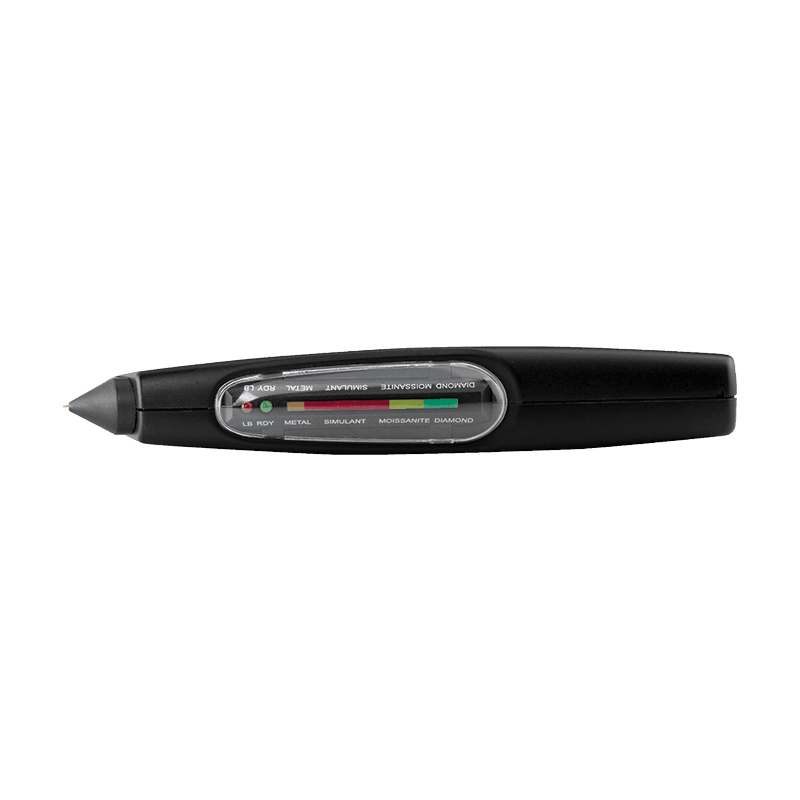
Goldot-Tec currently lists the Presidium Multi Tester III within its scientific-device range. The manufacturer describes it as a handheld tester with a retractable thermoelectric probe, a 0.6 mm probe tip, a 180-degree LED display, metal-contact alert, automatic power-off, and support for colorless diamonds as small as 0.02 ct.
The most useful conclusion from this Presidium Multi Tester III review is that good results depend heavily on correct probe contact, stone temperature, a clean testing surface, avoiding the jewelry setting, and understanding what each indicator actually means.
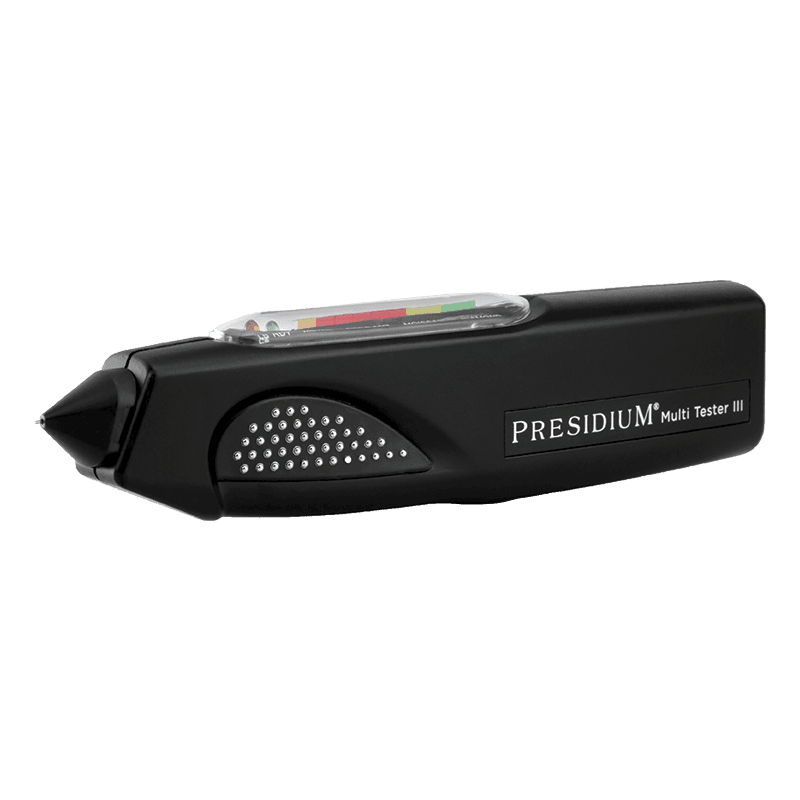
Presidium Multi Tester III: Purpose and Buyer Profile
The PMuT III is intended primarily for jewelry professionals and buyers who need a fast first-stage check of colorless stones.
Presidium describes the instrument as combining thermal and electrical testing to separate colorless diamonds from moissanite and common simulants including colorless sapphire, colorless spinel, cubic zirconia, and zircon.
Typical users include:
- Jewelers receiving customer pieces
- Jewelry buyers and resellers
- Pawn and second-hand jewelry businesses
- Gemstone traders
- Appraisers performing preliminary screening
- Collectors who regularly inspect colorless stones
However, this Presidium Multi Tester III review does not position the PMuT III as a substitute for gemological identification when origin, treatment, grading, or natural-versus-laboratory-grown status matters.
Presidium itself recommends further analysis when definitive verification is required.
What the Tester Can and Cannot Establish
Understanding the limits of the instrument is essential.
What It Can Screen
According to Presidium, PMuT III uses thermal and electrical properties to provide indications for:
- Colorless diamond
- Moissanite
- Diamond simulants
- Accidental contact with metal
Its 0.6 mm retractable probe also allows testing of relatively small stones.
What It Does Not Prove
A “diamond” result does not function as a laboratory certificate.
In particular, the PMuT III should not be relied upon by itself to determine:
- Natural versus laboratory-grown diamond
- Diamond grade
- Geographic origin
- Treatments
- Exact identity of every possible simulant
- Carat weight
- Clarity or color grade
Presidium recommends the Multi Tester III as an initial screening stage before using more specialized verification equipment or laboratory examination where necessary.
That limitation is one of the most important points in this Presidium Multi Tester III review.
Understanding the Probe-Based Testing Workflow
The probe is not simply touched casually against the stone.
The PMuT III handbook instructs the operator to place the probe tip perpendicular to the gemstone facet and apply enough controlled pressure for the retractable tip to make proper contact. Tests are normally made on the table facet, with the girdle providing another checking position if the initial result creates doubt.
A practical sequence is:
- Make sure the stone is clean and dry.
- Allow the stone and tester to reach suitable room temperature.
- Switch the PMuT III on.
- Wait until the preparation indicator stops flashing and the unit shows that it is ready.
- Position the probe at approximately 90 degrees to the stone.
- Apply controlled pressure.
- Read the LED and audible indication.
- Repeat the test if the result is questionable.
The handbook describes a warm-up period of around twenty seconds before testing.
Calibration: An Important Correction
A proper Presidium Multi Tester III review should correct a common misunderstanding: PMuT III does not require the user to calibrate it against a reference disc before normal testing.
The handbook states that units are calibrated during manufacture and that no further user adjustment is required. It specifically warns against attempting self-calibration and directs users to Presidium or a service center if recalibration becomes necessary.
Therefore:
- There is no routine user calibration procedure.
- A calibration disc is not listed in the PMuT III package.
- The metal accessory is a stone rest, not a calibration reference.
- A suspected calibration problem should be handled through service support.
That distinction prevents users from applying instructions intended for a different Presidium instrument.
Preparing the Stone Before Testing
Testing conditions matter because the PMuT III measures physical properties that can be influenced by temperature and contact.
Presidium recommends an operating environment of approximately 18°C to 27°C and says that jewelry should be allowed to adjust to room temperature before testing.
Before testing:
- Make sure the stone is dry.
- Remove dirt, oil, and fingerprints from the testing surface.
- Allow a cold or hot jewelry item to reach room temperature.
- Check that the tester has reached READY status.
- Avoid performing a test with a weak battery.
Very elaborate cleaning is not normally required, but the stone surface used for probe contact should be clean.
Testing Loose Stones Correctly
For loose gemstones, the handbook directs the user to place the stone on the supplied metal stone rest while holding the rest with one hand and the tester with the other.
The probe should approach the selected facet vertically rather than at a shallow angle.
For very small stones, hand stability becomes increasingly important.
If the result changes between tests:
- Allow the stone to cool.
- Reposition it.
- Test another point.
- Repeat the reading.
This repeated-testing approach is more dependable than treating one brief contact as final.
Testing Mounted Jewelry
Mounted jewelry introduces one of the largest sources of error discussed in this Presidium Multi Tester III review.
The handbook warns that the probe should contact the stone rather than the metal setting. Metal is highly conductive and accidental contact can produce a misleading indication. The issue becomes particularly important with very small mounted gemstones.
When testing mounted jewelry:
- Confirm that the stone is securely set.
- Aim for the center of an exposed facet where practical.
- Keep the probe perpendicular.
- Avoid prongs and bezels.
- Stabilize both the tester and jewelry.
- Repeat doubtful readings.
For very small mounted stones, careful visual positioning may be necessary before the probe touches the surface.
Reading the LED and Audible Results
Indicator interpretation is another area where a Presidium Multi Tester III review needs precision.
The PMuT III handbook describes the main results as follows:
| Indication | Handbook Interpretation |
|---|---|
| Red LED | High-thermal-conductivity simulant category such as sapphire or topaz |
| Yellow LED | Moissanite indication |
| Green LED + continuous beep | Diamond indication |
| Metal area + intermittent beep | Probe has contacted metal |
| No meaningful indication | May occur with lower-conductivity simulants such as glass or cubic zirconia |
The important word here is indication.
If a stone produces a confusing or inconsistent result, repeat the test rather than forcing the reading into the category you expected.
Small Stones, Heat and Multiple Readings
Presidium’s operating guidance specifically warns that very small gemstones can require additional care.
The handbook states that very small stones should be allowed to cool before subsequent tests and recommends taking multiple readings when there is doubt.
That gives this Presidium Multi Tester III review a simple professional rule:
Do not repeatedly press the probe against the same tiny stone in rapid succession and then assume every reading is independent.
Allow the testing conditions to stabilize.
Testing several accessible points on a larger stone can also help identify whether one reading resulted from poor contact.
Probe Care and Cleaning
The retractable probe is one of the instrument’s most important components.
Presidium recommends cleaning the probe tip before first use and after the tester has been unused for approximately a week.
The handbook procedure is to:
- Switch the tester off.
- Hold the tip perpendicular to clean paper or the stone rest.
- Move it gently in a circular motion.
- Avoid retracting the tip during cleaning.
- Repeat several times.
The protective cap should be replaced when the tester is stored because the probe is sensitive to physical damage.
This maintenance requirement is worth considering before purchasing a used instrument.
Power, Portability and Controls
Portability is a clear strength in this Presidium Multi Tester III review.
The current Presidium specification gives dimensions of approximately 165 × 25 × 40 mm and a weight of 54 grams without batteries. Power comes from three AAA alkaline batteries or an appropriate optional Presidium AC adaptor.
Other documented convenience features include:
- Low-battery indicator
- Automatic power-off
- Rubberized anti-slip grip
- 180-degree multi-view LED display
- Left- or right-handed usability
One specification deserves clarification: Presidium’s current product page states substantially longer continuous battery operation than wording found in an available PMuT III handbook version. Because the official sources do not fully agree, buyers should treat battery runtime as condition-dependent rather than relying on one fixed figure.
Package Contents Buyers Should Verify
The PMuT III handbook lists the core package as:
- Presidium Multi Tester III
- Metal stone rest
- User handbook
- Warranty card
- Protective carrying case
The current Presidium product page explicitly states that the AC adaptor is not included.
Before accepting delivery, check:
- Probe condition
- Protective cap
- Stone rest
- Case
- Documentation
- Battery compartment
- Serial number
- Warranty documentation
The adaptor can be treated as an optional accessory where mains operation is required.
Warranty and Seller Verification
Presidium’s current official warranty page states that its products carry a one-year manufacturer guarantee from the original purchase date against covered defects in workmanship or materials. Warranty registration requests the model, serial number, seller, purchase date, and invoice information.
Goldot’s listing may advertise dealer warranty arrangements that extend beyond the manufacturer’s standard terms. Buyers should therefore ask whether additional coverage comes from Presidium or from the seller and obtain the terms in writing.
The dedicated Presidium Multi Tester III page can be used to verify the current Goldot listing, while related jewelry-testing equipment can be explored through Goldot’s scientific detection devices section.
Practical Strengths
This Presidium Multi Tester III review finds several useful advantages:
- Compact handheld design
- Combined thermal and electrical screening
- Separate diamond and moissanite indications
- Very small probe tip
- Works with loose or mounted stones
- Metal-contact warning
- Factory calibration
- Fast repeat testing
- Simple LED interface
- Portable battery power
For jewelry counters and preliminary purchasing checks, that workflow can be much faster than sending every obviously simulated stone directly to a laboratory.
Important Limitations
The limitations are equally important.
The PMuT III:
- Is primarily intended for colorless diamond-related screening.
- Does not issue a gemological certificate.
- Does not grade a diamond.
- Cannot by itself establish natural versus lab-grown origin.
- Can produce misleading results if the probe touches metal.
- Requires suitable stone temperature and clean contact.
- Requires extra care with very small mounted stones.
- Depends on correct probe technique.
Presidium explicitly describes handheld testers as initial-testing tools and recommends laboratory verification where definitive identification is needed.
Final Buying Checklist
Before purchasing after reading this Presidium Multi Tester III review, verify:
- Genuine PMuT III model
- Serial number
- Undamaged 0.6 mm probe
- Protective probe cap
- Metal stone rest
- Carrying case
- User documentation
- Warranty documentation
- Clean battery compartment
- Seller support procedure
- Optional adaptor compatibility if required
For a used tester, also ask how the probe has been stored and whether the unit has ever required service or recalibration.
Frequently Asked Questions
Does the Presidium Multi Tester III need user calibration?
No. The handbook states that the tester is calibrated during manufacturing and that self-calibration should not be attempted.
Can PMuT III distinguish diamond from moissanite?
Yes. The manufacturer designed the instrument to use thermal and electrical properties to separate colorless diamonds, moissanite, and several common simulants.
Can it tell a natural diamond from a lab-grown diamond?
Not reliably by itself. Additional diamond-verification equipment or gemological laboratory testing is required when natural-versus-laboratory-grown origin must be established.
Can it test mounted jewelry?
Yes, but the probe must contact the gemstone rather than the metal setting. Metal contact can produce misleading results, especially with small mounted stones.
What should I do if readings are inconsistent?
Check the stone temperature, clean the surface and probe, avoid metal contact, maintain a 90-degree probe angle, allow small stones to cool, and repeat the test. If uncertainty remains, use additional gemological testing.
Conclusion
The final conclusion of this Presidium Multi Tester III review is that PMuT III is best viewed as a professional preliminary screening tool rather than a miniature gemological laboratory.
Its thermoelectric probe, diamond/moissanite indications, metal alert, compact design, and ability to work with very small stones make it useful for jewelers, traders, and buyers who need quick first-stage screening.
The strongest results come from disciplined technique: let the instrument stabilize, use a clean and dry stone, keep the probe perpendicular, avoid the jewelry setting, repeat doubtful readings, and recognize when the question requires another instrument or laboratory report.
For that buyer profile, the Presidium Multi Tester III review shows a practical tool with a clearly defined role—as long as its screening results are not treated as proof of diamond origin, quality, or full gemological identity.