

Choosing a Deep Scan Metal Detector for a US project should begin with the target, not with the largest advertised depth figure. A large metallic object, an empty cavity, a tunnel, and a disturbed underground zone create different search problems. Therefore, they may require different technologies.
Pulse Induction systems search directly for metal. In contrast, a 3D ground scanner records changes and anomalies across a structured survey area. Ground Penetrating Radar follows another workflow because it measures reflections from changes below the surface.
For this reason, buyers should not compare all three systems as though they perform the same job.
A Texas project focused on a substantial buried metallic target can require a different setup from a Colorado survey investigating a possible underground structure. Target dimensions also matter. Likewise, soil conditions, survey size, coil configuration, sensor method, and operator experience can change the correct equipment choice.
If your project mainly involves structured underground visualization, you can also compare ground imaging detector options before requesting your Goldot-Tec quote.
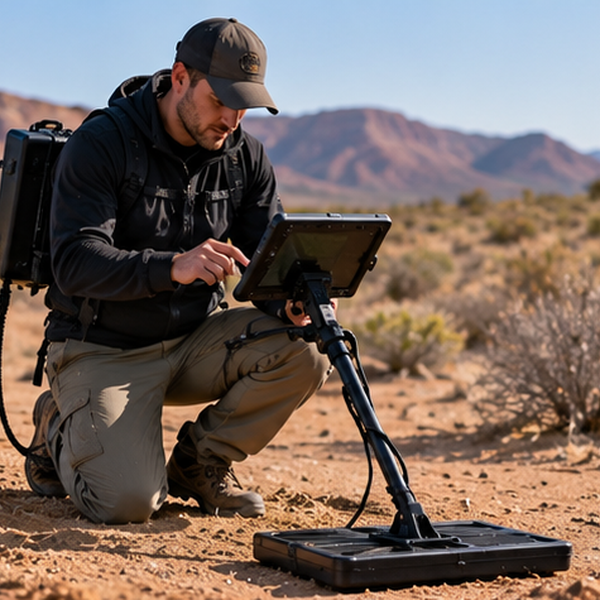
Deep-Scan Buying Decisions for US Projects
A professional project should answer one question before equipment is selected:
What exactly are you trying to locate?
The answer usually places the project into one of several categories.
Large Metallic Targets
Large buried metallic objects usually point toward direct metal detection.
For example, the project may involve:
Large containers.
Substantial metallic relics.
Buried equipment.
Large non-ferrous metal.
Military metal.
Archaeological metallic objects.
In this case, a professional PI or Pulse GBS platform can make sense.
The search coil creates much of the buying difference.
A larger frame can emphasize substantial targets and cover more ground. Meanwhile, a smaller coil can improve maneuverability and suit another target scale.
Therefore, the detector and coil should be selected together.
Cavities and Underground Structures
An empty cavity may contain little or no useful metal.
Consequently, an ordinary PI detector can answer the wrong question.
Instead, buyers may need a 3D ground-scanning system or another geophysical method.
This category can include:
Possible tunnels.
Chambers.
Voids.
Disturbed ground.
Buried structures.
Large subsurface anomalies.
The scanner does not take a photograph underground.
Instead, it collects measurements that software converts into a graphical representation.
Therefore, interpretation forms part of the purchase.
Mixed Metal and Structure Projects
Some sites create both questions.
A team may need to identify underground anomalies first. Afterwards, the same project may require direct metal confirmation.
In that case, a hybrid system can provide a more practical workflow.
However, the operator must understand when to use each mode.
A PI signal should not be interpreted like a 3D scan.
Likewise, an anomaly on a scan should not automatically be called a metal target.
Choose PI for Deep Metallic Targets
Pulse Induction becomes relevant when direct metal detection is the primary goal.
The coil transmits pulses and measures the response from conductive material. Therefore, the system requires metal to produce its core target response.
PI as a Purchasing Choice
PI can make sense when the target is physically substantial.
It can also help when mineralized ground makes another detector difficult to operate.
However, buyers should not reduce PI selection to one depth figure.
Target dimensions can change the response dramatically.
So can orientation.
Ground conditions matter too.
As a result, two objects at the same depth can create very different responses.
Lorenz Deepmax Z2 for Direct Metal Search
The Lorenz Deepmax Z2 represents this buying category clearly.
It uses the non-motion Pulse GBS Ground Balancing System.
In addition, Lorenz supports different coil configurations.
That makes the Z2 relevant to projects where target scale changes the required search setup.
A smaller coil serves a different job from a large frame.
Therefore, explain the expected target dimensions before selecting the package.
Buyers focused on this workflow can review the Lorenz Deepmax Z2 deep-target system before asking Goldot-Tec to confirm the suitable coil configuration.
What Pulse GBS Does Not Do
Deepmax Z2 can record detection data when the relevant Data Logger workflow is used.
However, that does not turn it into GPR.
Likewise, it does not make the system a dedicated cavity scanner.
Its core job remains direct metallic target detection.
This distinction matters when you are paying for professional equipment.
If the main objective is an empty tunnel, choose technology designed around subsurface anomalies rather than forcing a metal detector to solve the wrong problem.
Choose 3D Ground Imaging for Anomalies
A 3D ground scanner follows a structured measurement process.
Therefore, it should not be used like a conventional swing-and-listen detector.
How the Survey Workflow Changes
The operator creates a survey area.
Next, measurements are collected across that area.
Scan direction matters.
Walking speed also matters.
Sensor position should remain controlled.
In addition, the distance between survey lines affects the resulting dataset.
The software then processes the readings.
For the buyer, this creates one major requirement:
Training is part of the system.
A 3D Image Is Not an Underground Photograph
This point should be clear before purchase.
A ground scanner does not photograph a treasure chest, tunnel, or gold bar under the soil.
Instead, the software creates graphics from measured differences.
Those differences may indicate:
Magnetic material.
Other metallic responses.
Ground disturbance.
Void-like features.
Changes in subsurface conditions.
However, interpretation remains necessary.
Therefore, do not buy a scanner because a marketing image appears to show a perfect underground object.
Buy it because the measurement method matches your project.
Groundtech GR3 Plus for Scanning Projects
The Groundtech GR3 Plus belongs to the 3D scanning category.
Groundtech documents a dual-sensor scanning system with automatic and manual 3D scanning, Live Scan, and Pinpointer functions.
It also transfers data wirelessly to its analysis software.
Therefore, the system can suit a team whose main objective involves structured ground assessment rather than direct PI detection.
You can review the Groundtech GR3 Plus scanning configuration when your project centers on anomalies, structures, metals, or void-like features.
When a Scanner Is the Wrong Choice
A 3D scanner can add unnecessary complexity to simple metal recovery.
For example, a project focused on a single conventional coin does not normally require a grid-based ground survey.
Likewise, fine natural-gold prospecting needs another buying approach.
Choose imaging when the underground context matters.
Choose direct detection when the target itself is the main question.
Understand Where GPR Fits
Ground Penetrating Radar creates another category.
It should not be presented as simply a more advanced metal detector.
GPR Measures Subsurface Reflections
GPR sends electromagnetic energy into the ground and records reflected signals.
Changes between materials can produce different responses.
Therefore, GPR can support projects involving:
Layer changes.
Utilities.
Structures.
Voids.
Geological boundaries.
Buried features.
However, a GPR anomaly does not automatically identify gold.
GPR Is Not Gold Identification
This is an important purchasing limitation.
A radar response can show a subsurface contrast.
However, the image alone does not prove that the feature is a treasure target.
The operator still needs context and interpretation.
In addition, soil conditions strongly influence radar performance.
Therefore, do not buy GPR simply because the project asks for “maximum depth.”
First, confirm that radar can answer the site’s real question.
When GPR May Add Value
GPR can become relevant when structural investigation is more important than direct metallic detection.
For example, a project may focus on an underground wall, layer, tunnel, or utility.
In that case, radar can contribute useful data.
However, another project centered on a large metallic container may gain more practical value from PI.
The measurement goal should control the technology.
Hybrid Systems for Mixed Projects
Some buyers need direct metal detection and anomaly scanning.
A hybrid system can reduce the need to carry two separate platforms.
However, the combined system only creates value when both workflows matter.
Groundtech GR-4 Dual
The Groundtech GR-4 Dual combines 3D ground scanning with an integrated Pulse Induction detector.
Therefore, the operator can switch between two different search methods.
The 3D side supports structured anomaly investigation.
Meanwhile, the PI side provides direct metal detection.
This makes the platform useful for mixed projects.
Buyers can review the Groundtech GR-4 Dual system when both functions are required.
When the Hybrid Approach Makes Sense
Imagine a survey area with an uncertain underground response.
The team may first collect 3D data.
If the anomaly appears interesting, the operator can then use the PI function to check for a metallic response.
This gives the project two forms of information.
However, they should not be treated as identical evidence.
When a Hybrid System Adds Unnecessary Complexity
A buyer focused only on large metal may not need the scanner.
Likewise, a structural survey with no need for direct PI confirmation may work well with a dedicated scanner.
Therefore, the hybrid package should solve two genuine requirements.
Do not buy more systems simply because they appear more professional.
Metallic Targets Versus Subsurface Anomalies
A simple distinction can eliminate many wrong purchases.
Metallic Target Question
Ask:
“Is there conductive metal here?”
That question suits direct metal-detection technologies.
PI and Pulse GBS systems belong in this workflow.
Anomaly Question
Ask:
“Is something underground different from the surrounding ground?”
That question points toward scanning.
The anomaly may require more interpretation later.
However, the scanner helps identify the area for further investigation.
Structural Question
Ask:
“How is the underground structure changing?”
That may point toward GPR or another geophysical method.
Therefore, the buyer should define the question before asking which detector is deepest.
Target Size and Real Detection Depth
Depth marketing can cause expensive buying mistakes.
Therefore, target size should always accompany a depth discussion.
Large Targets Produce Different Responses
A substantial metallic object can produce a stronger response than a small coin.
Consequently, a detector demonstration using a large metal object does not predict performance on a smaller target.
The same applies to gold.
A large metallic mass and a fine nugget create completely different detection problems.
Orientation Matters
Target position can affect signal strength.
For example, a flat conductive surface can create a different response from the same object in another orientation.
Therefore, depth should never appear without target context.
Soil Changes Usable Performance
Mineralization can affect detector stability.
Conductive soil can also change performance.
Moisture may influence some systems.
Likewise, electromagnetic interference can force an operator to use more stable settings.
For this reason, manufacturer maximums should not become guaranteed US field results.
Coil Size Changes the Search
A larger PI frame can improve coverage for substantial metallic targets.
However, it may reduce practical sensitivity to smaller targets.
Meanwhile, smaller coils give the operator greater control.
Therefore, package selection should include target scale.
Texas Deep Search Planning
Consider a hypothetical authorized Texas project involving a possible large buried metallic object.
The team should not begin by purchasing the largest scanner available.
Instead, define the project first.
Define the Texas Target
Suppose historical information suggests a substantial metallic target.
That makes direct detection the primary question.
Therefore, professional PI can become the first technology to compare.
The approximate target size should guide the coil configuration.
Survey the Site Conditions
Next, inspect the site.
Is the terrain open?
Does the location contain fences?
Is reinforced concrete nearby?
Could utility infrastructure create interference?
These conditions matter.
Record them before the search.
Plan the Coil Configuration
Open ground may allow a large frame.
However, a restricted location may require a smaller configuration.
Therefore, the most powerful-looking coil is not automatically the correct coil.
Ask Goldot-Tec to match the coil to the target and working area.
Add Imaging Only When Needed
If the Texas project also includes a suspected cavity, PI alone may not answer the full question.
In that case, a hybrid system or separate scanner may make sense.
However, the second technology should solve an identified project requirement.
Colorado Survey Requirements
Now consider a hypothetical authorized Colorado project involving a possible underground structure rather than a defined metallic target.
This changes the buying decision.
Define the Colorado Survey Question
If the team wants to identify a possible void or structural anomaly, 3D scanning may provide a more suitable starting point.
Direct PI may still become useful later.
However, it should not lead the first stage when the suspected feature may contain no metal.
Terrain Affects the Scan Method
Colorado terrain can vary widely.
Therefore, this example should not be treated as a statewide ground profile.
Instead, assess the actual project location.
Uneven ground can make structured scanning harder.
Vegetation can also influence the walking path.
Therefore, the team may need a smaller, well-controlled survey grid.
Data Quality Comes Before Area Size
A large scan is not automatically a better scan.
Consistent lines matter more.
So does sensor orientation.
Therefore, divide difficult ground into manageable sections.
This produces cleaner survey records.
Plan Secondary Confirmation
If a 3D scan shows an anomaly, do not jump directly to excavation.
Instead, repeat the survey.
Then compare the location.
If metal is suspected, use a suitable metal-detection method.
If structure remains the primary question, another geophysical method may provide additional confirmation.
Training Requirements for Deep Systems
Professional equipment does not remove the need for training.
In fact, advanced systems can increase the importance of technique.
PI Training
A PI operator should understand:
Ground balancing.
Coil control.
Sweep speed.
Audio behavior.
Repeatable target signals.
Coil selection.
Interference.
Without those skills, maximum sensitivity can create more noise rather than better information.
3D Scanner Training
A scanner operator needs another set of skills.
These include:
Correct scan direction.
Straight scan lines.
Consistent speed.
Controlled sensor height.
Grid setup.
Software workflow.
Result interpretation.
Repeat scanning.
Therefore, ask what training comes with the package.
GPR Training
Radar interpretation can become even more specialized.
The operator needs to understand how reflections and soil conditions influence the data.
Therefore, a buyer should not assume that purchasing the hardware creates immediate expertise.
Training may be one of the most important project costs, even though this article does not discuss prices.
Data Interpretation Limits
Buying a scanner means buying a measurement workflow.
Therefore, interpretation limits should appear in the purchasing decision.
Color Does Not Equal Material Certainty
A software color can help classify data.
However, a red or blue zone does not automatically confirm treasure, gold, or a cavity.
The software follows its measurement model.
The operator still needs to evaluate the pattern.
Shape Is an Interpretation
A clean graphical shape may look convincing.
However, the software builds the image from collected data.
Therefore, poor scanning can create misleading graphics.
Depth Estimates Need Context
Software may estimate target or anomaly depth.
However, soil conditions and object size affect the result.
Therefore, treat the estimate as part of the investigation rather than a guaranteed measurement.
Deep Scan Metal Detector Package Planning
The correct package depends on the workflow.
Therefore, buyers should confirm every component before ordering.
PI Package Questions
Ask:
Which control unit is included?
Which coil comes with the package?
Is a frame coil included?
What battery system is supplied?
Which charger is included?
What headphones or audio equipment are provided?
Does the package support Data Logging?
Scanner Package Questions
Confirm:
The sensor unit.
Charging equipment.
Analysis software.
Supported phone or tablet requirements.
Bluetooth connection.
Carrying case.
Training.
Warranty documentation.
Hybrid Package Questions
A hybrid system requires both sides of the workflow.
Therefore, confirm that the PI coil is included.
Also verify the scanning sensor.
Ask how the device switches between modes.
Finally, confirm which analysis software supports saved scans.
Field Verification Before Excavation
Professional search equipment should help build evidence.
Therefore, excavation should not rely on one unclear response.
Repeat the Initial Result
Return to the target area.
Repeat the scan or detector pass.
Check whether the result stays linked to the same physical location.
Change Direction Carefully
When the workflow allows it, confirm the area from another direction.
However, maintain a controlled method.
Random movement can reduce comparison quality.
Use Another Appropriate Method
A large PI metal response may benefit from a second detector check.
Meanwhile, a 3D anomaly may require another scan or a different geophysical method.
Independent evidence is more useful than repeating the same assumption.
Record the Project
Write down:
Target location.
Search method.
Coil or sensor.
Ground conditions.
Settings.
Survey direction.
Repeat-test results.
Environmental interference.
This creates a record that the team can review before a major next step.

Compare Three Deep-Search Buying Paths
Three product categories illustrate the decision clearly.
Lorenz Deepmax Z2
Choose this route when the main goal is substantial metallic targets.
Its Pulse GBS platform and coil choices support direct metal searching.
However, do not select it as a dedicated empty-cavity scanner.
Groundtech GR3 Plus
Choose this route when structured ground scanning is the main requirement.
The workflow focuses on 3D scanning, Live Scan, and localization of anomalies.
However, it does not include a dedicated integrated PI system.
Groundtech GR-4 Dual
Choose this route when the project genuinely requires both scanning and direct PI metal detection.
It provides greater workflow flexibility.
However, the buyer must learn both search methods.
This comparison is more useful than calling one system universally deeper.
Deep Target Detector Buying Mistakes
Several mistakes repeatedly lead buyers toward the wrong equipment.
Comparing Different Technologies by One Depth Figure
A PI detector and a 3D scanner do not measure the same thing.
Therefore, one depth table can mislead the buyer.
Calling Every Ground Graphic a Treasure Image
3D graphics represent measurements.
They are not photographs.
Therefore, interpretation and repeat scans remain necessary.
Using PI for an Empty Cavity
PI needs a metallic response.
An empty tunnel can require another method.
Buying a Scanner for Small Nuggets
Fine natural gold creates another search requirement.
A specialist prospecting detector can make more sense.
Choosing the Largest Coil Automatically
Larger coils serve specific target scales.
They can also reduce maneuverability.
Therefore, match the coil to the target.
Ignoring Training
Complex equipment can produce poor data when used incorrectly.
Training should be confirmed before purchase.
Deep Scan Metal Detector US Buyer Checklist
Before requesting a quote, prepare a short project description.
Target Type
Is the main target metal?
A cavity?
A tunnel?
A larger underground structure?
A mixed target?
Target Scale
How large is the expected target?
Do you have historical information?
Is the estimated location already narrow?
Ground
Is the site mineralized?
Wet?
Rocky?
Open?
Restricted?
Survey Method
Do you need direct audio detection?
3D measurements?
Radar-style structural data?
More than one method?
Operator Experience
Who will use the system?
Does the operator understand PI?
Has the team completed structured 3D scans before?
Who will interpret the data?
Package Requirements
Which coils or sensors are required?
Which software is included?
What charging equipment is supplied?
Is training included?
Which warranty terms apply?
What delivery options apply to your state?
Once these questions are answered, the shortlist becomes much clearer.
Frequently Asked Questions
Do I need training before using a Deep Scan Metal Detector?
Training is especially important for professional deep-search systems. PI users should understand coil selection, ground response, sweep technique, and repeatable signals. Meanwhile, 3D scanner users need a controlled grid, consistent sensor movement, and software interpretation skills. GPR can require another level of specialist interpretation. Therefore, ask Goldot-Tec what training applies to the exact system before ordering.
Should I choose PI or ground imaging for my target?
Choose PI when the main objective is direct detection of a metallic object. Choose ground imaging when the project focuses on underground anomalies, possible cavities, structures, or disturbed ground. If the site may involve both, a hybrid platform such as the GR-4 Dual can provide both workflows. However, each mode still needs its own technique and interpretation.
How should I choose equipment for a Texas or Colorado deep-search project?
Start with the project rather than the state. Define the expected target, its approximate size, terrain, ground conditions, and survey method. A hypothetical Texas project involving substantial metal may favor PI, while a Colorado project focused on a possible underground structure may favor 3D scanning. These are examples only. Ask Goldot-Tec to compare the suitable systems and confirm coils, sensors, software, training, and package contents for your actual authorized site.
Request Your US Deep-Search Project Quote
A Deep Scan Metal Detector should answer a defined search question.
Therefore, do not begin with the deepest advertised device.
Begin with the target.
If the target is large and metallic, consider professional PI or Pulse GBS.
If the project involves a cavity or structural anomaly, evaluate 3D ground scanning.
If subsurface layers and reflections form the primary question, GPR belongs in a separate comparison.
When both metal and scanning matter, a hybrid system can create a more practical workflow.
The next step is target size.
After that, consider soil and terrain.
Then select the coil, sensor, or survey method.
Finally, confirm training and result verification.
Lorenz Deepmax Z2 suits direct professional metallic-target detection.
Groundtech GR3 Plus fits structured anomaly scanning.
Groundtech GR-4 Dual combines 3D scanning with an integrated PI detector for mixed projects.
None of these systems should be chosen because of one universal depth claim.
Instead, choose the technology that measures what your project needs to know.
Buying in the United States? Ask Goldot-Tec about availability and delivery options for your state. Send the team your target type, estimated target size, site conditions, survey area, operator experience, and preferred measurement method. Then ask Goldot-Tec to compare suitable deep-search systems, confirm the required equipment, and prepare a package quote for your US project.