

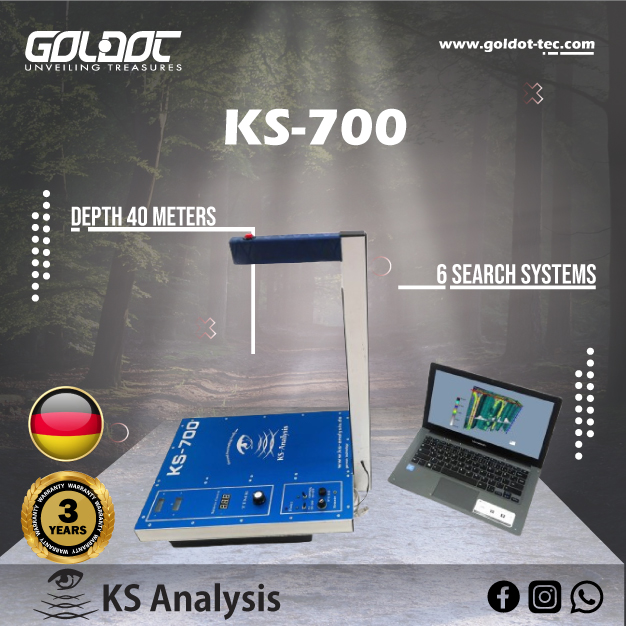
The KS-700 is not simply another conventional metal detector designed for sweeping a coil over the ground and identifying coins through Target ID numbers. Goldot-Tec currently presents the system as the KS Analysis KS 700, a professional Frequency Modulated Continuous Wave Ground Penetrating Radar, or FMCW GPR, developed for deeper subsurface investigation.
That distinction should shape every buying decision. The KS-700 is presented for applications including archaeology, geophysical investigation, cavity detection, underground structures, tunnels, bunkers, pipelines, and metallic anomalies. Its workflow involves radar measurements, grid-based scanning, computer visualization, and optional 3D data analysis rather than the familiar discrimination-and-audio workflow of a hobby VLF detector.
For buyers researching the KS-700 in 2026, the most important questions concern the radar technology, documented depth limits, operating workflow, external computer requirements, included software, battery configuration, package contents, training, and how the system compares with the KS 800 and KS 900.
This guide focuses on those practical points without treating published maximum-depth figures as guaranteed performance for every underground target.
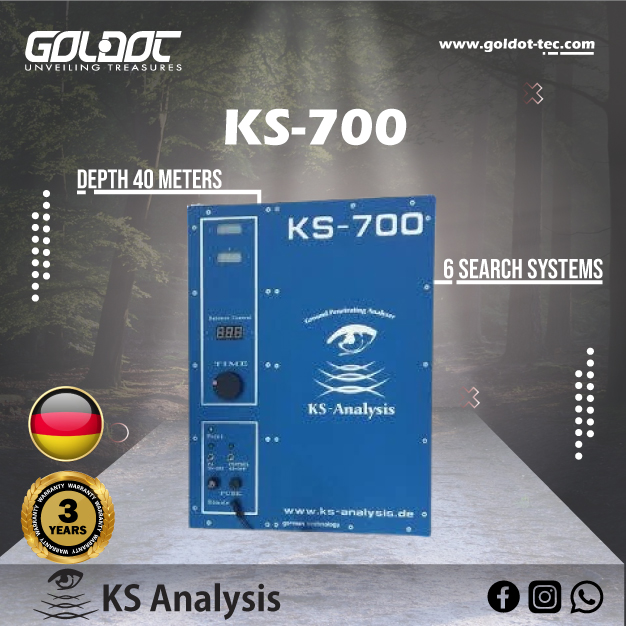
KS-700: Identify the Exact System Before Comparing It
Goldot-Tec identifies the product as the KS Analysis KS 700 and classifies it within the KS Analysis range alongside the KS 800 and KS 900. Its dedicated product page describes the unit as a professional GPR using FMCW radar technology and an integrated wideband antenna.
This immediately separates it from several other detector categories.
It is not primarily presented as:
- A coin-shooting VLF detector
- A handheld pinpointer
- A pulse induction nugget detector
- A conventional audio-only treasure detector
- A long-range directional locator
Instead, the operating concept is based on underground radar analysis.
Before comparing a seller listing, therefore, verify that the product is actually labeled:
KS Analysis KS 700 / SKU KS-700
Goldot lists that SKU on the current product page.
This verification matters because the KS Analysis product family also contains higher models with different scanning workflows and control systems.
How the FMCW Ground Radar System Works
The central technology of the KS-700 is FMCW, meaning Frequency Modulated Continuous Wave.
Goldot describes the system as transmitting through an integrated wideband antenna rather than requiring the operator to exchange antennas for different search depths. The product page positions this design for searching underground voids, structures, and metallic objects.
Why the Integrated Antenna Matters
Traditional ground-radar systems can require different antenna configurations depending on the desired balance between penetration and resolution.
According to the Goldot listing, the KS 700 uses one integrated shielded antenna across its intended scanning range.
From a practical buyer perspective, that means fewer hardware changes during a survey.
However, it should not be interpreted as meaning that every target produces the same resolution at every depth. Radar response can still depend heavily on:
- Target dimensions
- Material properties
- Soil conditions
- Moisture
- Geological layers
- Scan spacing
- Signal timing
- Operator technique
The hardware may simplify antenna management, but good survey planning remains important.
Technical Specifications Buyers Should Check
Goldot publishes a relatively detailed technical table for the KS-700.
| Specification | Goldot-Tec Listing |
|---|---|
| Manufacturer / Brand | KS Analysis |
| System | Ground Penetrating Radar |
| Radar technology | FMCW |
| Data processing | FFT |
| Antenna | Integrated, shielded wideband antenna |
| Main interface | USB |
| Operating environment | Windows computer required |
| Published dimensions | 445 × 334 × 120 mm |
| Published unit weight | 5.1 kg without battery |
| Battery | 12V 18Ah lead-acid/gel |
| Published operating time | Approx. 8 hours |
| Operating temperature | -10°C to 50°C |
| Primary visualization software | StoneAge |
| 3D compatibility | Voxler / Golden Surfer |
| Calibration listing | Automatic Ground Balance |
| Operator requirement | One-person operation |
These figures come from the current Goldot product specification table and should be verified again at the time of purchase because product configurations can be revised.
One especially important specification is the external computer requirement.
Goldot states that a Windows tablet or laptop is required and is not included according to the technical specification section.
A buyer should therefore include the computer requirement when calculating the complete operating setup.
Intended Search Tasks and User Profile
The KS-700 makes more sense for structured underground investigation than casual weekend metal detecting.
Goldot associates its use with archaeology, geophysics, construction-related investigation, cavities, tunnels, bunkers, cellars, buried infrastructure, and metallic objects.
Potential users may therefore include:
- Professional treasure-search teams
- Archaeological survey users
- Geophysical investigation teams
- Users researching underground chambers
- Tunnel and cavity search projects
- Infrastructure investigation projects
- Experienced detector users moving into GPR
The system may be excessive for someone whose main search target is a modern coin at shallow depth.
A conventional detector can provide a simpler workflow for:
- Coins
- Jewelry
- Small relics
- Surface metal
- Individual recoverable targets
Buyers who are still deciding which technology category fits their project can compare broader ground scanning detectors before selecting a radar platform.
Understanding the KS-700 Operating Workflow
The KS-700 uses what Goldot describes as a Stop & Go grid scanning method.
This is an important difference from the KS 800 and KS 900, which the same product page describes as supporting more continuous scanning workflows.
Step 1: Define the Survey Area
Before collecting data, establish a controlled survey grid.
Record:
- Start position
- End position
- Scan direction
- Line spacing
- Surface conditions
- Obstacles
- Nearby metallic structures
A consistent grid makes later radar data easier to interpret.
Step 2: Connect the System
The product uses an external Windows computer or compatible setup through USB.
Before beginning a serious survey:
- Check battery level
- Confirm cable connections
- Open the required software
- Confirm that the computer recognizes the radar
- Verify storage availability
- Test data acquisition
Do this before walking into the actual search grid.
Step 3: Collect the Radar Measurements
Goldot describes the KS 700 as a Stop & Go system, meaning measurements are collected according to the planned grid rather than through the fully continuous workflow associated with higher KS models.
Consistency is important.
Changing spacing, direction, or measurement procedure during the same survey can make anomalies harder to compare.
Step 4: Review the 2D Data
The product page lists a 2D Real-Time View for displaying underground anomalies through the connected computer or tablet.
The first objective should be identifying repeatable anomalies rather than immediately deciding what each anomaly represents.
Step 5: Export for 3D Analysis
Goldot states that data can be exported for further analysis using Voxler or Golden Surfer-compatible workflows.
This provides another level of visualization, but 3D graphics should still be interpreted as processed measurement data—not a photographic image of the underground target.
Field Setup and Sources of Measurement Error
Professional GPR equipment can collect sophisticated data, but poor survey technique can still reduce its usefulness.
When operating a KS-700, pay attention to several environmental and procedural variables.
Surface Conditions
Large differences in ground height can affect the consistency of a scan.
Try to keep the survey path as controlled as practical.
Soil Composition
Different materials transmit and reflect radar energy differently.
Goldot specifically references environments including limestone, clay, and sand in the technical section.
That does not mean identical performance should be expected in all three.
Ground Moisture
Wet and dry soils can behave differently during radar surveys. When comparing two scans, record whether conditions changed between sessions.
Nearby Infrastructure
Surface metal, electrical equipment, buried utilities, and other infrastructure can complicate interpretation.
Record known structures before scanning.
Operator Consistency
A repeatable survey should maintain:
- Similar line spacing
- Consistent measurement intervals
- Consistent antenna positioning
- Correct grid orientation
- Accurate labeling
If an anomaly matters enough to excavate, repeat the scan rather than relying on one dataset.
KS-700 Detection Depth: How to Read the Published Figures
Depth claims require particular care with any GPR.
Goldot’s primary feature table lists a 40-meter maximum depth, while another technical specification on the same page states 40 meters with up to 60 meters in limestone. The product description and FAQ emphasize approximately 40 meters under favorable conditions.
Those figures should be understood as published system limits or performance claims—not a promise that the KS-700 can identify every object at 40 or 60 meters.
A large cavity is not equivalent to:
- A coin
- A small gold object
- A narrow pipe
- A large bunker
- A tunnel
- A buried wall
The electromagnetic contrast and physical dimensions of the target strongly affect whether a radar anomaly can be recognized.
Therefore, instead of asking only:
“What is the KS-700 detection depth?”
ask:
“What target type, target size, geology, survey setup, and confirmation method were associated with that depth?”
That question is much more useful.
What the Detection Modes Actually Mean
Goldot lists four principal functions or workflows.
Cavity Detection
The system is presented for investigating:
- Tunnels
- Bunkers
- Cellars
- Underground chambers
- Caves and void-like structures
This is one of the applications where GPR technology differs substantially from conventional metal detecting.
Metal Detection
The Goldot page states that the KS 700 can identify radar responses associated with ferrous and non-ferrous metals, pipelines, and buried infrastructure.
This should not be confused with conventional Target ID discrimination found on a coin detector.
A radar anomaly may require interpretation and confirmation rather than simply displaying a numerical metal ID.
2D Visualization
This provides immediate radar-data visualization through the connected computer.
3D Analysis
Exported data can be analyzed using compatible visualization software.
The purpose is to understand anomaly shape and location more clearly, not to turn the radar into an underground camera.
Package Contents, Software, and Accessories
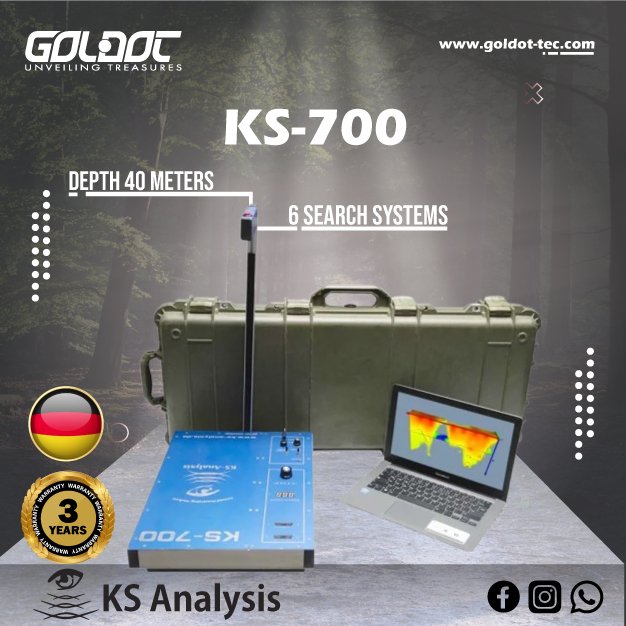
Goldot currently lists the following KS-700 package components:
- Main FMCW radar control unit
- Integrated wideband shielded antenna
- 12V 18Ah gel battery
- StoneAge 2D visualization software
- 3D export compatibility
- USB data cable
- Battery connection cable
- Automatic charger
- Protective carrying case
The product specification also states that a laptop or tablet is required but not included.
This is an important purchasing detail.
Before payment, ask whether the current package contains exactly the same components shown on the listing.
Also confirm:
- Software version
- Windows compatibility
- License requirements
- Export format
- Charger voltage
- Replacement battery availability
- Replacement cable availability
- Software installation assistance
For professional equipment, software support can be almost as important as the physical radar unit.
KS-700 Price and Total Ownership Value
At the time the current Goldot product page was reviewed, the KS-700 was listed at $16,500, with the corresponding euro price displayed dynamically on the store.
Prices can change, so buyers should verify the live product page before payment.
The real investment may also include:
- Compatible Windows laptop or tablet
- 3D visualization software if additional licenses are needed
- Spare battery
- Transport requirements
- Training
- International shipping conditions
- Taxes or customs charges depending on destination
- Future repair or service costs
A professional radar system should therefore be evaluated according to the complete operating environment rather than headline price alone.
KS-700 vs KS 800 Plus vs KS 900
Goldot positions the KS 700 as the starting model within a three-level KS radar progression.
| Area | KS 700 | KS 800 | KS 900 |
|---|---|---|---|
| Main scan workflow | Stop & Go grid | Continuous | Continuous / real-time |
| Control approach | External computer | Connected tablet workflow | Integrated touchscreen |
| 3D workflow | Manual export | More automated | Real-time onboard |
| Positioning | Portable deep survey | Faster area scanning | Higher-end professional workflow |
Goldot’s KS Analysis category currently lists the KS 700, KS 800 Plus, and KS 900 as separate products with progressively higher store prices.
This does not mean the most expensive system is automatically the correct one.
Choose the KS-700 when its manual grid-based workflow and external computer analysis fit the project.
Consider the higher models when continuous data acquisition or a more integrated visualization workflow provides a real operational advantage.
Seller Documentation, Training, and Warranty
Goldot currently states that the KS 700 is available for testing at its headquarters, that training is available, and that technical support continues after purchase. The product page also displays manufacturer-warranty information and a dedicated after-sales support process.
The technical specification specifically lists a two-year warranty for the KS 700, while broader store interface text mentions multiple warranty durations across devices. Because these statements are not identical, buyers should confirm the warranty applicable to the exact KS-700 unit in writing before payment.
Ask:
- What is the exact warranty period?
- Which components are covered?
- Is the battery covered?
- Where is warranty repair completed?
- Who pays shipping for service?
- Is software support included?
- Is practical training included?
- Can the detector be demonstrated before purchase?
- Are spare parts currently available?
Goldot also presents technical support and product assistance through its wider Goldot detection systems platform.
Final KS-700 Buyer Checklist
Before ordering a KS-700, confirm:
- Exact KS Analysis model
- SKU
- FMCW radar configuration
- Integrated antenna condition
- Main control unit
- Battery
- Charger
- USB cables
- StoneAge software
- Computer requirements
- Export compatibility
- Current software version
- Published depth conditions
- Warranty duration
- Training options
- Technical-support channel
- Replacement battery availability
- Spare-part availability
- Current delivered price
For a used device, also request operating demonstrations and confirm that the system communicates correctly with the computer before payment.
Rules concerning subsurface scanning, archaeological investigation, access to land, excavation, and protected sites vary by country and property. Obtain landowner permission and check the relevant local authority requirements before fieldwork.
Frequently Asked Questions
Is the KS-700 a conventional metal detector?
No. Goldot presents the KS-700 primarily as an FMCW Ground Penetrating Radar system. It can investigate metallic anomalies, but its workflow differs significantly from a conventional VLF or pulse induction detector.
Does the KS 700 require a laptop?
Yes. Goldot’s technical specifications state that the system uses Windows and requires an external laptop or tablet, which is listed as not included with the standard package.
Does the KS-700 provide 3D underground images?
It can export collected radar data for 3D analysis using compatible software such as Voxler or Golden Surfer according to the Goldot listing. The system itself primarily uses an external computer and manual export workflow rather than the real-time onboard 3D workflow listed for the KS 900.
Can the KS 700 detect tunnels and cavities?
Goldot specifically lists tunnels, bunkers, cellars, underground chambers, caves, and other void-related structures among the intended applications of its cavity-detection workflow.
Is the published 40-meter depth guaranteed?
No universal target guarantee should be inferred from the published figure. Goldot lists 40 meters as the principal maximum depth and also references higher performance in limestone within the technical table. Target type, geology, survey quality, and environmental conditions can materially affect actual results.
Who should choose the KS-700 instead of the KS 800 or KS 900?
The KS-700 is most logical for buyers who are comfortable with Stop & Go grid scanning, an external Windows computer, and manual 3D export. The higher models become more relevant when continuous scanning and more integrated visualization are priorities.
Conclusion
The KS-700 should be evaluated as a professional ground-radar platform rather than a conventional treasure detector. Its published strengths on Goldot-Tec center on FMCW radar technology, an integrated wideband antenna, grid-based subsurface scanning, 2D visualization, external 3D analysis, and applications involving cavities, tunnels, infrastructure, archaeological investigation, and metallic anomalies.
The most important buying decision is therefore not whether the KS-700 has the highest advertised depth. It is whether its Stop & Go workflow, external computer requirement, software environment, radar technology, and package fit the actual project.
Before ordering, verify the live price, warranty, software, computer requirements, battery condition, training, and exact package contents. Then compare the system with other KS Analysis models and ground-scanning technologies according to the work you actually intend to perform.