

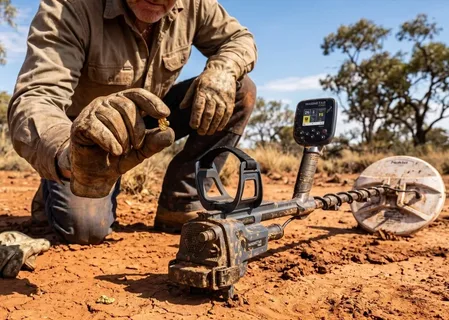
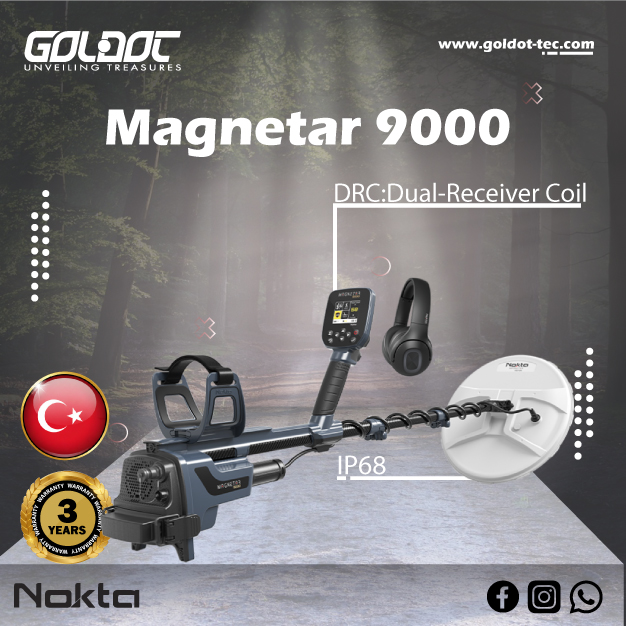
Finding the Nokta Magnetar 9000 best settings is less about copying one sensitivity number and more about building a stable configuration for the exact goldfield you are searching. The Magnetar 9000 is Nokta’s professional Advanced Pulse Induction gold detector, developed to respond to both deep gold and micro nuggets while operating in harsh mineralized ground. Its Dual-Receiver Coil system, Easy and Expert menus, Auto Noise Cancellation, Bluetooth audio, full-color display and waterproof IP68 construction give the operator considerable control, but those features only help when the detector remains stable enough for subtle target signals to stand apart from ground and electromagnetic noise.
The original content plan correctly focuses on sensitivity, mineralization, EMI, coil choice and repeatable audio instead of treating one preset as universally correct.
There is also an important current-software detail for owners. Nokta’s official software page lists system software V2.02.03, released June 26, 2026. An earlier June update changed the default Ground mode after a factory reset from Tough to Regular, along with related settings. That makes it especially important not to copy old Magnetar settings without checking the software version installed on your machine.
No configuration can guarantee that a particular nugget will be detected at a fixed depth. Gold size, orientation, mineralization, coil choice, ground conductivity, EMI, sensitivity and operator technique all influence practical field performance.
Build Settings Around Ground Conditions, Not a Universal Preset
The ground should determine your starting configuration.
Nokta designed the Magnetar 9000 specifically for demanding goldfields. The manufacturer highlights its Advanced Pulse Induction architecture and Dual-Receiver Coils as a combination intended to provide stability in difficult mineralized soil while retaining response to both deep and very small gold.
That does not mean the detector should always be pushed to its most aggressive settings.
Survey the Ground Before Raising Performance Levels
Spend the first few minutes listening to the machine rather than immediately changing every parameter.
Check whether the background is stable.
Look for obvious EMI sources such as vehicles, electrical infrastructure, communication equipment or another operating detector.
Pay attention to whether responses occur at repeatable points or broadly across changes in soil.
If the detector is noisy before a target is introduced, increasing sensitivity is unlikely to make faint gold easier to interpret.
The best initial profile is one that lets you recognize a genuine repeatable response without fighting continuous ground chatter.
If you are buying rather than already using the machine, you can inspect the Nokta Magnetar 9000 buying package and confirm the current configuration directly with Goldot-Tec. Its current product page lists Advanced Pulse Induction, Dual-Receiver Coil technology, Easy and Expert operation and Auto Noise Cancellation.
Start with a Stable Pulse-Induction Baseline
Nokta provides Easy and Expert menus for a reason.
Easy Mode is officially described as a pre-tuned environment intended to get the user detecting quickly. Expert Mode opens the advanced parameters for experienced operators who want greater control in demanding ground.
For a first session in unfamiliar terrain, Easy Mode can therefore provide a sensible reference.
Use Easy Mode as a Known Starting Point
A practical baseline sequence is:
Power the detector up away from obvious metal.
Make sure the search coil is securely installed.
Allow the detector to begin from a known configuration.
Run Auto Noise Cancellation before chasing sensitivity.
Sweep representative ground without a target.
Test a known gold or metal sample.
Listen for repeatability.
Only then start moving into advanced adjustments.
The advantage of beginning this way is diagnostic. If the detector is stable in its guided configuration but becomes unstable after several Expert settings are changed, you know the problem is more likely related to tuning than hardware.
Check Your Ground Mode After Software Changes
Owners who have updated the detector should note that Nokta changed the factory-reset default Ground mode from Tough to Regular in system software V1.02.03.
This means two users can discuss “factory settings” while actually referring to different defaults if one machine has older software.
Before copying another user’s field program, confirm:
- Installed software version
- Ground mode
- Coil
- Search environment
- Target size
- Whether the other user is operating in Easy or Expert
This is especially important for a new detector released in 2026, where software behavior has already been refined after launch.
Choose the Search Coil Around Target Scale and Terrain
The Magnetar 9000 currently supports two Dual-Receiver Coil sizes: MG29 at 11 × 8 inches / 29 × 21 cm and MG37 at 14.5 × 13 inches / 37 × 34 cm. Nokta’s current Magnetar site lists both coils as part of the platform.
Coil choice is part of your settings strategy because the search head influences handling, coverage and target response before you adjust software.
Favor the Smaller Coil When Control Matters
A smaller coil is generally easier to maneuver around vegetation, rocks and confined gold-bearing terrain.
Nokta’s own recent field-success report describes small and mid-sized natural gold being recovered with the MG29 coil in mineralized ground. That is a field example, not a guaranteed performance figure, but it illustrates why the smaller coil can be relevant when small-gold sensitivity and precise terrain coverage matter.
Use the Larger Coil When Coverage Is the Priority
The larger MG37 covers more ground with each sweep and forms part of the Magnetar’s deep-gold positioning.
That does not mean the larger coil automatically finds every target deeper. Coil size always interacts with target size, mineralization and terrain.
A very large coil may be less convenient among bushes, rocks or uneven ground, while a smaller coil may require more passes to cover the same open area.
The buying decision should therefore match the actual goldfield rather than simply choosing the largest available search head.
Manage Mineralization Before Increasing Sensitivity
Highly mineralized soil is one of the main reasons prospectors choose Pulse Induction equipment.
The Magnetar 9000 is explicitly engineered for difficult goldfield ground, and Nokta highlights stability in harsh mineralization as a core feature of the detector.
Reduce Instability Before Changing Multiple Controls
When the detector becomes noisy, avoid adjusting ground settings, sensitivity, audio and coil technique simultaneously.
Change one important variable and reassess.
Start by asking whether the problem is genuinely ground mineralization.
If instability appears only near a vehicle or electrical source, it may be EMI.
If it follows geological changes in the soil, ground response is more likely.
If it occurs only after sensitivity was increased, return toward the previous stable setting.
This method helps you identify why performance changed.
Treat Regular and Tough as Ground Decisions
The existence of Regular and Tough Ground modes is confirmed by Nokta’s software-update documentation. Nokta’s decision to change the reset default from Tough to Regular also shows why you should treat the mode as a field condition choice rather than assume one is always superior.
Use the detector’s current manual and software interface to choose the appropriate ground behavior for your specific site.
Avoid inventing a universal rule such as “Tough always finds less depth” or “Regular is always better.” The correct mode is the one that gives you interpretable responses in your actual ground.
Control EMI Before You Push Detector Performance
Electromagnetic interference is separate from mineralization.
A perfectly adjusted gold detector can still behave poorly next to strong electrical noise.
Nokta equips the Magnetar 9000 with Auto Noise Cancellation, which should be part of the setup before aggressive performance adjustments are attempted.
Complete Interference Checks Away from Vehicles
Before tuning in an unfamiliar location:
Move away from your vehicle where practical.
Keep phones and unnecessary electronics away from the control area.
Move other active detectors farther away.
Run Auto Noise Cancellation.
Observe the machine again before altering additional settings.
If stability improves, the original problem may have been electromagnetic rather than ground-related.
This saves time because reducing sensitivity to solve an EMI problem can unnecessarily sacrifice usable detector response.
Recheck Noise Cancellation When the Search Area Changes
A detector that is quiet at one end of a property may encounter different interference near buildings, power lines or communications infrastructure.
Treat Noise Cancellation as part of site setup rather than something performed only once after unboxing.
For buyers comparing Nokta’s PI platform with other technologies, you can review Nokta detection technology available at Goldot before selecting the final detector. Goldot-Tec currently lists Magnetar 9000 alongside Nokta VLF and simultaneous multi-frequency systems, making the technology difference important to the purchase.
Refine Sensitivity Without Losing Small-Gold Definition
Sensitivity should be increased only while the machine remains useful.
The aim is not to make the detector react to everything. The aim is to preserve weak, repeatable responses that could represent small or difficult targets.
Increase Sensitivity Gradually
Begin from the stable baseline you established earlier.
Use a known test target.
Increase sensitivity one controlled step at a time using the procedure in the current Magnetar manual.
After each change:
Sweep the same ground.
Check background stability.
Pass over the known target.
Compare how well the target stands out from the surrounding noise.
Stop increasing performance when extra background activity begins to obscure target definition.
The important measurement is signal-to-noise usefulness, not the number displayed on the screen.
Do Not Treat Small Gold and Deep Gold as Identical Problems
Nokta markets the Magnetar 9000 specifically around both deep gold and micro nuggets, which is one of the reasons the Dual-Receiver Coil design is central to the product.
Those target classes create different challenges.
Tiny gold demands clean sensitivity to subtle responses.
Large deep gold may generate a broader or weaker signal depending on depth and orientation.
The best configuration for one is not automatically the best for the other.
This is why coil selection, ground stability and audio interpretation must work together rather than sensitivity being treated as the only depth control.
Use Audio Behavior to Confirm Repeatable Targets
The Magnetar 9000 provides a built-in loudspeaker, Bluetooth audio and a 6.3 mm headphone connection. Nokta’s current package also includes Bluetooth headphones.
That flexibility matters because audio interpretation is central to serious gold prospecting.
Cross-Sweep Faint Signals at Controlled Speed
A possible target deserves more than one pass.
Sweep across the response.
Move away.
Return from the opposite direction.
Then change your approach angle.
A response that repeatedly occupies the same physical point deserves further investigation.
A sound that disappears as soon as the coil direction changes may still deserve checking, but it should not immediately be labeled gold.
Do Not Assign Gold to a Particular Tone Without Verification
The original draft includes simplified claims such as “consistent beep = real gold” and “low tone = large or deep target.” Those descriptions are not sufficient to identify gold and should not be used as guarantees.
A detector responds to electromagnetic properties, target size, orientation and surrounding ground. It cannot prove an object is natural gold simply because one audio characteristic occurs.
The safer rule is:
Repeatable audio means investigate.
It does not mean:
Repeatable audio guarantees gold.
This distinction prevents settings advice from creating unrealistic expectations.

Adjust the Detector as Terrain and EMI Shift
A strong Magnetar program should be flexible.
During one prospecting day you might move from dry, relatively quiet soil into iron-rich mineralization, then approach a road or electrical installation.
Your detector does not know that you want one permanent profile. It responds to the environment currently under the coil.
Recheck Stability When Conditions Change
If the detector starts behaving differently:
Look at the ground.
Check for nearby EMI.
Repeat Noise Cancellation if necessary.
Review the ground mode.
Check whether sensitivity is still appropriate.
Confirm that the coil and cable remain secure.
Test a known target again.
This prevents unnecessary factory resets or random control changes.
Keep a Field Log of Productive Configurations
Record what worked.
Useful notes include:
- Location
- Ground type
- Ground mode
- Coil
- Easy or Expert
- Sensitivity configuration
- EMI conditions
- Whether Auto Noise Cancellation was repeated
- Nugget sizes encountered
- Whether the soil was wet or dry
Over time, your own log becomes more useful than a generic “best settings” post because it is based on the ground you actually search.
Software versions should also be recorded. Nokta’s Magnetar platform is firmware-upgradeable, and the company has already issued multiple 2026 system updates.
Understand Why Pulse Induction Is Not the Same as Other Search Technologies
The Magnetar 9000 is an Advanced Pulse Induction detector. It should not be configured or evaluated as if it were a conventional VLF machine.
VLF detectors are widely used for coins, jewelry, relics and some natural-gold applications. Depending on the model, they can provide detailed target identification and discrimination.
Pulse Induction detectors are particularly relevant to prospecting and difficult mineralized or conductive environments. Magnetar 9000 belongs to this category and is engineered specifically around natural gold and demanding ground.
3D imaging detectors gather subsurface information for visual analysis. They do not perform the same job as the Magnetar’s conventional search coil.
GPR sends radar energy into the ground and is used for subsurface structural investigation.
Long-range locating systems represent another search concept entirely.
Understanding those distinctions is essential commercially. If you need dedicated native-gold prospecting, Magnetar 9000 is a relevant high-end option. If you need 3D underground mapping or radar analysis, a different product category is required.
For a wider comparison, you can shop detectors engineered for gold and ore searches and compare the Magnetar with other professional prospecting systems before placing an order.
Match the Detector Package to the Field
The current official Nokta Magnetar 9000 page lists two Dual-Receiver Coils, Bluetooth headphones, two lithium-ion batteries, charging equipment, vehicle charger, Detectobag, Bungee and Hipstick, digger and supporting cables in the current package description. Nokta specifies up to ten hours from a battery and notes up to twenty total hours with the two included batteries.
Goldot-Tec’s current product page also lists the Magnetar 9000 with its professional accessories, although package descriptions should always be reconfirmed at checkout because promotions and regional bundles can change.
Ask About Coil Options and Operator Training
Before buying, tell Goldot-Tec:
- Where you will use the detector
- Typical mineralization
- Target size priorities
- Whether small natural gold or larger deep gold is more important
- Expected EMI
- Whether river or underwater searching is involved
- Your experience with PI detectors
- Which coil configuration you need
Goldot-Tec states that training and product testing are available and that technical assistance is provided after purchase.
For a professional PI detector with Easy and Expert control levels, hands-on instruction can be more valuable than simply receiving another list of settings.
Frequently Asked Questions
What is the best starting mode for the Nokta Magnetar 9000?
For an unfamiliar site or a new operator, Easy Mode provides Nokta’s pre-tuned starting environment. Establish stability, run Auto Noise Cancellation and test the ground before moving into Expert settings. Also check your software version because Nokta changed the factory-reset default Ground mode from Tough to Regular in a June 2026 update.
Which Magnetar 9000 coil is best for gold?
There is no universal best coil. The Magnetar 9000 supports the MG29 11 × 8 inch DRC coil and MG37 14.5 × 13 inch DRC coil. The smaller coil can be attractive for maneuverability and detailed searching, while the larger option offers more ground coverage. Target size, mineralization and terrain should determine your selection rather than assuming that the larger coil always performs better.
Can the Magnetar 9000 guarantee deeper gold with higher sensitivity?
No. Increasing sensitivity can improve response under suitable conditions, but excessive settings can also make ground or EMI noise harder to separate from genuine targets. Actual detection depth varies with nugget size, shape, orientation, coil, soil, mineralization, EMI and operator technique. Nokta positions the detector for deep and micro gold, but does not provide one guaranteed depth for every target.
Build Your Magnetar 9000 Settings Around Stable Goldfield Performance
The Nokta Magnetar 9000 best settings are not a universal sensitivity number copied from someone else’s hunt.
Start with a known, stable configuration. Use Easy Mode when you need a controlled baseline and move into Expert controls only when there is a reason to change them. Complete Auto Noise Cancellation before trying to solve EMI with sensitivity. Match the Ground mode to actual soil behavior. Choose the MG29 or MG37 according to terrain and target scale. Increase performance gradually while listening for whether faint targets remain distinguishable from ground response.
Most importantly, treat repeatability as evidence worth investigating rather than proof of gold.
The Magnetar 9000 is a serious Advanced Pulse Induction detector with Dual-Receiver Coil technology, Easy and Expert menus, waterproof IP68 construction to three meters, Bluetooth audio and a field package built around professional prospecting. Nokta introduced it specifically for both deep gold and micro nuggets in difficult ground.
If those capabilities match your prospecting needs, contact Goldot-Tec to confirm current availability, coil package and warranty conditions, or request a terrain-specific setup recommendation and operator training before completing your order.