

Comparing waterproof metal detectors for sale in the United States requires more than checking whether the search coil can get wet. Before ordering, match the detector’s certified immersion limit to your intended beach, river, lake, snorkeling, or scuba search. Then evaluate saltwater stability, target identification, underwater audio, search coverage, and the exact accessories included with your package.
A detector rated to 5 meters serves shallow water; a 60-meter diving system serves another purpose. Neither rating describes target depth. This guide compares six existing models, explains their advantages and limitations, and helps you request a suitable US package from Goldot-Tec without relying on outdated prices or unsupported depth claims.
What Waterproof Buyers Need
The phrase waterproof metal detector can describe very different equipment. A weather-resistant control box, a waterproof coil, a fully submersible land detector, and a pressure-rated diving system are not interchangeable.
Understand Water-Protection Categories
- Weather resistant: The detector may tolerate rain or splashes but cannot necessarily be submerged.
- Waterproof coil only: The search coil can enter water within its rating, while the control housing stays dry.
- Fully submersible detector: The complete detector is approved for immersion to the manufacturer’s specified limit.
- Dive-rated system: The equipment is designed to withstand substantially greater water pressure, subject to its stated operating depth and accessory requirements.
Check the manufacturer-specific immersion rating and approved audio before entering water.
Questions to Resolve Before Ordering
A useful package discussion starts with these requirements:
- Intended water depth and whether the control unit will be submerged.
- Freshwater, dry sand, wet salt sand, or submerged saltwater conditions.
- Coins, rings, jewelry, relics, or close-range recovery targets.
- Waterproof headphones, vibration alerts, and connector compatibility.
- Suitable coil size, shaft length, and underwater handling.
- Battery design, charging procedure, seals, and maintenance.
- Written warranty terms and current US delivery availability.
Best Waterproof Detector Comparison
The following comparison retains six models serving different water-search needs. Immersion limits describe the protection of the detector as specified by its manufacturer, not target detection depth. Check complete audio and accessory configurations before purchasing.
| Detector | Detection Technology | Maximum Immersion | Best Buying Use | Underwater Audio or Main Limitation |
|---|---|---|---|---|
| Minelab X-TERRA PRO | PRO-SWITCH selectable single frequencies | 5 m / 16 ft, IP68 | First-time detecting, freshwater and suitable beaches | Verify compatible waterproof headphones; no simultaneous Multi-IQ |
| Nokta The LEGEND 2 | Simultaneous multi-frequency | 5 m / 16 ft, IP68 | Regular salt beaches, coins, jewelry, and mixed land use | Confirm water-rated audio and chosen LD-series coil package |
| Minelab EQUINOX 900 | Multi-IQ simultaneous multi-frequency | 5 m / 16 ft, IP68 | Frequent all-terrain and salt-beach searching | Standard wireless headphones are not underwater audio |
| Minelab MANTICORE | Multi-IQ+ simultaneous multi-frequency | 5 m / 16 ft, IP68 | Advanced beach detecting with detailed Target ID | Water-rated headphones and advanced-control learning required |
| Nokta PulseDive Scuba | Pulse Induction | 60 m / 200 ft, IP68 | Snorkeling, diving, and compact close-range recovery | Small coverage; confirm Scuba versus 2-in-1 kit contents |
| Minelab EXCALIBUR II | BBS multi-frequency | 60 m / 200 ft | Full-size dedicated saltwater diving | Hardwired underwater headphones; no numeric Target ID screen |
These are different purchase categories, not an absolute performance ranking. Buyers can explore the waterproof detector collection after identifying the appropriate use category, then verify the exact model and package.
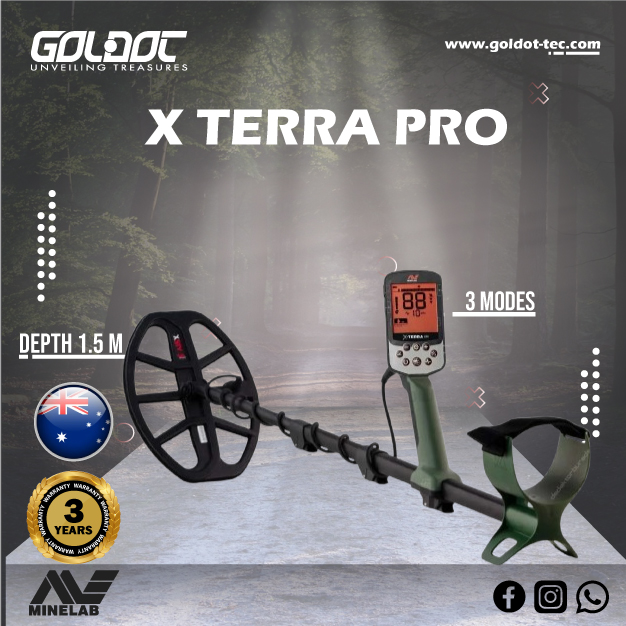
X-TERRA PRO for Accessible Water Detecting
Minelab X-TERRA PRO suits buyers who want a straightforward all-purpose detector that can move from authorized inland sites into appropriate shallow water. It uses PRO-SWITCH selectable-frequency technology rather than processing several operating frequencies simultaneously.
Search Modes and Advantages
The detector provides Park, Field, and Beach modes. Its selectable frequencies are 5, 8, 10, and 15 kHz, but availability depends on the chosen mode: Beach uses 8 kHz, while Park and Field offer the other supported options.
Key benefits include:
- Full IP68 waterproofing to 5 meters.
- Dedicated Beach operation for suitable shore searches.
- Adjustable ground balance and numerical Target ID.
- Rechargeable battery, vibration, and practical search controls.
- Lightweight collapsible construction for transport.
- Conventional use across coins, jewelry, parks, and fields.
Practical Limitations and Package Choice
X-TERRA PRO does not use simultaneous Multi-IQ, so regular wet-salt hunting may justify comparison with a suitable multi-frequency platform. The waterproof rating also does not mean the standard audio accessories are submersible. Buyers must confirm compatible underwater headphones separately.
Check the X-TERRA PRO waterproof setup for the supplied coil, charging equipment, appropriate audio options, and full package contents. Choose it when accessible controls and land-to-water flexibility matter more than advanced multi-frequency processing.
The LEGEND 2 for Regular Beach and Land Use
Nokta The LEGEND 2 suits buyers who regularly move between wet beaches, shallow saltwater, lakes, fields, and relic locations. Its simultaneous multi-frequency technology gives operators an alternative to single-frequency detection in conductive salt conditions.
Strengths for Water Searches
The LEGEND 2 features IP68 protection to 5 meters along with Park, Field, Beach, Relic, and Gold search modes. Its Target ID and adjustable recovery controls can help experienced users evaluate mixed-metal responses around busy shorelines.
Notable purchasing strengths include:
- Simultaneous multi-frequency operation and dedicated Beach mode.
- Full-body waterproofing to the published immersion limit.
- Detailed numerical target information and customizable tones.
- Adjustable recovery settings for contaminated locations.
- Suitable general land use alongside shallow-water searches.
- Different compatible LD-series coils for varied terrain.
Limits and Confirmations
The LEGEND 2 has more settings to learn than a basic starter detector. A buyer should also distinguish a waterproof detector from waterproof headphones: conventional wireless headphones do not communicate reliably underwater, and the necessary audio option must be confirmed.
Before requesting a quote, check The LEGEND 2 beach package for the supplied coil or coils, water-rated audio, charging equipment, and warranty details. Select this model when regular salt-beach detecting and conventional land versatility both matter.
EQUINOX 900 for Balanced All-Terrain Water Use
The Minelab EQUINOX 900 is designed for conventional detecting across parks, fields, beaches, and suitable prospecting locations. Its Multi-IQ simultaneous multi-frequency technology and dedicated Beach programs make it relevant to buyers who spend considerable time on conductive wet sand.
Everyday and Beach Advantages
EQUINOX 900 is IP68 waterproof to 5 meters. It includes Park, Field, Beach, and Gold applications and provides 119 Target ID segments to support target interpretation. A collapsible carbon-fiber shaft and adjustable recovery controls also contribute to its all-purpose use.
Minelab’s published standard configuration includes an 11-inch EQX11 coil and a compact 6-inch EQX06 coil. The wider coil suits general coverage, while the smaller one can help around rocks, heavy trash, and closely spaced targets.
Audio and Package Requirements
The supplied ML85 wireless headphones are useful on land but are not a substitute for purpose-built underwater audio. Before submersion, confirm compatible waterproof headphones and follow the manufacturer’s connection instructions. A waterproof shaft and coil do not make every attached accessory dive rated.
Review the EQUINOX 900 water-use configuration and ask Goldot-Tec to confirm the two coils, charging gear, underwater audio availability, and complete written package. This detector suits buyers who want versatile conventional detecting rather than a dedicated professional scuba-only setup.
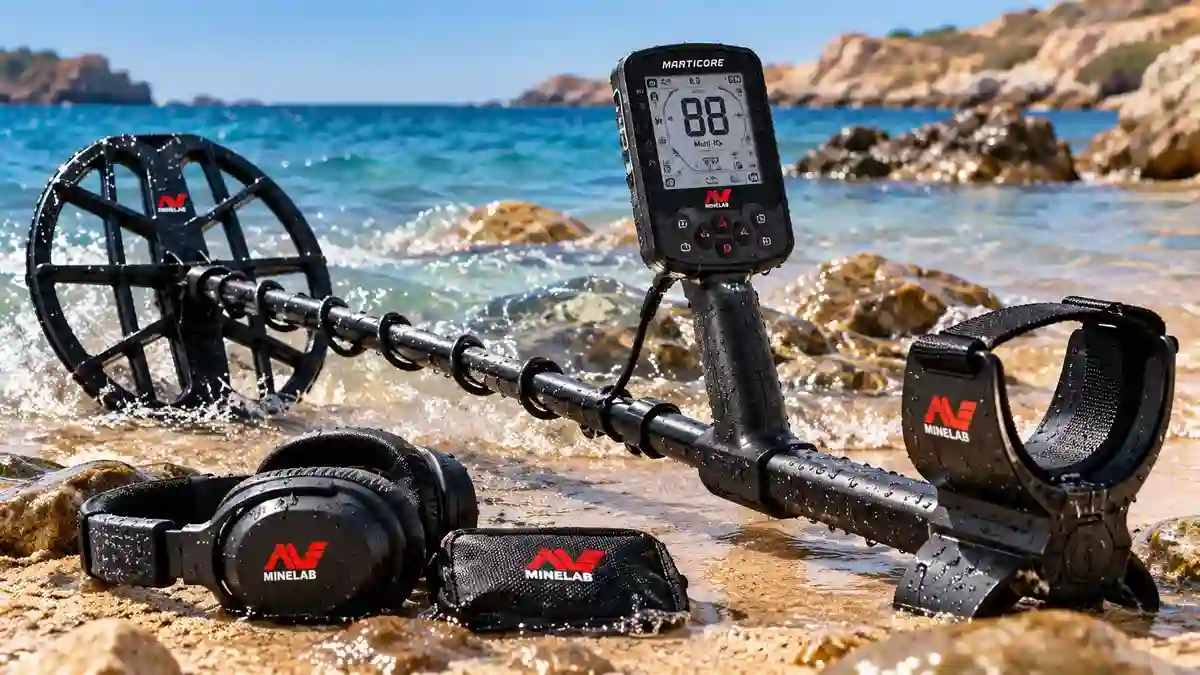
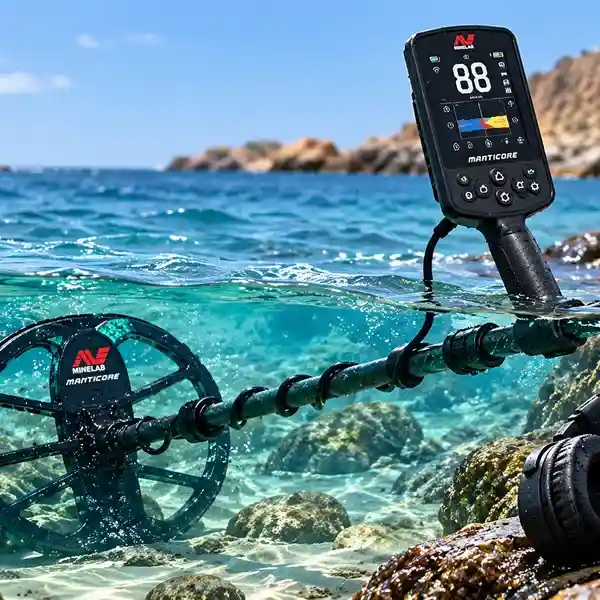
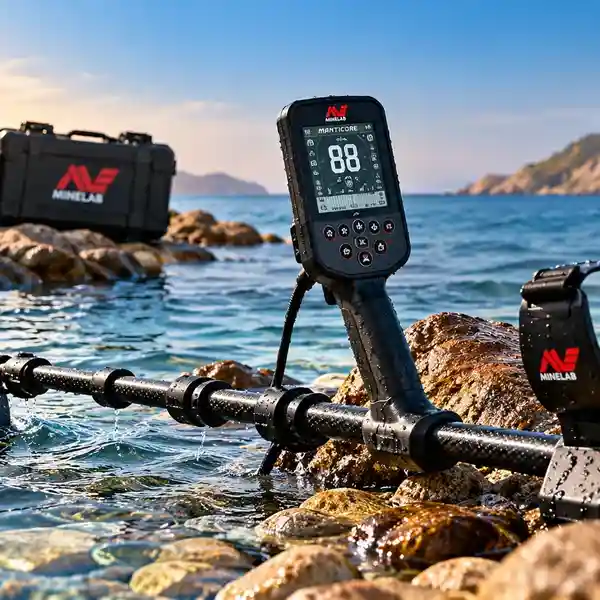
MANTICORE for Advanced Beach Target Analysis
Minelab MANTICORE addresses experienced beach hunters who want extensive audio and visual target information. It combines Multi-IQ+ technology with a two-dimensional Target Trace display showing conductive and ferrous response characteristics.
Benefits for Complex Beaches
MANTICORE provides Beach programs designed for different shore conditions, including surf and seawater situations. Its IP68 rating permits immersion to 5 meters within the stated limits. The advanced display and recovery controls can help users evaluate repeatable signals in sites containing iron, foil, and other unwanted metal.
Its principal advantages include:
- Detailed two-dimensional target analysis.
- Several beach-oriented programs and advanced ferrous controls.
- Full-detector water protection to 5 meters.
- Compatible coil options for general coverage or tighter searches.
- Manageable shaft design for long conventional sessions.
- Settings that experienced users can adapt to the site.
When Another Model Is More Appropriate
The advanced interface creates a learning curve, and extra controls may add little value for occasional beach users. Underwater audio must also be arranged separately from ordinary land headphones. MANTICORE’s water rating does not make it suitable for dives beyond 5 meters.
Choose it when detailed conventional target information matters more than simplicity. A dedicated diving unit may fit better when the project requires greater immersion depth or a shorter underwater shaft.
PulseDive for Compact Underwater Recovery
Nokta PulseDive Scuba serves a different purpose from long-shaft beach detectors. It uses Pulse Induction technology in a compact, pressure-rated design intended for snorkeling, diving, and close-range target checks. Nokta rates PulseDive to 60 meters.
Where Compact PI Adds Value
A small detection head makes PulseDive useful around underwater rocks, crevices, structures, and locations where a long detector is awkward. It offers audio, vibration, and LED indications, plus a dive mode designed to prevent unwanted key presses under pressure.
Buyers may prefer PulseDive for:
- Snorkeling and scuba work within its certified rating.
- Narrow underwater gaps or recovery locations.
- Backup use after another detector identifies an area.
- Compact storage and transport.
- Pulse-induction operation in salt-affected environments.
Confirm the Scuba or 2-in-1 Package
The compact coil covers less area per movement than a full-size beach detector. PulseDive also provides limited conventional discrimination. It is best judged as a specialist recovery tool rather than a primary detector for scanning entire beaches.
Nokta offers Scuba and convertible 2-in-1 configurations; buyers should not assume that a pinpointer tip is included with every Scuba package. Check the PulseDive Scuba recovery kit for the actual detection head, conversion accessories, charger, wrist strap, and carrying equipment. Its built-in wireless capability does not mean ordinary wireless headphones work underwater; plan to use manufacturer-approved underwater indication methods.
EXCALIBUR II for Full-Size Diving
Minelab EXCALIBUR II is designed for buyers who need a full-length detector suited to deeper saltwater searches. Its BBS multi-frequency technology uses 17 frequencies simultaneously, and Minelab specifies waterproof operation to 60 meters.
Full-Size Underwater Advantages
EXCALIBUR II includes an underwater-oriented design with a standard shaft and a shorter dive shaft. Its hardwired coil and waterproof headphones form part of the intended submersible setup. Rotary controls let operators adjust threshold, sensitivity, volume, and discrimination without relying on a digital Target ID display.
Its main strengths include:
- A manufacturer-specified 60-meter immersion limit.
- BBS technology intended for salt and mineralized underwater environments.
- Full-size search-coil coverage compared with compact recovery tools.
- Hardwired waterproof headphones.
- Standard and dive shafts for different handling positions.
- Audio discrimination for experienced underwater users.
When EXCALIBUR II Is Not the Right Buy
EXCALIBUR II is more specialized and less convenient for many dry-land sessions than lightweight all-terrain detectors. Its hardwired design limits component-swapping convenience, and users need to interpret audio without numeric Target ID. It is also not a dedicated natural-gold prospecting detector.
Choose this platform when full-size diving equipment and extended submersion are essential, rather than purchasing it for occasional shoreline detecting. Confirm the current supplied coil, battery, charging accessories, shaft arrangement, and warranty before ordering.
Waterproof Versus Water-Resistant Construction
Product descriptions must distinguish protection of the entire detector from protection of its coil or accessories. Water-resistant equipment may handle splashes, while an immersion-rated system specifies how deeply the complete unit can be submerged. Pressure-rated scuba designs require greater protection than casual shore equipment.
IP68 is not a single universal depth number. For example, full-length detectors in this guide are rated to 5 meters, whereas PulseDive and EXCALIBUR II are rated to 60 meters. Follow each manufacturer’s restrictions even when two models display the same IP designation.
Before entering water, inspect seals, connectors, headphones, and charging covers. A waterproof rating does not replace normal diving safety requirements.
Saltwater Detection Technologies
Conductive wet sand and saltwater can create detector responses that differ from dry inland soil.
Selectable Single-Frequency Detectors
X-TERRA PRO offers selectable single-frequency operation and a dedicated 8 kHz Beach setting. It can serve occasional surf and general detecting, but users with frequent challenging wet-salt searches may benefit from comparing suitable simultaneous multi-frequency systems.
Simultaneous Multi-Frequency Systems
The LEGEND 2, EQUINOX 900, and MANTICORE process multiple frequency components during a search. Their Beach programs and Target ID features make them relevant to conventional coin and jewelry recovery in mixed shore conditions. However, no multi-frequency setting eliminates all false signals or guarantees correct identification.
Broad-Band Multi-Frequency
EXCALIBUR II uses Minelab’s BBS system, designed for underwater and saltwater operation. Its audio-led workflow differs from the graphical displays of modern all-terrain detectors. Buyers should choose it for the required diving method, not assume BBS is universally better for every target.
Pulse Induction
PulseDive uses PI, which can provide stable operation in conductive saltwater and mineralized conditions. Its limitation is reduced conventional discrimination: fishing hardware, iron, aluminum, and desirable jewelry may all produce responses. PI’s ground-handling advantages do not make a compact coil suitable for wide-area coverage.
Realistic Detection Depth and Target Accuracy
Immersion depth and detection depth are entirely different measurements. A detector rated to 5 meters can operate at that water depth under the manufacturer’s conditions; it cannot therefore detect a coin buried 5 meters below the bottom.
Actual target response depends on:
- Metal type, target size, shape, and orientation.
- Coil design and its distance from the object.
- Salt concentration, black sand, and other mineralization.
- Water movement and sand displacement.
- Recovery settings, sensitivity, and interference.
- Sweep control, audio interpretation, and operator experience.
A thin chain may produce a much weaker signal than a substantial ring. A larger coil can cover more ground and suit certain target sizes, while a smaller one may isolate signals around rocks or unwanted metal. Neither guarantees a particular detection depth.
Practical Accuracy Underwater
Evaluate repeatability rather than relying on a single Target ID number. Sweep from another direction when conditions allow, slow down near suspected targets, and check the response after removing some surface sand. Use compatible audio or vibration indications, control cable movement, and rescan the recovery area. Strong salt responses and nearby iron can still distort identification.
Do not apply aggressive discrimination without considering thin jewelry and other low-conductivity objects. Manufacturer depth demonstrations require context: the target, ground, coil, settings, and test procedure must be comparable to your intended search.
Best Uses by Water Environment
These use cases connect the six existing models to their principal purchasing roles. Detect only where permitted.
| Water Environment | Detector to Consider | Key Buying Question |
|---|---|---|
| Dry beaches and occasional shallow water | X-TERRA PRO | Is selectable single-frequency operation adequate for your salt conditions? |
| Regular beach and freshwater detecting | The LEGEND 2 | Which coil and waterproof audio are included? |
| Frequent salt beaches plus inland sites | EQUINOX 900 | Do you need both supplied coils and dedicated underwater audio? |
| Advanced target identification on busy shores | MANTICORE | Will you use the additional Target Trace and audio controls? |
| Snorkeling and restricted underwater recovery | PulseDive Scuba | Do you need the Scuba-only or convertible 2-in-1 kit? |
| Full-size deeper scuba searches | EXCALIBUR II | Do the dive shaft, hardwired audio, and 60-meter rating match the dive plan? |
Water-Use Packages by Buyer Type
Different waterproof metal detectors for sale meet different operational needs. Instead of dividing models into unsupported price bands, compare them by the work each buyer plans to do.
First-Time Water Detecting
New users often benefit from straightforward controls, manageable weight, and a reliable waterproof body. X-TERRA PRO can suit shallow-water and mixed land detecting when its frequency approach matches the conditions. Confirm suitable audio before submerging the detector.
Regular All-Terrain and Beach Use
Buyers who alternate between wet salt beaches and inland sites may value the simultaneous multi-frequency options offered by The LEGEND 2 or EQUINOX 900. Those who want extensive visual target analysis may also compare MANTICORE.
Snorkeling and Scuba Diving
PulseDive is suited to compact underwater work, while EXCALIBUR II provides full-size diving coverage. Both are rated to 60 meters, but they are not interchangeable: handling, target identification, coil size, and search coverage differ. Choose according to the dive method and expected recovery area.
Package Value Comparison
Before purchasing waterproof metal detectors for sale, request an itemized package showing what is included, optional, or not supplied. The following table helps identify components that can materially change readiness for wet environments.
| Package Component | Why It Matters | What to Confirm in the Quote |
|---|---|---|
| Waterproof headphones | Normal wireless audio is not reliable underwater | Manufacturer-approved model and connector |
| Search coil and cover | Affect handling and protect against abrasion | Exact coil model, cover, and immersion rating |
| Compact additional coil | Can help around rocks or heavy trash | Compatibility and whether optional |
| Sand scoop or recovery tool | Helps recover targets without damaging equipment | Suitability for sand or local conditions |
| Pinpointer or scuba head | Useful for close-range target recovery | Whether included in the specific PulseDive configuration |
| Dive shaft | Improves underwater handling for supported systems | Included or optional, correct model |
| Battery and charger | Required for usable field sessions | Charger, battery type, and safe charging instructions |
| Carrying protection | Reduces transport and salt exposure issues | Case, bag, and component protection |
| Seals and servicing | Important for immersion-rated electronics | Inspection and replacement instructions |
| Warranty and support | Clarifies service procedures after water use | Written coverage and authorized assistance |
A larger bundle is worthwhile only when its accessories support your actual searches. Ask Goldot-Tec to separate standard equipment from extras, and confirm whether water-damage exclusions or maintenance conditions apply. For US shipments, also ask who handles warranty claims, whether replacement seals or approved underwater accessories can be obtained, and what documentation accompanies the package if service is needed later.
Pros and Cons Overview
A short list of practical trade-offs helps buyers avoid comparing unlike technologies through a single performance claim.
| Detector | Primary Purchasing Advantage | Main Practical Limitation |
|---|---|---|
| X-TERRA PRO | Accessible fully submersible all-purpose detection | No simultaneous multi-frequency operation |
| The LEGEND 2 | Salt-beach and inland versatility | Water-rated audio and package components need confirmation |
| EQUINOX 900 | Multi-IQ, detailed Target ID, and flexible coils | Standard land headphones are unsuitable underwater |
| MANTICORE | Advanced 2D target interpretation | More settings to learn; limited to 5-meter immersion |
| PulseDive | Compact 60-meter PI recovery tool | Limited search coverage and discrimination |
| EXCALIBUR II | Full-size dive system with hardwired audio | No numeric display and limited land convenience |
How to Choose the Right Device
Use the following sequence once, rather than making separate decisions about coverage and total package requirements in multiple parts of the purchase process.
- Choose the water environment. Identify freshwater, dry sand, wet salt sand, surf, snorkeling, or scuba, and decide whether the entire detector will be submerged.
- Verify the immersion rating. Match the intended maximum water depth to the manufacturer’s limit; do not confuse that rating with target depth.
- Choose the target and technology. Conventional multi-frequency detection may suit coins and jewelry, while compact PI may be more practical for close-range saltwater recovery.
- Match the search coverage. Use a full-size coil for broader areas and a compact configuration for crevices or narrow underwater locations.
- Assess Target ID and experience. Busy beaches may reward useful discrimination, whereas audio-led dive systems require more practice.
- Confirm audio and handling. Review waterproof headphones, vibration, shaft length, connectors, and stability in currents.
- Verify the actual package. Request the coil, power equipment, charger, accessories, seals, warranty, and support terms in writing.
- Confirm US delivery. Provide your state, request current availability, and review any applicable shipping or service arrangements before ordering.
For example, a permitted Florida shoreline search may prioritize Multi-IQ and comfortable beach handling, while a controlled freshwater dive may prioritize water-rated equipment and a compact recovery tool. Site permission and the actual conditions remain essential.
Common Buying Mistakes
Several avoidable errors can make an otherwise suitable underwater detector a poor purchase.
- Assuming a waterproof coil means a waterproof detector: Verify the entire system, including the control pod and connectors.
- Confusing immersion depth with target depth: Treat the former as an equipment-safety limit, not a performance promise.
- Using ordinary wireless headphones underwater: Confirm an approved waterproof audio or vibration method before immersion.
- Ignoring saltwater conductivity: Match the technology and Beach settings to the actual ground and water.
- Buying a compact scuba tool for whole-beach coverage: Choose full-length equipment when broad scanning is the priority.
- Purchasing a deep-diving detector only for dry sand: Avoid specialist complexity when shallow all-terrain equipment fits the job.
- Overlooking underwater balance: Shaft length, currents, coil size, and arm fatigue can alter handling.
- Skipping maintenance: Rinse salt and sand as instructed, inspect seals, and dry charging connections completely before charging or storage.
- Ignoring local rules and safety: Confirm detecting permissions, protected sites, dive qualifications, and conditions before any underwater search.
Final Buyer Recommendations
X-TERRA PRO can be a practical first fully submersible detector for mixed land and appropriate shallow-water searches. The LEGEND 2 suits buyers who want simultaneous multi-frequency operation across regular beaches and inland locations. EQUINOX 900 adds detailed Target ID and a versatile coil configuration for frequent all-terrain users.
MANTICORE is relevant to experienced beach hunters who will make use of advanced two-dimensional target analysis. PulseDive is a compact 60-meter recovery instrument, while EXCALIBUR II suits divers needing a full-size detector with a dedicated deep-water configuration. Each choice serves a different role, and none guarantees a particular discovery or target depth.
Frequently Asked Questions
Which waterproof detector should I choose for saltwater beaches?
The LEGEND 2, EQUINOX 900, and MANTICORE are simultaneous multi-frequency options with dedicated beach operation. Select based on your experience, target-information needs, search coil, and required waterproof audio. X-TERRA PRO may be appropriate for some occasional beach searches when correctly configured.
Can I use ordinary wireless headphones while a detector is submerged?
No. Standard land wireless audio is not a reliable underwater solution. Confirm a manufacturer-approved waterproof headphone arrangement or an appropriate vibration indication for the exact detector. Also verify the immersion limits of every connected accessory.
Do the 5-meter and 60-meter ratings describe how deeply a detector finds metal?
No. They are maximum equipment immersion limits under manufacturer-defined conditions. Actual target-detection depth depends on the object’s size, metal type, shape, orientation, coil, settings, sand mineralization, water conditions, and operator technique.
Request Your US Waterproof Detector Package
The right choice among waterproof metal detectors for sale begins with how and where you intend to search. For everyday beaches, lakes, and shallow water, confirm a suitable all-terrain detector and its underwater audio. For snorkeling or scuba work, compare the compact PulseDive workflow with the full-size EXCALIBUR II design before choosing the dive package.
Buying in the United States? Contact Goldot-Tec for Availability. Share your water type, planned immersion depth, targets, experience, preferred coil, and delivery state. Ask for a written configuration showing the detector, waterproof audio, charging equipment, warranty, maintenance requirements, and current shipping options so you can order a package suited to your actual search.