
Understanding Gold Vision Metal Detector Price factors is essential for US buyers considering a professional underground scanning and multi-system exploration device. The right purchase depends on the intended search project, ground conditions, software compatibility, included accessories, operator experience, and available technical support.
GeoGround Gold Vision combines a 3D ground-scanning function with several additional manufacturer-defined search systems. However, its different technologies should not be confused with conventional VLF metal detection, Pulse Induction, or Ground Penetrating Radar. Each approach requires separate evaluation before purchase.
This guide reviews the Gold Vision’s documented functions, explains the differences between Gold Vision and Groundtech GR-4 Dual, and outlines what US buyers should confirm before requesting a package from Goldot-Tec. The objective is to choose a suitable configuration without relying on unsupported depth claims, promotional rankings, or unverified field results.
Overview of the GeoGround Gold Vision
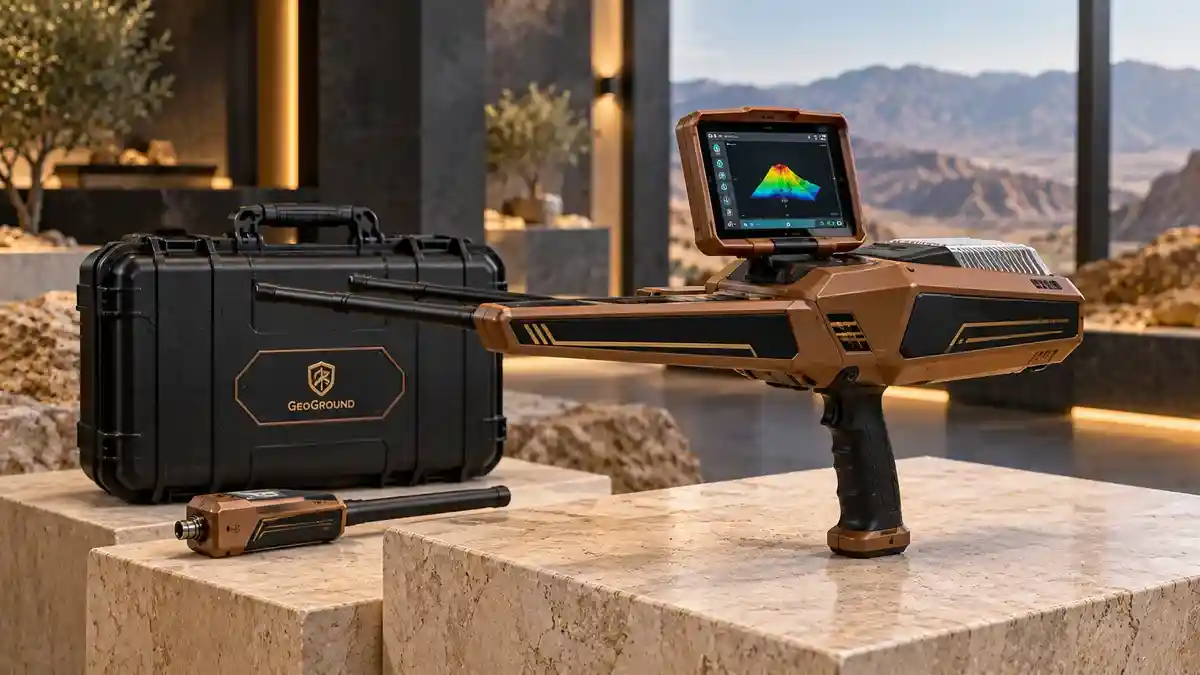
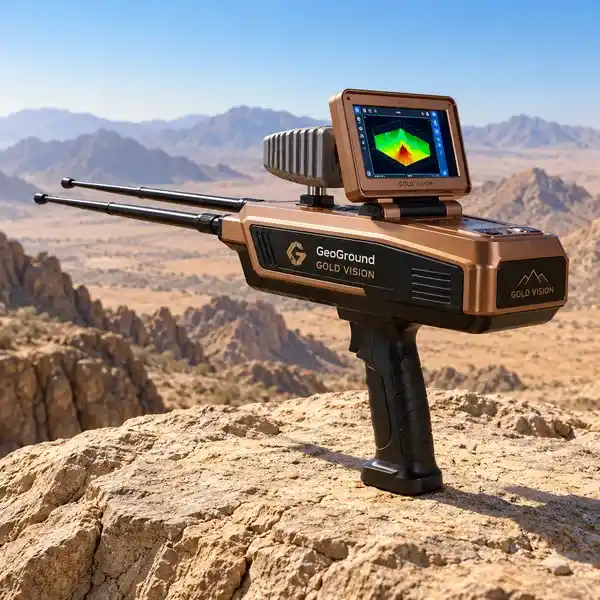
GeoGround Gold Vision is a multi-system exploration device developed by GeoGround Detection Technologies. It combines an electronic control unit, a Smart Sensor, associated search accessories, and software designed to visualize collected ground-scanning measurements.
The manufacturer’s documentation identifies six operating systems, including 3D Ground Scan, Long Range, Free Mode, Smart Depth, Ionic, and Bionic.
These functions are presented as different search methods rather than identical versions of conventional metal detection.
For buyers evaluating Gold Vision Metal Detector Price and package suitability, the first step is to identify which functions are actually needed for the project.
Gold Vision Search Applications
The manufacturer markets Gold Vision for several exploration applications, including:
- Preliminary investigation of underground anomalies.
- Exploration of possible buried metallic objects.
- Surveys of locations suspected to contain underground structures.
- Treasure-hunting projects at authorized locations.
- Preliminary archaeological investigations where permitted.
- Exploration projects requiring ground-scanning visualization.
However, the presence of these applications in product documentation does not guarantee successful identification of a particular target.
A scan showing an underground anomaly does not automatically establish the presence of gold, treasure, a tunnel, or a chamber.
Instead, buyers should evaluate the measurement method, scanning procedure, interpretation requirements, and evidence needed to confirm an interesting result.
Confirm the Gold Vision Configuration
Before choosing a package, review the GeoGround Gold Vision configuration and check which accessories are included in the current Goldot-Tec offer.
The manufacturer identifies a main electronic unit, Smart Sensor, signal booster, wireless handle, RF antennas, charging equipment, user manual, and warranty documentation within its published package information.
However, the exact dealer configuration should always be confirmed in writing.
Gold Vision Metal Detector Price Factors
Gold Vision Metal Detector Price comparisons should focus on the complete equipment package rather than an isolated product listing.
Two offers may refer to the same detector while differing in accessories, software arrangements, warranty documentation, training, or delivery conditions.
For a professional buyer, these differences can affect how quickly the equipment can be prepared for fieldwork.
Package Configuration
The first consideration is whether the offer contains the components required for the intended operating modes.
Request confirmation of:
- Main Gold Vision control unit.
- Smart Sensor and related connections.
- Signal Booster Dish.
- Wireless handle assembly.
- RF antenna components.
- Battery and charging equipment.
- Carrying and protective accessories.
- User manual and warranty documentation.
- Compatible software and installation instructions.
A package should be judged by whether the included components support the planned work.
Accessories should not be added merely to increase the size of the offer.
Software and Training Requirements
Software is particularly important for buyers intending to use the 3D Ground Scan system.
GeoGround documents an Android-compatible analysis application that receives scanning data through Bluetooth and displays graphical representations.
Before ordering, confirm the current application version, compatible Android devices, installation procedure, and support arrangements.
Training should cover scan preparation, sensor handling, consistent data collection, and interpretation limitations.
US Delivery and Support
Buyers in the United States should ask Goldot-Tec to confirm current availability and delivery options for their specific state.
Warranty arrangements, software assistance, technical support, and any shipping requirements should appear in the written offer.
Do not assume that a product listing establishes immediate availability or identical delivery conditions for every destination.
Key Features of Gold Vision
Gold Vision offers several manufacturer-described search functions. Understanding the purpose and limitations of each function is more useful than treating the number of operating modes as a performance ranking.
3D Underground Imaging
The 3D Ground Scan system uses the Smart Sensor to collect measurements associated with magnetic-field variations across the investigated area.
Collected information is transmitted through Bluetooth to the manufacturer’s Android analysis application, where it can be displayed graphically.
This workflow is intended to support the investigation of underground anomalies.
Potential buying benefits include:
- Organizing ground-scanning measurements.
- Visualizing variations recorded during a survey.
- Reviewing an area before deciding on further investigation.
- Comparing repeated measurements.
- Supporting structured field documentation.
However, the resulting visualization is not an underground photograph.
A displayed shape or color does not independently establish the composition, identity, or exact depth of a buried target.
Long-Range and Free Mode Systems
GeoGround also describes Long Range and Free Mode systems within the Gold Vision platform.
These modes use manufacturer-defined operating procedures and adjustable search settings.
However, their long-distance target claims should not be treated as independently verified detection capability without appropriate evidence.
Buyers should request a demonstration that explains the exact operating method, test conditions, repeatability, and limitations.
These functions must not be confused with the direct electromagnetic target responses produced by conventional VLF or Pulse Induction detectors.
Smart Depth, Ionic and Bionic Systems
The manufacturer’s remaining systems include Smart Depth, Ionic, and Bionic modes.
Smart Depth is presented as a method for estimating target depth using a particular operating procedure.
Ionic and Bionic are additional manufacturer-defined locating modes.
Their outputs should be evaluated cautiously because an estimated depth or target indication is not independent proof of a buried object.
For a professional project, repeatable measurements and suitable secondary confirmation remain necessary.
Portable Hardware and Rechargeable Power
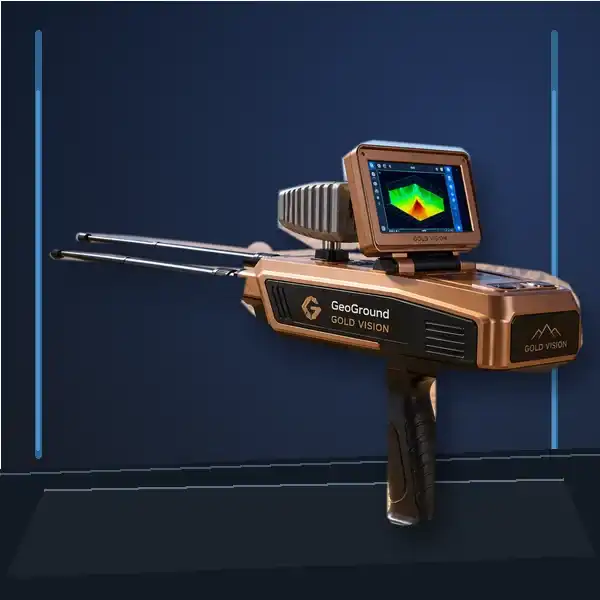
GeoGround documents a compact electronic control unit with an integrated display and rechargeable lithium-ion battery.
The manufacturer also lists a Smart Sensor, wireless handle, and related search accessories.
These components may support field transportation and setup.
However, buyers should consider the complete working kit rather than the control unit alone.
Remote projects may require additional planning for charging, carrying equipment, device compatibility, and operating conditions.
Gold Vision vs GR-4 Dual
Comparing Gold Vision with GR-4 Dual is useful when buyers are deciding between a multi-system exploration platform and equipment that combines structured ground scanning with direct Pulse Induction metal detection.
The GR-4 Dual scanning package represents a different approach because the manufacturer documents a dedicated PI detector alongside its 3D ground-scanning system.
Neither device should be described as universally more accurate or powerful without a controlled comparison relevant to the project.
Gold Vision Strengths
Gold Vision’s purchasing appeal comes from its combination of manufacturer-defined operating systems, 3D scanning functionality, and Android-based visualization.
It may suit buyers who want to evaluate that particular workflow and are prepared to learn its different operating procedures.
However, the existence of multiple modes does not prove that every mode provides reliable results under all conditions.
GR-4 Dual Strengths
Groundtech GR-4 Dual combines an MFS-2 dual-sensor scanning system with a separate Pulse Induction metal detector.
The system supports structured scanning and direct metallic-target detection through different operating methods.
This can be relevant when a project genuinely requires both forms of investigation.
However, its scanning output still requires interpretation, while PI detection relies on metallic target responses.
Gold Vision and GR-4 Dual Comparison
| Comparison Factor | GeoGround Gold Vision | Groundtech GR-4 Dual |
|---|---|---|
| System type | Multi-system exploration device | 3D ground scanner with integrated PI detector |
| Ground imaging | Smart Sensor-based 3D Ground Scan | MFS-2 dual-sensor ground-scanning system |
| Additional search functions | Long Range, Free Mode, Smart Depth, Ionic, Bionic | Direct PI metal detection and additional scanning modes |
| Data visualization | Android-compatible GeoGround application | Built-in screen and Groundtech Portal application |
| Operator requirements | Training for different search modes and interpretation | Training for both structured scanning and PI operation |
| Suitable buying scenario | Buyer evaluating Gold Vision’s documented multi-system workflow | Project needing structured survey data and direct metallic-target checks |
| Practical limitation | Long-range and other system claims require independent validation | PI cannot directly establish the presence of an empty cavity |
| Package requirements | Smart Sensor, handle, antennas, software, power, accessories | Scanner sensor, PI coil, software, power, accessories |
The comparison does not establish a numerical performance winner.
Instead, it highlights which equipment and operating methods buyers should evaluate before ordering.
Choosing Between the Two Systems
A buyer focused on Gold Vision’s specific operating systems should assess those methods and request clear demonstrations.
Meanwhile, a professional team needing conventional direct metal detection alongside structured ground scanning may find the GR-4 Dual architecture more relevant.
When the project does not require imaging or the additional search modes, a different detector category may provide a simpler purchasing route.
Understanding Ground Imaging Limitations
Professional underground scanning requires more than collecting visually attractive graphics.
A useful survey should follow a defined measurement process and produce results that can be reviewed consistently.
Ground Imaging Is Not Photography
A 3D scanner does not provide a literal photograph of underground treasure, tunnels, or buried metal.
Instead, software processes collected measurements into visual representations.
Different subsurface conditions can produce ambiguous signals.
Therefore, an unusual color or shape should lead to investigation rather than an automatic claim about target identity.
Different Detection Technologies
Several technologies may be discussed together in the underground exploration market, but they are not interchangeable.
- VLF metal detectors: Respond to metallic targets and often provide conventional discrimination.
- Pulse Induction detectors: Use pulse-based electromagnetic detection and may be suitable for particular mineralized-ground or large-metal applications.
- 3D ground scanners: Collect structured measurements that require interpretation.
- Ground Penetrating Radar: Records subsurface electromagnetic reflections through a separate surveying method.
- Long-range locating systems: Require independent evaluation of their measurement claims and repeatability.
The right technology depends on the question the project needs to answer.
Buyers considering conventional scanning equipment can compare ground imaging systems before choosing a package.
Performance and Field Verification
The original Gold Vision review discussed field results and reported success. However, reliable purchasing advice should distinguish documented functions from independently demonstrated performance.
Without verified test records, it would be misleading to claim that a detector consistently identifies chambers, tunnels, valuable metals, or underground structures under particular field conditions.
Instead, evaluate how the system behaves during a controlled demonstration.
Check the Search Method
Ask the seller to explain which operating system is being demonstrated.
A 3D ground scan should not be compared directly with a long-range indication or conventional PI target response.
Document:
- The selected operating mode.
- The target or test object.
- Ground conditions.
- Scan or search procedure.
- Equipment configuration.
- Relevant software settings.
- Environmental interference.
Repeat the Demonstration
A single interesting result does not establish reliable performance.
Where practical, repeat the procedure under comparable conditions and include locations without the test target.
The purpose is to understand whether the instrument provides consistent information rather than relying on one favorable indication.
Verify Target Interpretation
Ask how the operator distinguishes a possible metallic target from a ground disturbance or other anomaly.
For professional survey work, important findings may require repeated measurements or another appropriate method.
An estimated target depth should also be treated as an interpretation requiring context.
Evaluate Survey Area Coverage
Large-area capability depends on site accessibility, measurement procedure, sensor handling, and the amount of data the operator can collect consistently.
A larger survey is not automatically more informative than a smaller, carefully documented one.
Buyers should establish realistic project requirements before accepting claims about coverage or field efficiency.
Dealer Offers and Package Requirements
Gold Vision Metal Detector Price evaluations should include the service and equipment requirements associated with the purchase.
A professional detector package may need more preparation than a conventional recreational detector.
Confirm the Included Equipment
Before requesting an offer, ask Goldot-Tec to identify the exact supplied components.
A useful checklist includes:
- Main electronic unit and Smart Sensor.
- Signal Booster Dish and wireless handle.
- RF antenna components.
- Charging equipment.
- Protective carrying accessories.
- User manual and documentation.
- Current software requirements.
- Warranty terms.
- Technical assistance and training.
Do not assume that every accessory shown in promotional material comes with the standard dealer package.
Confirm Software Compatibility
The manufacturer documents Android-based visualization for Gold Vision.
Therefore, buyers should confirm the supported operating-system version and hardware requirements.
Also ask whether software installation, initial setup, data transfer, and application guidance are included.
These details matter when the purchaser intends to use the device for structured survey work.
Confirm Training and Support
Professional equipment can require substantial familiarization.
Ask whether the available assistance covers sensor setup, survey preparation, operating modes, software use, and result interpretation.
Warranty and service procedures should also be documented.
The value of training depends on whether it addresses the functions the buyer will actually use.
Used Gold Vision Market
Some buyers researching Gold Vision Metal Detector Price may consider purchasing previously owned equipment.
However, a used-market offer should not automatically be considered available, authentic, or complete.
The condition and operating history of an individual unit can make a significant difference.
Benefits of Considering Used Equipment
A properly maintained used scanner may be an option for a buyer who can verify its condition and the included equipment.
However, any expected purchasing benefit must be weighed against software compatibility, battery health, missing accessories, and warranty limitations.
No general conclusion about used-market availability should replace verification of a specific unit.
What to Inspect Before Buying Used
Check the following:
- Physical condition of the control housing.
- Smart Sensor and connections.
- Wireless handle and antenna components.
- Battery condition and charging operation.
- Display, buttons, and audio functions.
- Software compatibility and data transfer.
- Serial number and purchase documentation.
- Warranty status and service eligibility.
- Availability of replacement accessories.
Where possible, request a controlled functional demonstration.
Used-System Limitations
A previously owned detector may have incomplete documentation or accessories.
Software installation may also require additional verification.
Therefore, buyers should compare the complete used configuration with a current new-device offer rather than judging the product from its exterior condition alone.
Gold Vision Price History and Market Information
Historical Gold Vision Metal Detector Price information may appear in older product listings or promotional material.
However, an old listing does not reliably establish the conditions of a current US purchase.
Likewise, statements that professional scanners consistently retain their value require evidence from comparable transactions.
Factors That Can Affect Offers
Current package terms may vary according to:
- Available detector configurations.
- Included accessories.
- Software arrangements.
- Dealer stock.
- Warranty coverage.
- Training and support.
- Delivery requirements.
- Product condition when comparing used equipment.
These factors should be confirmed for the particular offer.
Avoid Unsupported Resale Claims
Professional equipment should not be described as maintaining a fixed resale value without documented market evidence.
Depreciation can depend on condition, software support, accessory availability, and demand for the particular model.
For buyers, it is more useful to evaluate the equipment’s suitability and condition than to rely on generalized market predictions.
Best Time to Request a Gold Vision Offer
The best time to request a Gold Vision package depends on the buyer’s project schedule, equipment requirements, and confirmed availability.
Promotions or dealer campaigns should not be assumed to exist unless Goldot-Tec confirms them.
Project Readiness
A professional buyer should prepare the site requirements before placing an order.
Confirm the planned search method, operating team, software compatibility, and equipment needed in the field.
This helps avoid receiving a package that does not match the actual project.
Availability and Delivery
A detector may be listed online without every configuration being immediately available.
Ask Goldot-Tec to confirm the specific package and delivery options for your US state.
A written offer should distinguish included equipment from optional additions.
Optional Package Additions
Additional accessories only create value when they support a real project requirement.
For example, extra carrying equipment or technical assistance may be useful to one team but unnecessary to another.
Request a package based on the work rather than the largest possible bundle.

Warranty Information
Warranty coverage is an important part of professional detector ownership.
However, buyers should confirm the actual terms for the specific unit, dealer, and destination.
New Gold Vision Systems
Before ordering a new device, confirm:
- Applicable manufacturer warranty.
- Serial number and authenticity documentation.
- Components covered by the warranty.
- Software support arrangements.
- Repair and service procedures.
- Required purchase documentation.
- Available technical assistance.
Do not assume that every seller offers the same after-sales process.
Used Gold Vision Systems
For a used detector, request written confirmation of any remaining warranty coverage.
Also ask whether the warranty is transferable and what documentation is required.
If warranty status cannot be verified, treat that uncertainty as part of the purchase decision.
Gold Vision Package Value
The value of Gold Vision should be evaluated according to its suitability for the intended exploration workflow and the complete package supplied.
A detector with numerous search modes is not automatically better than a simpler device with a clearly defined measurement method.
Potential Buying Advantages
Gold Vision may appeal to buyers interested in:
- A manufacturer-defined multi-system exploration platform.
- Smart Sensor-based 3D ground scanning.
- Android-based scan visualization.
- Integrated display and rechargeable power.
- Portable field equipment.
- Several selectable operating modes.
These features should be assessed according to the functions the buyer intends to use.
Practical Limitations
Before purchasing, consider:
- Different operating methods require different training.
- Graphical output does not confirm target identity.
- Some advertised search claims require independent validation.
- Software compatibility must be checked.
- Professional interpretation may be necessary.
- The complete package can involve several accessories.
- Ground conditions affect measurement quality.
A responsible purchase decision should acknowledge these limitations rather than assuming that a more complex device guarantees better results.
Who Should Buy the Gold Vision?
Gold Vision Metal Detector Price research often comes from buyers who are close to selecting exploration equipment.
However, the right product depends on whether its operating methods answer the intended project question.
Treasure-Hunting Buyers
Treasure hunters considering Gold Vision should define the expected target, search area, and evidence required before excavation.
If the main objective is an individual metallic object, another conventional detector may provide a more direct approach.
Archaeological and Survey Teams
Authorized archaeological or survey teams may be interested in structured measurements and graphical documentation.
However, the equipment should only be considered when its measurement method meets the project’s requirements.
Professional interpretation and suitable verification methods remain important.
Exploration Teams
Organizations conducting preliminary exploration may benefit from equipment that supports documented field procedures.
Before choosing Gold Vision, the team should clarify which operating modes it expects to use and whether it can validate the results.
Buyers Who Need Another Detector
Gold Vision is not automatically the correct equipment for every underground search.
Buyers focused on coins, jewelry, natural-gold nuggets, or direct metallic-target detection may benefit from a conventional VLF or specialist PI system.
If the project does not require Gold Vision’s multi-system workflow, explore multi-purpose detector alternatives before choosing a professional package.
Gold Vision US Purchase Checklist
Before requesting a Gold Vision Metal Detector Price offer, prepare the information Goldot-Tec needs to recommend a suitable configuration.
- Define the project: Explain whether the main goal involves buried metal, ground anomalies, suspected structures, or another exploration task.
- Identify the operating modes: Specify which Gold Vision search functions you expect to use and request demonstrations of their practical limitations.
- Describe the site: Include soil conditions, terrain, survey area, obstacles, and possible electromagnetic interference.
- Confirm the equipment: Check the main unit, Smart Sensor, antennas, handle, booster, charger, and carrying accessories.
- Verify the software: Identify the compatible Android device, application version, installation requirements, and data-handling procedure.
- Assess operator experience: Determine whether the team needs training in scanning, software interpretation, or the additional search modes.
- Review warranty and support: Confirm the applicable terms, documentation, technical assistance, and service procedure.
- Confirm US delivery: Provide your state and request written confirmation of current availability, included components, and delivery options.
For buyers still comparing technology categories, compare detector functions before ordering to distinguish conventional detection from underground scanning and other exploration methods.
A suitable written quotation should make the package and operating requirements clear before payment.
Frequently Asked Questions
What affects Gold Vision Metal Detector Price for US buyers?
The complete package, accessories, software requirements, warranty terms, training, support, and delivery arrangements can affect an offer. Ask Goldot-Tec to confirm the exact configuration and current availability rather than relying on an older product listing.
Is Gold Vision better than Groundtech GR-4 Dual?
Neither device is universally better. Gold Vision offers six manufacturer-defined search systems, including 3D Ground Scan, while GR-4 Dual combines structured ground scanning with a separate PI detector. Choose according to the required measurement method, operator experience, software, and complete package.
Can Gold Vision identify underground gold or cavities with certainty?
No. Ground-scanning visualizations and estimated target information require interpretation and cannot guarantee material identity, depth, or the presence of a specific underground structure. Buyers should request controlled demonstrations and suitable confirmation procedures before relying on a result.
Request Your Gold Vision Package from Goldot-Tec
GeoGround Gold Vision is a multi-system exploration device that combines 3D ground-scanning visualization with additional manufacturer-defined search functions. Its suitability depends on the project’s actual measurement requirements, operator experience, and ability to interpret results responsibly.
For buyers comparing Gold Vision with GR-4 Dual, the important difference is not a promotional performance score. It is the underlying operating method and whether the project needs structured scanning, direct PI metal detection, or another investigation approach.
A complete purchasing decision should also consider software compatibility, included accessories, warranty documentation, training, current availability, and delivery requirements.
Buying in the United States? Contact Goldot-Tec for Availability and request a personalized Gold Vision package. Share your project type, ground conditions, intended search methods, operator experience, and delivery state. Ask the team to confirm the complete configuration, software requirements, technical support, and current ordering arrangements before proceeding with your purchase.