

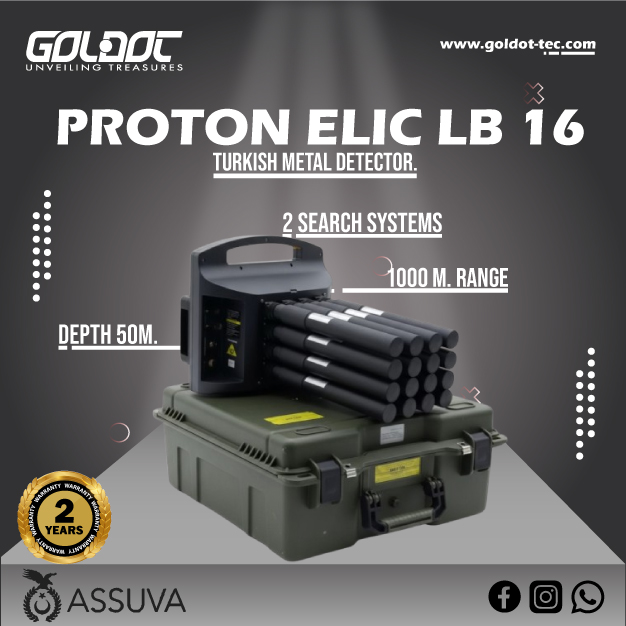
The Proton 16 Scanner is the search term commonly used for the Proton Elic LB-16, a professional hybrid underground detection system currently listed by Goldot-Tec. Unlike a conventional coil-based metal detector, the LB-16 combines thermal sensing with a multi-point magnetic sensor array and is positioned for applications involving metallic anomalies, cavities, underground structures, archaeology, geology, and professional exploration.
For a buyer in 2026, however, evaluating the Proton 16 Scanner should involve more than comparing its advertised range or depth with another detector. Its 16-point magnetic sensor system, thermal camera, visual LED output, Bluetooth connectivity, optional radar module, field workflow, and method of confirming suspicious readings all matter.
This guide explains those areas while separating Goldot-Tec’s published specifications from practical evaluation.
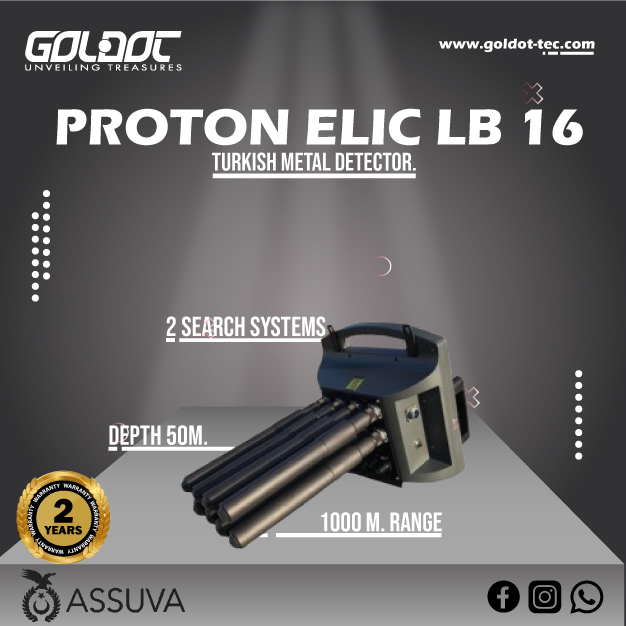
Proton 16 Scanner: What Buyers Are Usually Looking For
A buyer searching for the Proton 16 Scanner is generally not looking for a simple coin detector.
Goldot lists the Proton Elic LB-16 within its imaging, electromagnetic, multiple-system, professional, treasure, and metal-detector categories.
The product is presented for professional applications such as:
- Underground metal investigation
- Cavity and anomaly detection
- Archaeological exploration
- Geological fieldwork
- Treasure-related surveys
- Professional subsurface investigation
This distinction is important because the operating philosophy differs considerably from that of a conventional VLF detector.
With a traditional detector, the user normally sweeps a coil close to the ground and interprets target audio or numerical Target ID.
With the Proton platform, the buyer is evaluating a multi-sensor system designed to detect and display broader physical anomalies.
Understanding the LB-16 Hybrid Sensor System
Goldot describes the Proton Elic LB-16 as combining two principal sensing technologies.
64-Pixel Thermal System
The current product specifications list a thermal resolution of 64 pixels arranged as 4 rows × 16 columns, together with a 60-degree viewing angle.
Goldot describes this thermal system as being used to detect temperature differences associated with underground anomalies or cavities.
This should not be interpreted as a literal camera view of an underground treasure.
The system is analyzing thermal differences and displaying information that the operator must interpret in context.
16 Magnetic Sensors
The second major component of the Proton 16 Scanner is its 16-point magnetic sensor array.
Goldot identifies this as a JEO PHASE system that measures DC magnetic-field strength at multiple points. The product page states that the sensors are used to analyze magnetic anomalies associated with metallic objects and underground structures.
The value of having multiple sensors is the ability to collect information from several zones rather than relying on a single measurement point.
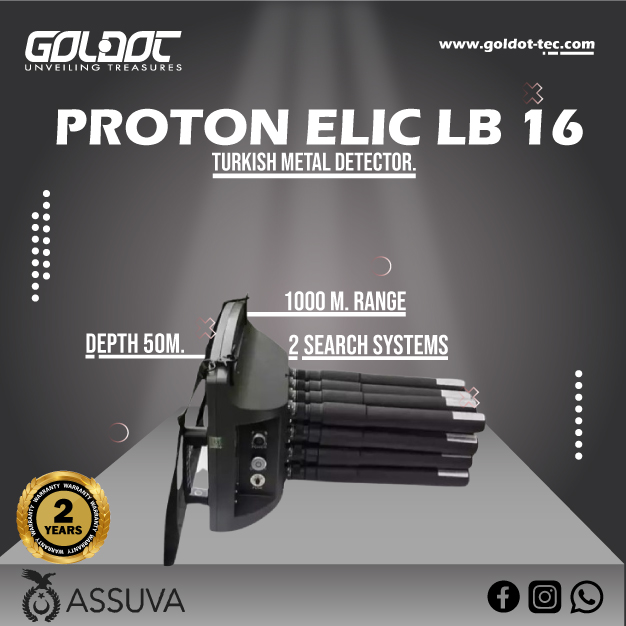
The seller page also describes 32 rear-panel LEDs used to provide visual information across 16 detection zones.
How Target Indication Is Presented
Goldot documents a visual indication method using different colors.
According to the current listing:
- Red is associated with metallic targets.
- Blue is associated with cavities or underground anomalies.
This can make field interpretation faster, but buyers should still avoid treating every color response as final proof of a particular buried object.
A red response does not automatically establish:
- Target composition
- Target value
- Exact object dimensions
- Exact depth
- Whether several pieces of metal are present
Likewise, a blue indication should be investigated before concluding that a tunnel or chamber exists.
The most useful response is a repeatable anomaly at a repeatable physical location.
Understanding the Ground-Scanning Workflow
Using the Proton 16 Scanner effectively requires more discipline than walking randomly across a property.
A structured search can make it much easier to compare readings.
Define the Search Area
Before beginning:
- Identify the boundaries of the area.
- Choose reference points that can be found again.
- Note nearby structures and visible metal.
- Divide a large site into smaller sections.
- Decide how suspicious locations will be recorded.
The purpose is to make every interesting reading traceable to a real position on the ground.
Establish a Consistent Route
Maintain a controlled search path.
Avoid changing direction, operator position, or device orientation randomly whenever an interesting response appears.
Instead:
- Complete the original pass.
- Mark the suspected location.
- Repeat the area.
- Compare the new reading.
This produces more useful information than repeatedly moving around the same anomaly without a defined method.
Preparing the Site for Cleaner Measurements
Environmental conditions can complicate almost any subsurface investigation.
Before using the Proton 16 Scanner, record obvious potential sources of interference such as:
- Vehicles
- Metal fences
- Reinforced structures
- Surface scrap
- Electrical equipment
- Underground utilities
- Large machinery
- Other strong magnetic sources
Because the LB-16 includes magnetic sensors, nearby ferrous objects deserve particular attention.
Do not invent a fixed exclusion distance unless the manual or seller documentation provides one. The objective is simply to understand what else could be influencing the measured field.
Surface conditions should also be recorded.
Useful notes include:
- Wet or dry soil
- Recently excavated ground
- Rocky areas
- Highly disturbed soil
- Visible construction materials
- Changes in terrain
These details become especially useful when comparing two survey sessions.
Published Proton 16 Scanner Range and Depth Claims
Goldot currently publishes substantial performance figures for the Proton Elic LB-16.
The product page states:
- Up to 1,000 meters horizontal range
- Up to 50 meters depth capability
These should be treated as Goldot-published product specifications, not as a guarantee that every buried object can be identified at 50 meters.
Goldot’s own FAQ qualifies the depth statement by noting that performance depends on soil conditions and target size.
That qualification is critical.
A large underground structure is fundamentally different from:
- A coin
- A small gold object
- A thin metallic plate
- A large metal container
- A cavity
When evaluating a claimed deep target, ask:
- What was the target?
- How large was it?
- What soil was present?
- Which sensor mode was used?
- Was the target location already known?
- Was the result repeated?
A maximum specification becomes more meaningful only when the test conditions are understood.
How Operator Movement Affects Scan Quality
The Proton 16 Scanner relies partly on how consistently the operator surveys the site.
Changing the measurement process can create results that are difficult to compare.
Try to maintain:
- Similar device orientation
- Similar operator position
- Consistent route
- Controlled pace
- Similar distance from the surveyed zone
- Consistent method during repeat tests
If a suspicious location produces one response during a fast approach and a completely different response during a slow side approach, the operator should investigate further rather than choosing whichever result appears more exciting.
Good field technique is based on reproducibility.
Interpreting Anomalies Conservatively
The objective of professional scanning should be to identify areas requiring further investigation.
It should not be to turn every unusual reading into a treasure conclusion.
When the Proton 16 Scanner identifies a suspected zone, record:
- Physical location
- Sensor mode
- Direction
- LED response
- Environmental conditions
- Whether the reading repeated
- Whether nearby metal is present
Then repeat the test.
A useful anomaly should show some level of positional consistency.
If an indicated target appears in entirely different places every time the search is repeated, the evidence is weaker.
Confirming a Result With Repeat Measurements
A practical verification routine is:
First Pass
Complete the initial search and mark suspicious areas.
Second Pass
Repeat the same area using as similar a method as possible.
Ask whether the indication remains in the same place.
Change Direction
If the operating method permits, approach the suspected area from another direction.
The exact signal pattern does not need to look identical, but the physical location of a genuine anomaly should remain meaningful.
Record the Result
Do not rely on memory.
Write down:
- Direction
- Location
- Mode
- Signal type
- Number of successful repeat detections
This helps separate a one-time reading from something reproducible.
Using a Second Detection Method
A major excavation decision should ideally not depend on one instrument alone.
After the Proton 16 Scanner identifies a suspected target zone, another suitable technology can provide additional evidence.
Depending on the project, confirmation might involve:
- Pulse induction detector
- Conventional metal detector
- 3D magnetic scanner
- Ground Penetrating Radar
- Another professional imaging system
Goldot’s 3D imaging detectors category includes several different technologies, demonstrating that no single sensor architecture answers every underground question.
For example, Goldot’s GR4 Dual combines a dual-sensor 3D scanner with a separate pulse-induction metal detector, providing a different verification workflow from the Proton Elic system.
That does not mean GR4 Dual is automatically better. It simply illustrates the value of using technologies designed for different measurements.
Optional Doppler Radar Module
Goldot states that the Proton Elic LB-16 can be equipped with an optional IF Doppler Radar module.
The listing describes this module as being intended for detecting living beings behind certain barriers such as:
- Wood
- PVC
- Panels
This function should be distinguished from the system’s thermal and magnetic underground-search functions.
Goldot indicates that the Doppler module is an optional add-on rather than a standard component in every package.
Before paying for an advanced kit, confirm whether it is actually included.
Bluetooth, PC Software, and Data Handling
The current Goldot specifications list Bluetooth wireless data transfer and compatibility with PC software for additional analysis.
This introduces several buyer questions that should be answered before purchase:
- What software is supplied?
- Which Windows version is supported?
- Is software activation required?
- Does the package include a computer?
- Can data files be exported?
- Can scans be backed up?
- Are software updates included?
- Is remote software support available?
For a professional scanning platform, software compatibility can affect long-term usability almost as much as the sensor hardware.
What Is Included With the Proton Elic LB-16?
Goldot currently lists the following components for the LB-16 package:
- Proton Elic LB-16 main unit
- Rechargeable battery pack
- Battery charger / adapter
- Bluetooth module
- Protective carrying case
- User manual and quick-start guide
- Warranty card and certification
- Optional IF Doppler Radar depending on package
Because the radar module is optional, compare complete packages rather than comparing only the headline Proton 16 Scanner price.
Ask the seller to provide the exact written package list before payment.
Proton 16 Scanner Price and Buying Value in 2026
The price alone does not establish value.
Evaluate whether the package includes the functions your project genuinely needs.
Consider:
| Buying Factor | What to Check |
|---|---|
| Thermal system | 64-pixel system documented |
| Magnetic array | 16 sensors documented |
| Radar | Optional, confirm package |
| Bluetooth | Included according to listing |
| Software | Confirm exact version and access |
| Battery | Rechargeable system |
| Case | Listed in package |
| Warranty | 2-year manufacturer warranty listed |
| Training | Confirm what seller provides |
| Final price | Confirm before payment |
Goldot currently publishes a two-year manufacturer warranty for the LB-16.
Before purchasing, ask how warranty repair is actually handled and where the unit would need to be sent.
Proton 16 Scanner vs a Conventional Metal Detector
The Proton 16 Scanner should not automatically replace a conventional detector.
| Search Requirement | Proton Elic LB-16 | Conventional Detector |
|---|---|---|
| Broad anomaly investigation | Relevant | Limited |
| Thermal sensing | Yes | No |
| Multi-point magnetic sensing | Yes | Usually no |
| Coin hunting | Not primary workflow | Strong use case |
| Audio target recovery | Different workflow | Core function |
| Small-target pinpointing | Confirmation may be needed | Common strength |
| Underground cavities | Documented application | Usually unsuitable |
If the main objective is coins, jewelry, individual relics, or other recoverable metallic targets, a simpler detector may provide a faster and more economical workflow.
Buyers can compare those options through the wider metal detector store.
Is a Proton 16 Scanner Right for Your Search Method?
The system makes the strongest case when the buyer actually needs a hybrid sensor platform.
It may be worth considering for:
- Professional exploration
- Archaeological surveys
- Underground anomaly investigation
- Large-area search projects
- Cavity-related research
- Teams already comfortable with multi-sensor interpretation
A simpler detector may be preferable when:
- Targets are small and shallow
- Search locations are parks or beaches
- Fast target recovery is the priority
- The user does not need imaging or anomaly analysis
- Budget does not justify specialist sensing technology
The goal is to purchase capability that will actually be used.
Buyer Checklist Before Payment
Before ordering a Proton 16 Scanner, confirm:
- Exact Proton Elic LB-16 model
- Serial number
- Manufacturer details
- 64-pixel thermal sensor
- 16-point magnetic array
- LED indication system
- Bluetooth module
- PC software
- Software requirements
- Battery and charger
- Protective case
- Doppler module inclusion or exclusion
- Two-year warranty terms
- Training availability
- Repair location
- Replacement battery availability
- Current final price
- Shipping terms
- Return conditions
Also verify applicable rules before beginning fieldwork. Land access, archaeological work, subsurface scanning, and excavation regulations can vary by country, site, and landowner. Obtain permission and consult the relevant local authority where required.
Frequently Asked Questions
Is Proton 16 Scanner the same as Proton Elic LB-16?
The Goldot-Tec product matching the Proton 16 Scanner search is the Proton Elic LB-16. Goldot identifies it as a hybrid thermal and magnetic detection system manufactured by Assuva Savunma Sanayi.
How many sensors does the Proton Elic LB-16 use?
Goldot lists 16 magnetic sensors using the JEO PHASE system, together with a 64-pixel thermal system arranged in four rows of sixteen pixels.
How deep can the Proton 16 Scanner detect?
Goldot publishes a maximum depth capability of up to 50 meters and states in its FAQ that actual results depend on soil conditions and target size. The figure should not be interpreted as a guaranteed detection depth for every object.
Does the standard package include Doppler Radar?
Not necessarily. Goldot describes the IF Doppler Radar as an optional add-on and states that advanced kits may include it. Confirm the exact package before purchasing.
Should Proton Elic results be confirmed before excavation?
Yes. Repeating the survey and using another appropriate detection method provides a stronger basis for a major excavation decision than relying on a single anomaly reading.
Conclusion
The Proton 16 Scanner, correctly identified on Goldot-Tec as the Proton Elic LB-16, is a specialized hybrid system rather than a conventional sweep-and-dig detector. Its documented configuration combines a 64-pixel thermal system with 16 magnetic sensors, visual LED indications, Bluetooth connectivity, and an optional Doppler Radar module.
Its published 1,000-meter horizontal range and 50-meter depth figures should be read in context rather than interpreted as universal performance guarantees. Target dimensions, soil conditions, the sensing mode, operator technique, and repeatability all matter.
The best way to evaluate the Proton 16 Scanner is to define the search objective first, prepare a controlled survey area, keep the operating method consistent, record anomaly positions, repeat suspicious readings, and use another suitable technology for confirmation when the excavation decision is significant.