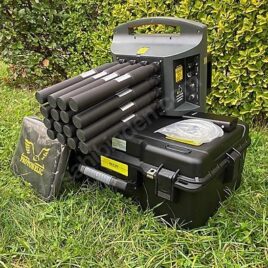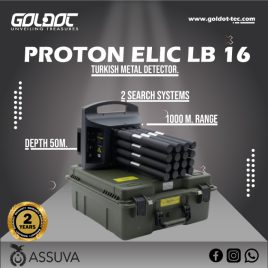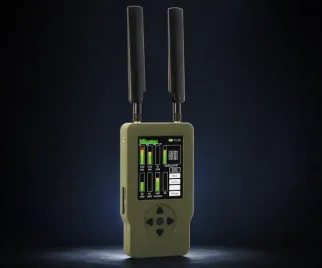


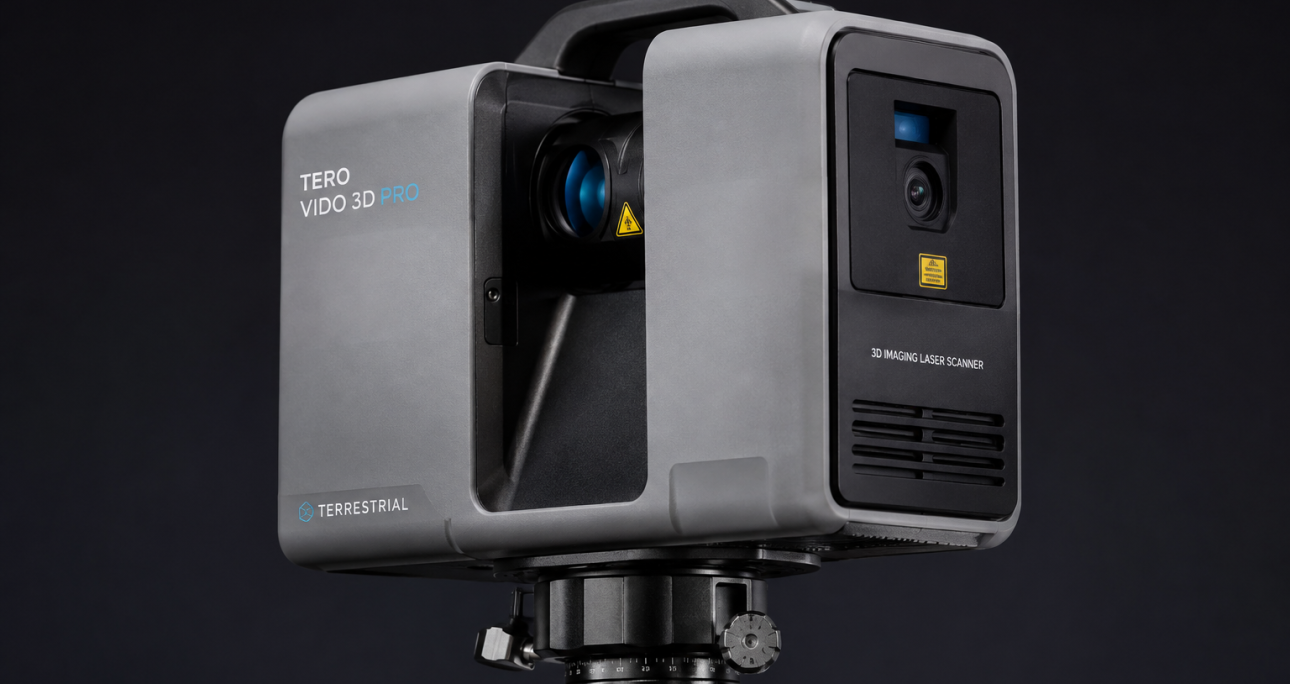
The Tero Vido 3D Pro is a professional underground imaging system currently listed by Goldot-Tec under the full product name Tero Vido 3D System Pro. Rather than functioning like a conventional coin detector that relies mainly on audio signals and numerical Target ID, the system is designed around structured 3D ground scanning, multiple probes, real-time visualization, software-based analysis, and investigation of underground anomalies.
Goldot-Tec positions the system for professional users and lists applications including archaeology, geophysical studies, mining, tunnels, voids, underground rooms, pipes, cables, treasure chests, and metallic objects. The current product information also describes three separate probes, dedicated Tero Vido 3D software, real-time tablet visualization, mineral filtering, pinpointing, live-view capability, and detector mode.
For buyers in 2026, evaluating the Tero Vido 3D Pro should therefore involve much more than asking for a maximum detection depth. Survey planning, probe selection, consistent operator movement, scan interpretation, repeatability, training, software use, and secondary confirmation all influence how useful the collected data becomes.
This guide focuses on those practical questions and separates Goldot-Tec’s published specifications from conclusions that still require field verification.
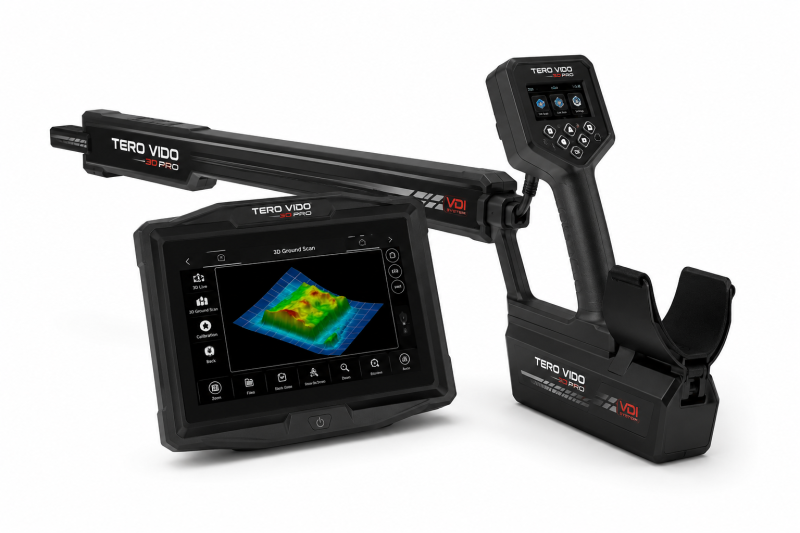
Tero Vido 3D Pro System Overview
Goldot-Tec lists the Tero Vido 3D Pro as a German professional 3D ground-imaging platform developed for advanced users.
Its current package is built around three probes:
- Vertical probe: 85 cm
- Horizontal probe: 50 cm
- Horizontal probe: 100 cm
Goldot explains that the horizontal probes are intended for faster investigation of larger areas, while the vertical probe is designed for more detailed scanning.
The current product page documents four operating modes:
- 3D Ground Scan
- Pinpoint
- Live View
- Detector Mode
The supplied Tero Vido 3D software displays scan results on a tablet and allows data to be saved for later analysis. Goldot also states that the software can help distinguish magnetic ferrous metals such as iron from non-magnetic metals such as gold, silver, and copper.
These functions make the system substantially different from a conventional VLF or pulse-induction treasure detector.
What a 3D Ground Scan Can and Cannot Tell You
One of the most important skills when operating the Tero Vido 3D Pro is understanding what the displayed 3D image actually represents.
A ground scanner does not take a photographic image through the soil.
Instead, the sensor records changes in the underground environment. Software processes those measurements and creates a graphical visualization that can help the operator investigate:
- Anomaly position
- Approximate dimensions
- Orientation
- Possible depth
- Magnetic behavior
- Possible void-like structures
Goldot states that the system can provide width, length, depth, and dimensional information after a scan.
However, a visually impressive anomaly should not automatically be labeled as treasure.
Separate Measurement From Interpretation
For example, an unusual scan may represent:
- Metal
- Mineralization
- Disturbed ground
- A cavity
- Buried construction material
- A pipe
- Geological variation
The software can help classify responses, but interpretation remains a separate stage from data collection.
That distinction prevents one of the most common errors in professional scanning: deciding what the target is before confirming that the anomaly itself is repeatable.
Preparing a Survey Area Before Scanning
The Tero Vido 3D Pro is most useful when the operator begins with a controlled survey plan.
Walking randomly around a large site and scanning only where something “looks interesting” can make later analysis difficult.
Mark the Scan Field
Establish:
- Start point
- End point
- Scan direction
- Field width
- Number of scan lanes
- Physical reference points
Use visible landmarks or markers that can be relocated later.
If the software shows a suspicious anomaly, you need to know exactly where that position exists in the real survey area.
Record Surface Conditions
Before scanning, note:
- Soil moisture
- Slope
- Rocky sections
- Vegetation
- Recently excavated soil
- Filled ground
- Visible metal
- Buildings or structures nearby
These observations become useful when comparing multiple scans.
A scan made after rainfall should not necessarily be interpreted exactly like a scan made in very dry ground.
Choosing the Correct Probe
The three-probe configuration is one of the major practical differences between the Tero Vido 3D Pro and Goldot’s cheaper 3D System Basic Plus.
Goldot lists:
| Probe | Intended Practical Role |
|---|---|
| 85 cm vertical probe | Detailed scanning |
| 50 cm horizontal probe | Standard-area scanning |
| 100 cm horizontal probe | Faster coverage of larger areas |
Probe selection should depend on the objective.
Large Survey Areas
The larger horizontal probe may be more practical when the first goal is efficiently identifying suspicious zones across a wide area.
Detailed Investigation
Once a smaller zone becomes important, the vertical sensor can provide a more focused survey workflow.
This creates a useful two-stage approach:
- Search the broader site.
- Narrow the investigation around repeatable anomalies.
Using the same probe for every task may not take full advantage of the professional package.
Building Consistent Scan Lines
The quality of the Tero Vido 3D Pro data depends not only on the hardware but also on the operator.
A professional scanner cannot correct every movement error automatically.
Keep Lane Spacing Consistent
Each scan lane should follow a planned pattern.
Avoid:
- Large gaps between some lanes
- Heavy overlap between others
- Changing the field dimensions halfway through the survey
Inconsistent spacing can make the resulting image harder to evaluate.
Maintain Steady Movement
Try to keep:
- Walking speed stable
- Probe orientation consistent
- Sensor height controlled
- Scan direction predictable
The goal is not to move at one universal speed. The correct method should follow training and product instructions.
The important point is that one lane should not be performed very differently from another.
Avoid Metal Carried by the Operator
Because the Tero Vido 3D Pro is designed to investigate metallic anomalies, objects carried by the user deserve attention.
Potential sources include:
- Large belt buckles
- Tools
- Metal containers
- Phones positioned close to sensors
- Keys
- Other detection equipment
Whether a specific object affects the scan depends on sensor configuration and distance, so buyers should follow training instructions rather than inventing a universal exclusion distance.
Still, reducing unnecessary metal around the active sensor can make field procedures easier to standardize.
Mineral Filtering and Difficult Ground
Goldot highlights mineral filtering as an important feature of the Professional system.
The product page states that the software can help remove or filter responses associated with minerals in the soil, allowing the operator to focus more clearly on useful anomalies.
This does not mean mineralized soil becomes irrelevant.
Ground conditions can still affect:
- Signal stability
- Anomaly shape
- Interpretation
- Repeatability
- Effective depth
When working difficult soil, save the original scan and compare filtering changes carefully rather than applying aggressive processing and keeping only the most visually attractive result.
A clean-looking 3D image is not automatically a more accurate measurement.
Reading Tero Vido 3D Results Without Jumping to Conclusions
The Tero Vido 3D Pro software provides real-time scan visualization on the included tablet according to Goldot. Data can also be stored for later review.
This enables a more structured analysis workflow.
First Review: Locate Anomalies
Look for:
- Concentrated changes
- Repeated structures
- Unusual shapes
- Depth consistency
- Contrast with surrounding ground
Do not immediately classify them.
Second Review: Compare Physical Location
Ask:
Does this anomaly correspond to a clearly identifiable position in the survey grid?
If the answer is no, the scan may be difficult to verify.
Third Review: Repeat the Measurement
A repeatable anomaly is more useful than a single scan result.
This principle matters more than how dramatic the 3D colors appear.
Repeating Suspicious Areas for Confirmation
When the Tero Vido 3D Pro produces an important anomaly, create a repeat-measurement procedure.
Repeat the Original Direction
Use:
- Same starting position
- Same scan field
- Same probe
- Similar movement
- Same orientation
Check whether the anomaly appears in approximately the same physical location.
Scan From Another Orientation
When suitable for the official workflow, scan the target zone from a different direction.
For example:
- North to south
- Then east to west
The graphic appearance may change because the scan direction changed.
The important question is whether the suspected underground feature remains associated with the same physical location.
Compare Before Excavation
Record:
- First scan
- Repeat scan
- Cross-direction scan
- Estimated anomaly location
- Environmental conditions
This creates a much stronger basis for a decision than one measurement.
Tero Vido 3D Pro Detection Depth: Understanding the 25-Meter Claim
Goldot currently publishes a maximum depth of 25 meters for the Tero Vido 3D Pro. The same product page associates the system with detecting underground spaces such as tunnels, tombs, shelters, rooms, and metallic targets.
This figure should be treated as a Goldot-published maximum specification rather than a guarantee that every target can be identified at 25 meters.
Detection depth depends on factors including:
- Target size
- Target material
- Soil composition
- Mineralization
- Target orientation
- Probe
- Scan quality
- Environmental conditions
- Operator technique
A tunnel creates a very different subsurface anomaly from a small metallic object.
Therefore, a buyer should never interpret “25 meters” as meaning the system will detect a coin or small piece of gold at that depth.
Ask for Target-Specific Demonstrations
When evaluating performance, ask:
- What target was used?
- What was its size?
- What depth was physically measured?
- Which probe was selected?
- Was the target location known?
- Was the result repeated?
- Can another operator reproduce the scan?
These questions make depth claims much more meaningful.
Target Discrimination: Use the Correct Meaning
Goldot states that the Tero Vido software can distinguish between ferromagnetic metals such as iron and non-magnetic metals within the precious-metal group such as gold, silver, and copper.
That is useful, but it should not be confused with perfect chemical identification.
The Tero Vido 3D Pro should not be described as automatically guaranteeing that every non-ferrous anomaly is gold.
A practical interpretation is:
- Magnetic response may indicate ferrous material.
- Non-magnetic response can narrow the classification.
- Scan shape and position provide additional information.
- Secondary confirmation remains valuable.
This creates a more realistic approach to target discrimination.
Suitable Project Types for a 3D System
Goldot lists several applications for the Professional model:
- Archaeological work
- Geophysical studies
- Mining
- Agricultural investigation
- Tunnels
- Voids
- Underground rooms
- Pipes
- Cables
- Treasure chests
- Metallic objects
The Tero Vido 3D Pro therefore makes the most sense where visualization and survey data are genuinely useful.
Stronger Fit
It may suit:
- Professional treasure projects
- Archaeological field investigation
- Tunnel searches
- Cavity investigation
- Large underground metallic objects
- Repeated geophysical surveys
Weaker Fit
It may be unnecessarily complex for:
- Park coin hunting
- Jewelry recovery
- Quick beach searches
- Small shallow relics
- Routine hobby detecting
For those targets, the broader metal detector store includes simpler conventional systems.
Package Contents of the Tero Vido 3D Pro
Goldot currently lists a substantial Professional package.
It includes:
- 85 cm vertical probe
- 50 cm horizontal probe
- 100 cm horizontal probe
- Infrared soil-temperature measuring device
- Tablet with Tero Vido 3D software
- Charger
- Travel adapter
- Bluetooth/Wi-Fi headphones
- Telescopic carrying handle
- Tablet protection bag
- Impact-resistant Pelicase
Before payment, buyers should ask the seller to confirm that every item shown in the current package is supplied with the specific unit being purchased.
Missing specialist probes can materially reduce the value of the Professional configuration.
Training, Software, and Workflow Considerations
Learning the Tero Vido 3D Pro involves more than switching between four operating modes.
A new operator should understand:
- Field design
- Probe selection
- Scan direction
- Lane spacing
- Movement consistency
- Mineral filtering
- Data saving
- 3D interpretation
- Repeat measurements
- Target confirmation
Goldot states that it provides training for devices and currently advertises testing at its headquarters along with technical support after purchase.
Buyers should verify whether training for this specific product includes actual field scans and software interpretation.
A demonstration showing only a known target provides less training value than a session explaining how to handle uncertain or conflicting results.
Tero Vido 3D Pro Price in 2026
Goldot’s current page creates an important pricing issue buyers should notice.
The active purchase area currently displays $15,900 USD, while a lower product-description section still states $18,500 USD. The current imaging category also lists 3D System Pro at $15,900.
Because the same Goldot page contains two different figures, buyers should not assume either number will remain valid indefinitely.
Before payment:
- Confirm the checkout price.
- Request a written quotation.
- Check package contents.
- Confirm shipping terms.
- Verify warranty.
- Ask whether any promotion is temporary.
The current storefront figure of $15,900 appears to be the active sale/listing price, but final confirmation remains necessary.
Comparing the Professional and Basic Plus Systems
Goldot currently lists both Tero Vido systems among its 3D imaging detectors.
A practical comparison is:
| Feature | 3D System Basic Plus | Tero Vido 3D Pro |
|---|---|---|
| Published price | $13,000 | $15,900 current storefront |
| Published max depth | Up to 18 m | Up to 25 m |
| Vertical probe | 85 cm | 85 cm |
| Horizontal probes | Not listed in standard package | 50 cm + 100 cm |
| 3D software | Yes | Yes |
| Tablet | Included | Included |
| Mineral filtering | Documented | Documented |
| Professional multi-probe workflow | More limited | Yes |
The Professional package may offer greater value when multiple probe sizes and wider survey workflows are necessary.
A buyer who does not need those extra capabilities should still consider whether the less expensive Basic Plus configuration can perform the intended project.
Buyer Checklist Before Choosing Tero Vido 3D Pro
Before ordering the Tero Vido 3D Pro, confirm:
- Exact model name
- All three probes
- Sensor condition
- Tablet
- Tero Vido 3D software
- Software activation
- Infrared soil-temperature meter
- Wireless headphones
- Charger and adapter
- Telescopic handle
- Protective cases
- Current firmware/software version
- Warranty duration
- Training
- Technical support
- Final current price
- Shipping conditions
- Return procedure
For field projects, also verify local requirements before scanning or excavation. Rules governing land access, archaeological work, protected sites, and excavation vary by country, property, and landowner. Obtain permission and check relevant local authorities where necessary.
Frequently Asked Questions
Is Tero Vido 3D Pro a conventional metal detector?
No. The Tero Vido 3D Pro is primarily a professional 3D ground-imaging system using multiple scanning probes, software visualization, pinpointing, live-view, and detector modes.
How deep can the Tero Vido 3D Pro detect?
Goldot publishes a maximum depth of 25 meters. This should not be treated as a guaranteed depth for every object because target size, soil, probe selection, scan quality, and other conditions influence performance.
How many probes come with the Professional Edition?
Goldot lists three: an 85 cm vertical probe and 50 cm and 100 cm horizontal probes.
Can the system detect tunnels and cavities?
Goldot lists shelters, tombs, tunnels, rooms, and other underground voids among the intended applications of the system.
What is the current Tero Vido 3D Pro price?
Goldot’s active storefront currently displays $15,900, although the descriptive text on the same page still contains an older $18,500 figure. Buyers should confirm the final checkout price before ordering.
Should a Tero Vido scan be confirmed with another method?
For important excavation decisions, yes. Repeat the scan first, compare results from another orientation when appropriate, and use a second suitable technology where practical. This reduces reliance on a single anomalous measurement.
Conclusion
The Tero Vido 3D Pro is best evaluated as a professional survey and underground-imaging platform rather than a conventional treasure detector. Goldot documents three specialized probes, real-time 3D visualization, mineral filtering, metal classification, void investigation, four operating modes, tablet-based analysis, and a published maximum depth of 25 meters.
Its real usefulness depends heavily on how it is operated. A well-planned survey with clearly marked lanes, consistent movement, appropriate probe selection, careful data storage, repeat scanning, and conservative interpretation provides more meaningful information than one dramatic scan image.
Before purchasing the Tero Vido 3D Pro, verify the complete three-probe package, software, tablet, training, warranty, and current price. Then compare the Professional configuration with the Basic Plus and other imaging technologies according to the actual project rather than selecting a system solely from its maximum depth specification.